


AI in High School Navigating Opportunities and Challenges
September 09, 2025
As generative AI shatters the traditional content assembly line, your role must shift from managing production to directing strategy. Your value is no longer in the how of creation, but in mastering the what and the why.
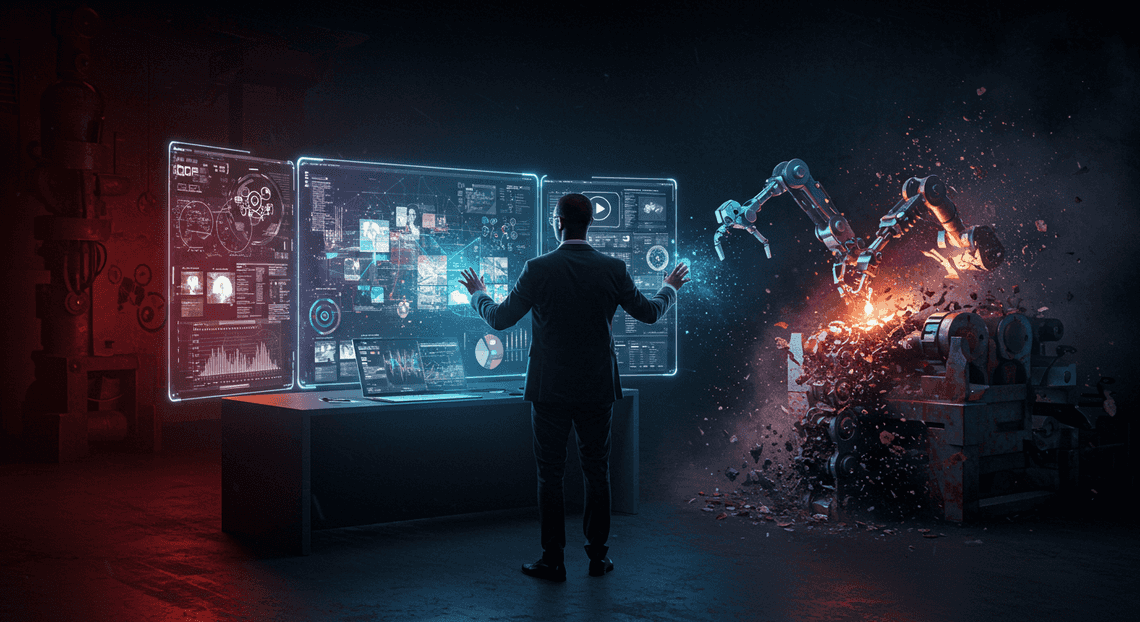
The rise of generative AI isn’t just another tool in the marketing stack; it’s a fundamental catalyst for a role transformation. For decades, marketing leaders have managed a process centered on the human effort of creation. Your team’s value was measured in articles written, designs completed, and campaigns launched. This is changing, and fast. The new paradigm demands a shift in focus—from managing a production line of human creators to embodying the role of a Creative Director, orchestrating a powerful synthesis of human strategy and AI execution. Your value is no longer in overseeing the how of content production, but in mastering the what and the why.
For years, we’ve operated on a familiar, linear model of content creation. It’s an assembly line: an idea becomes a brief, which is passed to a writer, then a designer, then an editor, before finally navigating a gauntlet of approvals to be published. This process, while reliable in a slower-moving world, is now a competitive anchor in the age of digital immediacy.
The cracks in this model are becoming impossible to ignore:
The Speed Mismatch: The assembly line moves at a human pace, while audiences consume and demand content at the speed of the algorithm. The weeks-long cycle to produce a single pillar piece of content is simply too slow to capitalize on emerging trends or to feed the voracious appetite of multiple social channels.
The Economics of Scarcity: This model is built on a scarcity of creative hours. Scaling means hiring more writers, more designers, and more project managers—a linear and expensive proposition. Your budget, not your strategy, becomes the primary constraint on your output.
The Inability to Experiment at Scale: True optimization requires massive experimentation. The traditional model makes this prohibitive. Testing three ad variations is manageable; testing 300 to find the absolute optimal combination of copy, imagery, and call-to-action is a logistical and financial nightmare.
The Brittleness of the Chain: The linear process is fragile. A single bottleneck—a key creative on vacation, a stakeholder slow to approve—can halt the entire production line, delaying campaigns and squandering market opportunities.
This industrial-era approach to a digital-era problem is no longer sustainable.
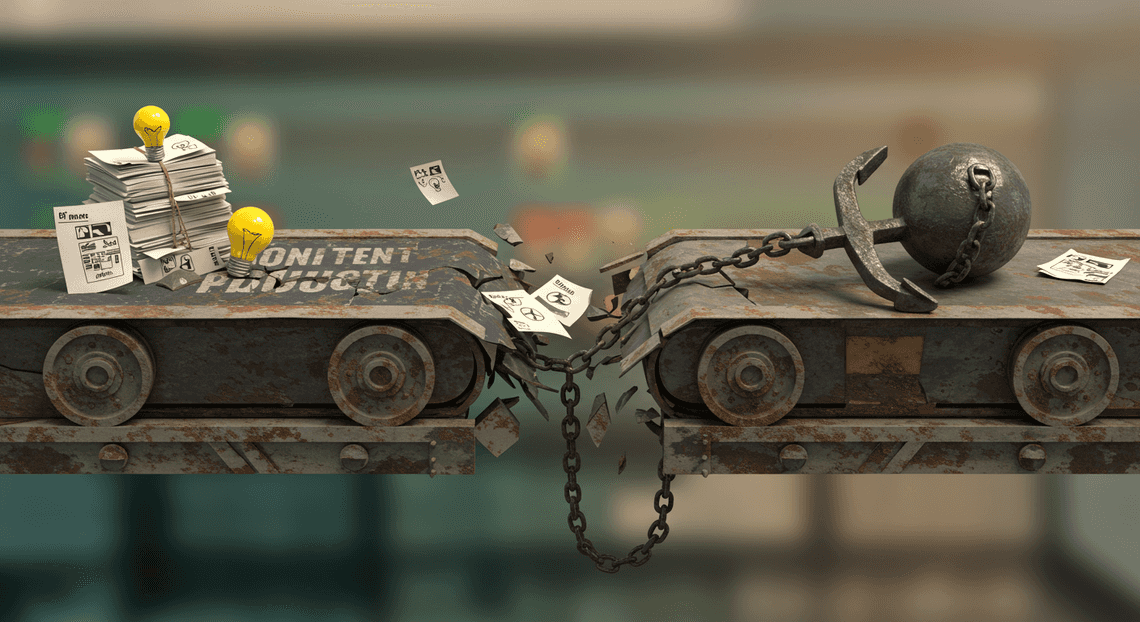
Imagine trading your assembly line for a digital foundry—a place where you can conceptualize an idea and have it forged into reality almost instantly. This is the power of integrating generative AI as your core production engine. It’s not a single tool; it’s a multi-talented, on-demand team that works at the speed of thought.
Consider the new “hires” at your disposal:
The Tireless Copywriter: Needs 50 variations of an ad headline in 30 seconds? Done. Needs a 1,000-word blog post drafted from a simple outline? Ready in minutes. This AI team member can generate email sequences, social media captions, and product descriptions without ever needing a coffee break.
The Instantaneous Art Director: From photorealistic product mockups to whimsical brand illustrations, AI image generation can produce a vast array of visual assets based on a simple text prompt. The bottleneck of visual creation is shattered, enabling you to match every piece of copy with a unique, compelling image.
The Infinitely Curious Researcher: Task your AI with summarizing the latest industry reports, analyzing the messaging of your top three competitors, or identifying the most common pain points expressed by customers on Reddit. It can synthesize vast amounts of information, delivering the strategic insights you need to inform your creative direction.
This AI-powered production team fundamentally rewrites the rules of content economics. The marginal cost of creating one more blog post, one more ad creative, or one more social media image approaches zero. This unlocks a new level of operational capability, moving from a world of constrained output to one of abundant creative potential. Your primary job is no longer to manage the labor, but to provide the direction.
If AI is the infinitely capable production team, then you, the marketing leader, are the indispensable Creative Director. The value of your role doesn’t diminish—it elevates from tactical oversight to strategic command. The focus shifts from managing hands on keyboards to leveraging your most valuable human assets: judgment, taste, and strategic foresight.
Here is where the human leader remains irreplaceable:
Setting the North Star: AI can execute a task, but it cannot define a purpose. It doesn’t understand your company’s mission, its brand soul, or its long-term business objectives. The human director sets the overarching vision, defines the brand voice, and ensures every piece of content, no matter how quickly produced, serves the strategic goals.
The Spark of True Originality: AI is a master of remixing and reinterpreting the vast dataset it was trained on. It excels at creating variations on a theme. However, the truly disruptive, category-defining ideas—the “Think Different” or “Just Do It” moments—spring from human intuition, lived experience, and a deep, empathetic understanding of the cultural zeitgeist.
The Art of Curation and Taste: In a world of content abundance, the ultimate differentiator is taste. AI can generate 100 images, but the director’s discerning eye is needed to select the one that perfectly captures the intended emotion and brand essence. This act of curation—of separating the signal from the noise—becomes one of the most critical functions of modern marketing leadership.
Orchestrating the Human-Machine System: The leader is the conductor of this new orchestra. You are responsible for designing the workflows, crafting the master prompts, selecting the right AI models for the job, and establishing the ethical guardrails. You don’t just use the tools; you build the engine.
Ultimately, this paradigm shift frees you from the tyranny of the production queue. It allows you to spend less time managing process and more time thinking, strategizing, and creating. Your role becomes more impactful as you direct this incredibly powerful new creative engine, transforming your strategic vision into tangible business results at a scale and speed that were unimaginable just a few years ago.
The transition from a traditional Creative Director to an AI Creative Director isn’t merely a title change; it’s a fundamental evolution of the role. While the core mandate to deliver compelling, brand-aligned creative remains, the how has been radically transformed. This new leader operates at the intersection of artistic vision, strategic marketing, and cutting-edge technology. Their responsibilities can be broken down into three distinct, yet deeply interconnected, functions: The Visionary, The Conductor, and The Quality Guardian.
Strategy remains the bedrock of great creative, and in an AI-powered world, it becomes more critical than ever. The AI Creative Director’s primary function is to translate high-level business objectives into a clear, actionable creative vision that can effectively guide both human talent and machine intelligence. This is where the art of the brief is elevated to a new level of precision.
An AI-ready creative brief is more than a set of instructions; it’s a master prompt for the entire creative engine. It must meticulously define:
The Strategic Intent: What business problem are we solving? What is the single most important message?
The Audience DNA: Moving beyond simple demographics to nuanced psychographics, pain points, and emotional triggers that can inform AI-driven personalization at scale.
The Brand Parameters: Codifying the brand’s voice, tone, visual aesthetics, and ethical guardrails in a way that is unambiguous for both human creators and AI models.
The Creative Sandbox: Defining the constraints and freedoms. What are the non-negotiables? Where can the AI experiment and generate novel ideas?
The Visionary doesn’t just ask, “What campaign should we run?” They ask, “Given our strategic goals and this suite of AI tools, what is the most ambitious, effective, and innovative creative territory we can explore?” They set the destination, ensuring the powerful AI engine is pointed in the right direction from the very beginning.
If the vision is the sheet music, the Conductor is the one who brings it to life. The modern creative process is no longer a linear assembly line but a dynamic, iterative collaboration between people and platforms. The AI Creative Director is the maestro of this new orchestra, orchestrating a complex symphony of specialized AI tools and irreplaceable human expertise.
This responsibility involves:
Curating the AI Stack: They must maintain a deep understanding of the rapidly evolving AI landscape. They are responsible for selecting, testing, and integrating the right tools for the job—from text generation (GPT-4, Claude) and image synthesis (Midjourney, DALL-E 3) to video creation (Runway, Pika) and campaign analytics.
Designing Hybrid Workflows: The Conductor designs the “playbook.” They map out the creative process, defining where AI takes the lead (e.g., generating 100 initial headline variations), where humans intervene (e.g., a senior copywriter selecting the top three and refining them), and how feedback is looped back to improve the models. This is about building a “centaur” team, where human and machine intelligence work in seamless partnership.
Empowering Human Talent: This role is not about replacing artists but augmenting them. The Conductor ensures that designers, writers, and strategists are trained and equipped to use AI as a co-pilot. They foster a culture of experimentation, teaching the team how to “speak” to the AI through effective prompting and how to use its output as a springboard for their own unique creative genius.
Just as a symphony conductor doesn’t play every instrument, the AI Creative Director doesn’t need to be a master prompter or data scientist. They need to know the capabilities of each “instrument”—human and machine—and how to arrange them to create a harmonious and powerful final piece.
With the ability to generate content at an unprecedented scale comes an equally unprecedented risk: the dilution of brand identity and the proliferation of mediocrity. The AI Creative Director’s most crucial role is to serve as the ultimate guardian of quality, taste, and brand integrity. They are the final human filter in an increasingly automated world.
As the Quality Guardian, they are accountable for:
Brand Consistency at Scale: They establish the standards and perform the final review to ensure every single asset, whether an email subject line or a hero image for a global campaign, is flawlessly on-brand. AI can mimic style, but it cannot truly understand a brand’s soul. The Guardian protects that soul.
Elevating Beyond “Good Enough”: AI is exceptionally good at producing content that is technically correct and stylistically plausible but often lacks nuance, emotional resonance, and genuine insight. The Guardian’s job is to push the work from “acceptable” to “exceptional,” guiding the human team to add the layers of polish, wit, and humanity that AI cannot replicate.
Ethical and Legal Oversight: This is a critical new frontier. The Guardian must ask the tough questions. Is this AI-generated image free from hidden bias? Are we transparent about our use of generative tools? Do we have the legal rights to the output? They are responsible for navigating the complex ethical landscape and protecting the brand from reputational and legal risks.
Ultimately, while AI can generate infinite options, it possesses no judgment. The AI Creative Director provides that judgment. They are the arbiter of taste, the champion of the brand, and the final backstop ensuring that no matter how automated the process becomes, the creative output remains intelligent, authentic, and profoundly human.
Theory is inert. To truly step into the role of an AI Creative Director, you need more than a new mindset; you need a new operational model. The ad-hoc, experimental nature of early AI adoption won’t scale, nor will it produce the consistent, brand-aligned excellence you demand. The shift from managing human talent to directing a hybrid human-AI team requires a structured, repeatable framework.
This four-step process is designed to be that framework. It’s a loop that moves from strategic intent to scalable execution, ensuring that your team’s creative output is not just faster or cheaper, but fundamentally better and more intelligent.
The single most critical skill in the age of generative AI is prompt engineering. But for a leader, this isn’t about becoming a power user who can conjure a specific image. It’s about elevating the prompt to the level of a strategic creative brief. A lazy, one-line prompt is the equivalent of a “make it pop” brief—it invites generic, unusable output. A masterful prompt, however, is a container for your entire strategic intent.
Your role is to teach your team to move beyond simple commands and build prompts that encode deep context. A world-class prompt doesn’t just ask for something; it directs the AI with precision. Institute a structured approach, such as the C.R.A.F.T. model:
Context: The “Why.” Provide the background. Who is the target audience (e.g., “skeptical CFOs,” “early-adopter Gen Z gamers”)? What is the campaign’s core objective? What is the competitive landscape? What brand truths must be upheld?
Role: The “Who.” Assign the AI a persona. This is a powerful way to shape its output. “Act as a world-renowned luxury copywriter known for minimalist, evocative prose.” “You are a direct-response strategist obsessed with conversion.” “Adopt the persona of a witty, slightly irreverent social media manager for a challenger brand.”
Action: The “What.” Use a precise verb for the task. Don’t just “write.” Instead, “Generate 10 alternative headlines,” “Brainstorm three distinct visual concepts,” “Critique this copy for clarity and tone,” or “Summarize this market research into five key creative insights.”
Format: The “How.” Specify the exact structure of the output. This saves immense time on rework. “Provide the answer in a Markdown table with columns for Headline, Key Emotion, and Target Persona.” “Write a 30-second video script with two columns: Visuals and VO/Dialogue.” “Generate a 16:9 cinematic image in a photorealistic style.”
Tone & Constraints: The “Guardrails.” This is where you inject brand nuance. Define the tone of voice (“witty but sophisticated,” “aspirational and empowering”). Set the boundaries. “Avoid industry jargon.” “Do not use stock photo clichés.” “The primary color palette must be limited to our brand’s approved hex codes.”
As a leader, your objective is to make this level of detailed prompting the default standard for your team. When the input is strategic, the output has a fighting chance of being brilliant.
The first output from a generative model is rarely the final product. It’s the first draft. The myth of “one-shot” generation is a trap that leads to mediocre work. The true creative power of AI is unlocked through conversation and iteration. Your job is to formalize this process, turning it from a random series of tweaks into a disciplined review cycle.
This is the new creative review. Instead of giving subjective feedback to a human designer (“I’m not sure I like that blue”), you must guide your team in giving objective, instructional feedback to the AI.
Establish a clear iterative loop:
Generate v1: The team executes the initial, well-crafted prompt from Step 1.
**Strategic Critique: You and your senior creatives review the output not for what it is, but for what it could be. The feedback should be framed as a follow-up prompt.
Instead of: “The image feels a bit boring.”
Try: “This composition is a good start. Let’s regenerate it from a lower camera angle to make the subject feel more heroic and dominant in the frame. Add volumetric lighting coming from the top left to create more drama.”
Instead of: “The copy isn’t punchy enough.”
Try: “These headlines are too focused on features. Rewrite them to emphasize the primary emotional benefit for the user. Use the ‘Problem-Agitate-Solve’ framework and keep them under 10 words.”
Refine and Regenerate: The team uses this strategic feedback to continue the “conversation” with the AI, honing the output with each pass.
Document Learnings: Crucially, track which feedback chains lead to the best results. This builds an internal knowledge base on how to best direct your specific AI toolset to achieve your brand’s unique aesthetic and voice.
This disciplined process transforms AI from a magic black box into a predictable, directable creative partner.
Generative AI is an engine of abundance. It can produce hundreds of options in the time it would take a human to develop one. This volume is a powerful advantage, but it presents a new challenge: signal vs. noise. An AI can generate a technically perfect image, but it cannot feel its emotional resonance. It can write grammatically flawless copy, but it cannot intuit its cultural relevance.
This is where the leader’s taste, experience, and strategic wisdom become paramount. Your role shifts from directing creation to curating possibility.
This step is about applying the irreplaceable human filter:
Curation: Your team’s most important task is to sift through the vast quantity of AI-generated options to find the 1% that has true potential. This requires a deep understanding of the brand, the strategy, and the intangible “feel” that separates generic content from iconic creative.
Synthesis & Hybridization: The best solution is often not a single AI output, but a combination of several. The leader’s eye can spot a killer headline from one generation, a compelling visual metaphor from another, and a powerful call-to-action from a third. The art is in synthesizing these disparate elements into a cohesive, powerful whole.
The Final Polish: Raw AI output should never be the final product. The curated concepts must be handed over to your human experts for elevation. A talented copywriter will rephrase a line to perfect its rhythm. A skilled art director will take an AI image into Photoshop to adjust lighting, correct artifacts, and ensure compositional perfection. A strategist will ensure the final concept aligns flawlessly with the customer journey.
This human touch is your ultimate differentiator. AI provides the clay; your team’s expertise is the sculptor’s hand that shapes it into a masterpiece.
A single successful AI-assisted project is an anecdote. A system that reliably produces successful projects is a competitive advantage. The final step in the framework is to move from individual successes to institutional capability. As the AI Creative Director, you are not just leading projects; you are building the creative engine of the future.
This involves operationalizing what you’ve learned and creating a system that scales excellence.
Deconstruct and Document: After every major win, conduct a post-mortem. What was the exact C.R.A.F.T. prompt that unlocked the core idea? What was the iterative feedback loop that refined it? Which combination of tools yielded the best results? Document this with obsessive detail.
Build a Prompt Library: Create a centralized, living repository of your “golden prompts.” These are not just templates to be copied but exemplars that encode your strategic thinking. Organize them by task (e.g., “Product Launch Social Copy,” “Brand Manifesto Video Script,” “Lifestyle Hero Image Concepts”) so your team has a world-class starting point for any new project.
Create an AI Style Guide: Your brand has a style guide for logos and typography; you now need one for AI interaction. This guide should define your brand’s persona for the AI to adopt, list negative constraints (clichés to avoid, words never to use), and specify technical parameters for visual styles (e.g., preferred camera lenses, lighting setups, color grading).
Standardize the Human Touch: Define the non-negotiable checkpoints for human intervention. For example, a rule might be: “All AI-generated copy for customer-facing assets must be reviewed and edited by a senior copywriter.” Or, “All hero visuals must undergo a final quality check and refinement by a human designer to remove artifacts and ensure brand consistency.”
By turning successful experiments into documented workflows, you create a flywheel. The quality of your team’s inputs improves, the iterative process becomes more efficient, and the final output becomes more consistently excellent. You stop relying on happy accidents and start manufacturing breakthrough creative on demand.
The rise of the AI creative partner doesn’t render human leadership obsolete; it refines it. The value of a creative leader is no longer measured by their personal output or their mastery of a specific craft, but by their ability to direct, inspire, and govern a powerful new form of intelligence. The focus shifts dramatically from the tactical trenches to the strategic command center. Thriving in this new landscape requires a recalibration of core competencies, prioritizing a different class of skills that amplify, rather than compete with, artificial intelligence.
For decades, the best creative leaders were often the best practitioners—the sharpest copywriter, the most visionary art director. Their ability to “do the work” was their primary source of authority. That paradigm is now inverted. While craft and taste remain essential, their application has changed.
AI models can generate thousands of tactical executions—headlines, images, video scripts, ad variations—in the time it takes a human to brew a cup of coffee. Attempting to compete on this level is a fool’s errand. The new imperative for leaders is to master the “why” that precedes the “what.” Their value is not in writing the ten perfect headlines, but in architecting the single, perfect prompt that enables the AI to generate a thousand relevant ones.
This requires a profound understanding of the business objectives, market dynamics, and deep-seated customer psychology. The leader’s role is to translate this strategic intelligence into clear, nuanced, and potent directives for their AI counterparts. They become the ultimate curator, using their refined judgment and strategic filter to sift through an abundance of AI-generated options and identify the one that truly resonates with the brand’s soul and the campaign’s goals. The creative leader is no longer just the creator; they are the chief strategist, the editor-in-chief, and the final arbiter of taste.
The ground beneath our feet is shifting at an unprecedented velocity. The cutting-edge AI model of today is the baseline of tomorrow and the relic of next year. In this environment, a static skillset is the equivalent of a death sentence. The most critical skill for a modern creative leader is not mastery of a specific tool, but the cultivation of a mindset of perpetual beta.
This means embracing a state of continuous learning and unlearning. Leaders don’t need to become machine learning engineers, but they must develop a strong “technical literacy.” They need to understand the fundamental capabilities, limitations, and inherent biases of different AI systems. What is a Large Language Model (LLM) best suited for? What are the weaknesses of a diffusion model for image generation? Knowing the nature of the instrument is essential to composing a masterpiece.
This passion for learning must cascade throughout the team. The leader’s role is to champion a culture of experimentation, where testing new platforms, workflows, and prompts is not just encouraged, but required. They must create a psychologically safe environment where failure is framed as a data point for learning, not a mark of incompetence. By modeling curiosity and a willingness to be a novice again, they empower their entire organization to stay on the crest of the technological wave, rather than being swept away by it.
As AI democratizes content creation at a massive scale, it also introduces a minefield of new risks. Issues of copyright infringement, inherent model bias, data privacy, and brand authenticity are no longer abstract academic concerns; they are immediate business challenges. In this high-stakes environment, the creative leader assumes a vital new role: the ethical gatekeeper and the ultimate brand steward.
An AI can mimic a brand’s tone of voice with frightening accuracy, but it has no understanding of its values, its history, or its soul. It cannot discern whether a piece of generated content, while technically “on-brand,” might inadvertently alienate a key audience segment, perpetuate a harmful stereotype, or cross an invisible ethical line. This is where human wisdom and stewardship are irreplaceable.
The leader is responsible for establishing a clear governance framework for AI use. This involves creating ethical guardrails, defining processes for human review, and ensuring transparency in how AI-generated content is produced and deployed. They must ask the hard questions: Where did this model’s training data come from? Is this output truly novel, or is it a derivative of a copyrighted work? Does this creative reinforce biases we are actively trying to combat? Ultimately, accountability cannot be delegated to an algorithm. The leader’s name is on the door, and they are responsible for every word and every pixel the brand puts into the world, regardless of whether it was conceived in a human mind or a neural network.
The narrative that AI is coming for creative jobs is fundamentally flawed. It’s a narrative of replacement, of obsolescence. The reality, and the opportunity for visionary leaders, is a story of collaboration. AI is not the new creative director; it is the most powerful tool the creative director has ever had. It is a tireless brainstormer, an infinitely skilled artist, and a data-savvy strategist all rolled into one. But it lacks the one thing that gives creative its power: human judgment. It has no taste, no strategic intuition, no understanding of brand soul, and no ethical compass.
Your role is not to be replaced, but to be elevated. You are moving from directing a team of people to directing a hybrid team of humans and intelligent systems. Your value is no longer just in your final approval but in your initial question. The future of creative leadership is not about having all the answers, but about orchestrating the synergy between human insight and artificial intelligence to ask better questions and explore an exponentially larger creative territory.
The most common—and most limited—application of AI in marketing today is the pursuit of efficiency. Writing social media posts faster, generating blog outlines in seconds, creating stock-style images on demand. These are valuable, table-stakes applications, but they are the strategic equivalent of using a supercomputer to do basic arithmetic. Stopping here is a failure of imagination.
True transformation happens when you shift your mindset from “How can AI do our current work faster?” to “What impossible new work can AI enable?”
This is where you move from incremental gains to exponential leaps in creative potential:
Concept Generation at Scale: Instead of brainstorming three campaign concepts, what if you could explore three hundred? An AI can generate a vast spectrum of taglines, visual motifs, and narrative angles based on a single strategic prompt. Your team’s role shifts from the friction of initial ideation to the high-value work of curation, strategic filtering, and identifying the brilliant, unexpected gems within the noise. You become a creative portfolio manager, diversifying your conceptual bets.
Exploring Uncharted Visual Territories: Your brand has an established visual identity. But what does it look like through the lens of Japanese Ukiyo-e art, or blended with Brutalist architecture, or rendered in a style that doesn’t even exist yet? AI can create these “what if” scenarios in minutes, not weeks. This isn’t about abandoning your brand guidelines; it’s about stress-testing them, finding inspiration at their edges, and discovering novel visual languages that can set you apart for the next decade.
Dynamic, Hyper-Relevant Storytelling: We’ve talked about personalization for years, but it has largely meant swapping out a first name or a product recommendation. AI unlocks the ability to create truly dynamic creative. Imagine an ad campaign where the imagery, copy, and even the background music subtly shift based on the viewer’s location, the time of day, the local weather, and recent browsing behavior—all while staying perfectly on-brand. Your role is to design the creative system, its rules, its boundaries, and its narrative arcs, then let the AI execute millions of bespoke variations.
**Predictive Creative Insight: By analyzing vast datasets of competitor ads, social media trends, and cultural conversations, AI can begin to forecast which creative elements—colors, themes, messaging styles—are likely to resonate with a specific audience before you even build the campaign. This doesn’t replace human intuition; it supercharges it. It provides a data-informed starting point, allowing your team to focus its brilliant human creativity on a pre-validated territory.
Transitioning into this new role doesn’t require a degree in computer science. It requires a shift in mindset, process, and priorities. Here are the foundational steps to begin your journey.
Your ability to get breakthrough results from an AI is directly proportional to the quality of your prompt. “Prompt engineering” is the single most important skill for the modern creative leader. Think of the prompt as a hyper-detailed creative brief directed at a brilliant but literal-minded intern. A powerful prompt doesn’t just state what you want; it provides context, defines the persona and tone, sets clear constraints, offers examples, and even specifies what to avoid. Start by creating a “Prompt Library” for your team, documenting the prompts that yield the best results for recurring tasks like writing ad copy or generating brand-aligned images.
Don’t just default to the most popular, general-purpose tool. An effective AI Creative Director understands that a suite of specialized tools is necessary. Start thinking in categories and build a recommended stack for your team:
For Text & Ideation: Tools like Jasper, Copy.ai, or Claude for crafting copy and brainstorming concepts.
For Visuals & Video: Platforms like Midjourney for stylistic exploration, Stable Diffusion for more controllable image generation, and RunwayML for experimenting with AI-powered video.
For Strategy & Insight: Explore tools that use AI for market trend analysis, sentiment analysis, and predictive performance.
The goal isn’t to be an expert in all of them, but to understand their core strengths and how they can be combined to form a powerful creative workflow.
AI-driven creativity is inherently probabilistic; it will generate brilliant ideas alongside utter nonsense. You must create a culture and a process that embraces this. Implement a simple, repeatable loop:
Hypothesize: Clearly define the creative problem or question.
Generate: Use AI tools to produce a high volume of diverse options. Don’t judge at this stage.
Curate: Apply human taste, brand knowledge, and strategic intuition to shortlist the most promising 5-10%.
Refine: This is where human artists and writers take over, polishing the AI’s raw output into a finished, professional asset.
Test: Deploy variations into the market and use real-world data to inform the next cycle.
This process transforms your team from a production line into a rapid-learning engine.
If you only measure AI’s impact by “hours saved,” you’re missing the point. To justify investment and prove its strategic value, you need to evolve your KPIs. Start tracking and reporting on new metrics that reflect this new way of working:
Creative Velocity: The number of distinct, viable creative concepts your team can explore in a week.
Testing Throughput: The number of A/B or multivariate tests you can launch per month.
Market-Learning Cycle Time: The time it takes to go from a new hypothesis to conclusive in-market data.
These metrics shift the conversation with your C-suite from a cost-saving exercise to an investment in innovation, speed, and market intelligence.
Quick Links
Legal Stuff