

The True Cost of Manual Proposals Quantifying Wasted Sales Time


While you track pipeline velocity and win rates, a silent killer is eating away at your most valuable asset: your sellers’ time. This is the hidden, grinding reality of manual proposal creation—a process that systematically strangles productivity.

Introduction: The Silent Killer of Sales Productivity
It’s 4:45 PM on a Friday. Your top sales rep, the one you’re counting on to close the quarter strong, isn’t on the phone with a high-value prospect. They’re not strategizing their next move or nurturing a key relationship. Instead, they’re frantically toggling between a three-year-old PowerPoint, a corrupted Word document, and a shared drive that resembles a digital attic, hunting for the right case study and the latest pricing table. This frantic, last-minute scramble to assemble a proposal isn’t an anomaly; it’s a daily ritual. This is the hidden, grinding reality of manual proposal creation—a silent killer that systematically strangles sales productivity, one misaligned logo and outdated boilerplate at a time. While you track pipeline velocity and win rates, this insidious process is quietly eating away at your most valuable asset: your sellers’ time.
The familiar chaos of manual proposal creation
For most sales teams, the process is a painful form of déjà vu. It begins with a hopeful request from a promising lead and quickly devolves into a scavenger hunt. The salesperson opens a “master” template that hasn’t been updated since the last rebrand. They copy and paste sections from a proposal they sent to a different client six months ago, praying they remember to change the company name in all the right places.
The chaos is a multi-front battle:
-
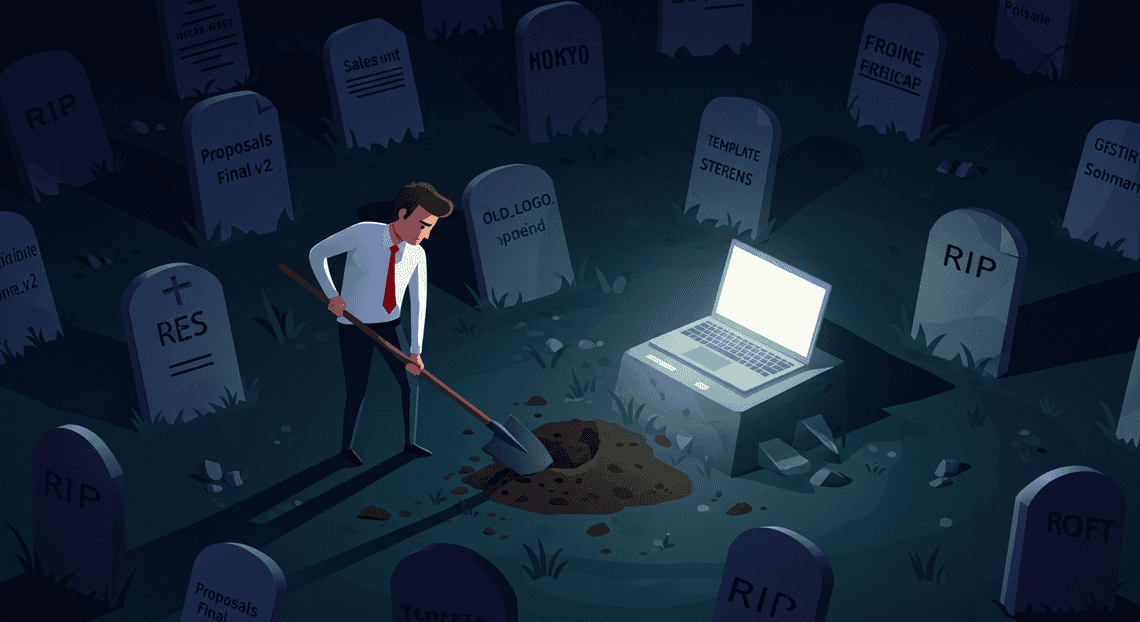
The Content Graveyard: Sifting through endless folders—
Proposals_Final,Proposals_Final_v2,Proposals_John_Doe_FINAL_FINAL—to find the most recent and relevant content. -
The Formatting Quagmire: Wrestling with Word or Google Docs to keep images, tables, and text from spontaneously reformatting, turning a simple document into a layout nightmare.
-
The Cross-Departmental Chase: Firing off urgent Slack messages and emails to marketing for the latest product one-pager, to legal for the approved terms and conditions, and to finance to confirm a custom pricing structure.
This isn’t just inefficient; it’s high-risk. Every manual proposal is an opportunity for embarrassing errors, brand inconsistencies, and outdated information to slip through, undermining the very professionalism it’s meant to convey.
Why this critical time sink is often overlooked
If the problem is so pervasive, why isn’t every sales leader declaring war on it? The answer lies in its deceptive nature. The cost of manual proposals isn’t a single, glaring line item in your budget; it’s a death by a thousand paper cuts, distributed across your entire team, every single day.
This critical time sink flies under the radar for three main reasons:
-
Normalization of Pain: The struggle is accepted as “just part of the job.” It’s a rite of passage, a necessary evil that salespeople have endured for decades. The friction is so constant that it becomes invisible, like background noise you’ve learned to ignore.
-
Fragmented Costs: The impact is never felt all at once. It’s 20 minutes spent searching for a logo, 45 minutes formatting a table, and two hours chasing approvals. These small fragments of wasted time don’t trigger alarms, but their cumulative effect is staggering.
-
**Focus on Lagging Indicators: Leadership naturally focuses on outcomes—revenue, closed deals, and quota attainment. The process that leads to those outcomes is often a black box. As long as the numbers are being hit (or are close enough), the underlying inefficiencies are rarely questioned. We celebrate the hero who stayed up all night to finish a proposal, rather than questioning the broken system that made it necessary.
Setting the stage: quantifying the real cost of inaction
Anecdotes of late-night proposal scrambles are relatable, but they don’t drive change. To grasp the true magnitude of this problem, we must move from the qualitative pain to the quantitative impact. We need to attach a dollar value to the wasted hours, the lost opportunities, and the corrosive effect on team morale.
This is the central purpose of our analysis. We will dissect the process and put a number on the true cost of inaction. Consider these questions for a moment:
-
What is the opportunity cost of every hour your A-players spend on administrative tasks instead of selling?
-
How many more qualified discovery calls could your team conduct if proposal generation time was reduced from four hours to 30 minutes?
-
What is the financial impact of a single deal lost due to a proposal that was slow, sloppy, or inaccurate?
In the following sections, we will provide the framework to answer these questions. We will break down the hours, calculate the costs, and reveal the staggering ROI hidden within a streamlined proposal process. The numbers will speak for themselves.
The Anatomy of Manual Proposal Management: A Step-by-Step Breakdown
To truly grasp the hours leaking from your sales cycle, we need to dissect the manual proposal process. On the surface, it seems straightforward: grab a template, fill in the blanks, and send it off. But for anyone who’s actually lived it, the reality is a chaotic, multi-stage gauntlet that saps energy and kills momentum. Let’s walk through the all-too-familiar steps.
Step 1: Hunting for the right templates and assets
This is the digital scavenger hunt that kicks off every proposal. Your sales rep, fresh off a promising discovery call and eager to act, opens their laptop and immediately hits a wall. The quest begins.
-
The Template Graveyard: Where is the master template? Is it the one in the “Sales Resources” folder on SharePoint that was last updated 18 months ago? Or is it the “NEW_Proposal_Template_2024_FINAL” on the shared drive? Or maybe it’s the version your top-performing colleague, Sarah, emailed you last quarter, which she saved to her desktop as
Client_Proposal_Good_Version.docx. Each potential starting point is a gamble, potentially loaded with outdated branding, old legal disclaimers, or retired product descriptions. -
The Asset Scramble: A great proposal is more than just text. It needs compelling visuals, relevant case studies, and up-to-date technical diagrams. This sends your rep on another frantic search through a maze of disconnected systems. They might pull a case study from the marketing team’s Dropbox, a technical spec sheet from a separate product portal, and a team bio from the company website. The result? A time-consuming process of verification. “Is this our current logo? Is this case study relevant to the client’s industry? Does this diagram reflect the latest software update?”
Every minute spent hunting and verifying is a minute not spent selling. This initial step alone can burn an hour or more, turning a rep’s post-call momentum into pure frustration before they’ve even written a single word about the client’s needs.
Step 2: The version control nightmare of customization
Once the disparate pieces have been gathered, the delicate and dangerous work of customization begins. This is where the manual process transforms from inefficient to actively risky, creating a minefield of potential errors.
-
The “Franken-doc” Effect: The most common shortcut is to find a recent, successful proposal for another client and perform a “find and replace.” This is the single most common source of catastrophic, deal-killing errors. We’ve all heard the horror stories: proposals sent with the wrong client’s name, incorrect pricing from a previous deal, or scope details that are completely irrelevant to the new prospect.
-
The Filename Fiasco: As the document is created, a familiar and chaotic naming convention emerges on the rep’s desktop:
-
Proposal_ACME_Corp_v1.docx -
Proposal_ACME_Corp_v2_edits.docx -
Proposal_ACME_Corp_FINAL.docx -
Proposal_ACME_Corp_FINAL_FINAL_USE_THIS_ONE.docx
This isn’t just messy; it’s a recipe for disaster. It becomes impossible to track which version contains the latest pricing, the correct scope, or the feedback from a manager. Sending the wrong version is not a matter of if, but when.
- Brand and Messaging Drift: Without a centralized content library, each rep becomes their own copywriter. They describe your company’s value proposition in slightly different ways. They explain your service offerings with varying levels of detail and accuracy. This inconsistency dilutes your brand and creates a confusing experience for the buyer, who may be comparing your proposal against the crisp, consistent messaging on your website.
Step 3: The tedious process of assembly, review, and approval
The document is finally drafted. But it’s not ready to send. Now it must survive the internal gauntlet of reviews and approvals, a process where deal velocity grinds to a halt.
-
The Email Chain of Command: The rep attaches the Word document to an email and sends it to their manager for review. The manager, swamped with other tasks, adds comments using Track Changes and sends it back. The rep then needs a technical expert to validate the solution, who adds their own notes in blue text. Now there are multiple versions of the document floating in different inboxes, and a painful, manual reconciliation process must begin. “Did you see my comment on page 4?” “Wait, are we working from v2 or v3?”
-
The Approval Bottleneck: For any significant deal, sign-off is required from other departments. Legal needs to approve the terms. Finance needs to sign off on the pricing structure. A senior director might need to give the final green light. Each of these stakeholders is a potential bottleneck. Your proposal, the key to closing a major deal, sits idle in an inbox for hours—or even days—while your client’s initial excitement cools.
-
Final Formatting Hell: After all feedback is incorporated, the final, frantic assembly takes place. The rep pastes in the approved legal text, which messes up the document’s formatting. They convert it to a PDF, only to find that the page breaks are in all the wrong places and an image is now distorted. This last-mile scramble adds unnecessary stress and introduces one final opportunity for error before the document is, at long last, sent to the client.
Putting a Price on Wasted Time: A Data-Driven Calculation
The frustration of manually building proposals is a universal pain point for sales teams. We feel the drag, we see the late nights, and we know it’s inefficient. But “feeling” isn’t a metric you can take to your CFO. To truly grasp the magnitude of the problem, we need to move beyond anecdotes and into cold, hard numbers. Let’s break down the hidden costs locked away in your proposal process and translate wasted hours into a tangible financial impact.
The formula for calculating hours lost per proposal
First, we need to dissect the manual proposal workflow. It’s not a single task but a series of time-consuming steps, each contributing to the overall bloat. While it varies by company, the core stages are remarkably consistent:
-
Information Scavenging: Hunting down client details in the CRM, finding relevant technical specs, and chasing colleagues on Slack for key inputs.
-
Content Archaeology: Digging through old proposals and shared drives for the “perfect” case study, boilerplate text, or team bio, then trying to customize it.
-
Document Wrestling: Fighting with Word or PowerPoint to align logos, fix broken tables, ensure brand consistency, and export a clean PDF.
-
Pricing & Approval Limbo: Building complex pricing tables in a separate spreadsheet, getting them approved, and then manually transferring them back into the proposal, hoping no errors were made.
-
Review Cycles: Emailing drafts back and forth, collating feedback from multiple stakeholders, and manually implementing every change.
To quantify this, we can use a simple formula:
Time Wasted Per Proposal (TWPP) = Total Manual Proposal Time (TMPT) - Ideal Automated Time (IAT)
Let’s plug in some conservative, real-world estimates:
-
TMPT:
-
Information Scavenging: 1.5 hours
-
Content Archaeology: 2 hours
-
Document Wrestling: 2 hours
-
Pricing & Approval Limbo: 1.5 hours
-
Review Cycles: 1 hour
-
Total Manual Time = 8 hours
-
IAT: With a modern proposal How to Automate Invoices platform, where content is centralized, templates are pre-built, and pricing is integrated, the same proposal could be generated in 1 hour.
Now, let’s calculate the waste:
TWPP = 8 hours - 1 hour = 7 hours
That’s seven hours of a highly-paid sales professional’s time completely vaporized on administrative overhead for every single proposal they create. It’s nearly an entire workday dedicated not to selling, but to clerical tasks.
Multiplying the cost across your entire sales team
The seven hours lost on a single proposal is alarming. But the true financial hemorrhage becomes clear when you scale this across your entire organization. To do this, we need to factor in your team’s size, proposal volume, and their loaded cost.
The formula looks like this:
Total Annual Cost = (TWPP) x (Proposals per Rep per Month) x (Number of Sales Reps) x (Average Rep Hourly Cost) x 12
Let’s run the numbers for a hypothetical mid-sized sales team:
-
Time Wasted Per Proposal (TWPP): 7 hours
-
Proposals per Rep per Month: 4
-
Number of Sales Reps: 10
-
Average Rep Hourly Cost: $60 (This should include salary, commission, benefits, and payroll taxes. A rep with a $125,000 OTE costs a company far more.)
Let’s calculate the monthly cost first:
Monthly Cost = 7 hours/proposal *4 proposals/rep* 10 reps * $60/hour = $16,800
That’s nearly $17,000 of productive, value-generating time lost every single month. Now, let’s annualize it:
Total Annual Cost = $16,800 x 12 = $201,600
Let that number sink in. This isn’t a hypothetical expense; it’s the real, tangible cost of inefficiency. Your company is spending over $200,000 a year for your sales team to perform low-value, repetitive administrative work that could be automated. This is budget that could be allocated to hiring another sales rep, increasing marketing spend, or investing in sales enablement tools that actually help them sell.
The opportunity cost: What could your reps be doing instead?
The direct financial drain is only half of the story. The more devastating cost is the opportunity cost—the revenue-generating activities your reps aren’t doing because they’re bogged down in proposal creation.
Using our example team, the total time lost per month is:
7 hours/proposal *4 proposals/rep* 10 reps = 280 hours per month
That’s the equivalent of having 1.75 full-time employees doing nothing but administrative work. What could your team achieve with an extra 280 hours of pure selling time each month?
-
More Prospecting: If a rep makes 20 calls an hour, 280 hours translates to 5,600 additional prospecting calls per month. How many new meetings would that book?
-
More Discovery Calls: At 45 minutes per call, that’s time for 373 more in-depth discovery calls to better qualify leads and understand customer needs.
-
More Product Demos: If a demo takes an hour, that’s 280 more product demonstrations to move deals forward in the pipeline.
-
More Strategic Follow-up: Time to craft personalized, high-impact follow-up emails instead of generic “just checking in” messages.
-
More Upsell/Cross-sell Opportunities: Time to engage with existing customers, strengthen relationships, and uncover expansion revenue that is often the most profitable.
The true cost of manual proposals isn’t just the salary dollars you waste. It’s the deals that never enter the pipeline, the demos that never get scheduled, and the revenue that is left on the table, all because your most valuable resources are trapped in a cycle of copy, paste, and format.
The Automation Advantage: How AC2F Reclaims Selling Hours
The hours lost to manual proposal creation aren’t just a line item on a timesheet; they represent a massive opportunity cost. Every minute a sales rep spends wrestling with formatting, hunting for content, or chasing approvals is a minute they aren’t engaging with prospects or closing deals. This is where automation shifts the paradigm. By systemizing the entire proposal lifecycle, a platform like AC2F doesn’t just make the process faster—it fundamentally transforms it, turning a time-draining administrative burden into a strategic sales asset. Let’s break down how this reclamation of selling hours actually works.
Centralized templates for brand consistency and speed
The foundation of an inefficient proposal process is often a lack of standardized starting points. Reps are left to their own devices, either starting from a blank document or, more commonly, using the “File > Save As” method on their last proposal. This introduces two critical problems: brand erosion and wasted time.
AC2F tackles this at the source by providing a centralized template library. This isn’t just a shared folder of Word documents; it’s a controlled environment where your best, most effective, and perfectly branded proposal structures live.
-
Enforce Brand Integrity: Marketing and leadership can create and lock down core template elements—logos, color schemes, fonts, legal disclaimers, and company boilerplate. This ensures every document that reaches a client is a perfect reflection of your brand, eliminating the “brand drift” that occurs when reps customize things on their own.
-
Slash Creation Time: Instead of building a proposal from scratch, a rep simply selects the appropriate template for the use case (e.g., “Enterprise Software Proposal,” “SMB Services Quote,” “Renewal Agreement”). The entire structure is already in place, allowing them to focus on the content that matters, not the container. This simple step can cut the initial setup time from an hour to a matter of seconds.
One-click generation of tailored, error-free proposals
Personalization is non-negotiable in modern sales, but manual personalization is a minefield of potential errors. The dreaded copy-paste mistake—addressing a proposal to the wrong client or leaving in details from a previous deal—instantly destroys credibility.
This is arguably where automation delivers its most powerful blow to inefficiency. By integrating directly with your CRM (like Salesforce, HubSpot, etc.), AC2F turns personalization from a tedious chore into an automated, error-proof action.
The process is elegantly simple:
-
A sales rep is working on an opportunity in your CRM.
-
They click a “Generate Proposal with AC2F” button directly on the opportunity record.
-
AC2F instantly pulls all relevant data—client name, company, contact details, products/services in the deal, pricing, and any custom fields—and merges it into the chosen template.
A perfectly tailored, accurate, and professional proposal is generated in a single click. The risk of embarrassing and costly human error is virtually eliminated. This isn’t just about saving time; it’s about protecting your reputation and ensuring every proposal is built on a foundation of accurate data pulled directly from your system of record.
Streamlined workflows for approval and delivery
Creating the proposal is only half the battle. The subsequent administrative dance of approvals, revisions, and final delivery can create significant delays that stall deal momentum. A proposal sitting in a manager’s inbox for two days is a deal that isn’t moving forward.
AC2F digitizes and automates this entire post-creation workflow, transforming it from a series of manual handoffs into a seamless, transparent process.
-
Automated Approval Chains: You can configure rules-based workflows. For example, any proposal with a discount over 15% or a total value exceeding $50,000 can be automatically routed to the sales director for approval. The approver is notified instantly and can review, comment on, or approve the document directly within the platform—no more chasing people down via email or Slack.
-
Integrated Delivery and Tracking: Once approved, the proposal can be sent to the client through a secure, trackable link. Sales reps gain invaluable intelligence, receiving notifications the moment a client opens the document. They can see which pages were viewed and for how long, allowing for perfectly timed and highly relevant follow-ups.
-
e-Signature Integration: The final step is brought into the same workflow. With built-in e-signature capabilities, clients can review and sign the proposal in one fluid motion, closing the loop and dramatically shortening the sales cycle from proposal-sent to deal-won.
Reinvesting Saved Admin Time into Revenue-Generating Activities
Time, once wasted, is gone forever. But time saved is a strategic asset. By automating the soul-crushing administrative work of manual proposal creation, you aren’t just cutting a hidden cost; you are liberating your most valuable resource—your sales team’s focus. Every hour clawed back from formatting documents and chasing internal approvals is an hour that can be directly reinvested into the activities that actually drive revenue. This isn’t about working less; it’s about selling more. Let’s break down how this reclaimed time translates into a tangible impact on your top line.
More time for strategic prospecting and outreach
A reactive sales team is always playing catch-up, buried under the paperwork of today’s deals and unable to build the pipeline for tomorrow. This leads to the dreaded “feast or famine” cycle. When your reps are freed from the proposal mill, they can pivot from low-value, high-volume outreach to high-value, strategic prospecting.
This means shifting from:
-
Generic email blasts to hyper-personalized outreach based on deep research into a prospect’s specific challenges, industry, and recent company news.
-
Chasing any lead to executing targeted Account-Based Selling (ABS) plays, identifying key stakeholders, and building multi-threaded relationships within high-value accounts.
-
Simply making calls to building a professional brand through social selling, sharing valuable insights, and establishing themselves as trusted advisors, not just vendors.
The result is a more predictable and robust pipeline. Instead of just filling the top of the funnel with unqualified leads, your team spends its energy on opportunities with a significantly higher probability of closing, leading to better conversion rates and larger deal sizes.
Faster response times to accelerate the deal cycle
In sales, momentum is everything. The gap between a prospect saying “This sounds great, send me a proposal” and them actually receiving it is a danger zone. In this void, buyer enthusiasm wanes, priorities shift, and competitors can slip in. Manual processes, which can take hours or even days, create a dangerously large gap.
By automating proposal generation, your reps can capitalize on peak buyer interest. Imagine the power of:
-
Generating and sending a tailored, professional proposal live on the call or within minutes of hanging up. This demonstrates efficiency, professionalism, and a respect for the client’s time.
-
Instantly creating revised proposals during negotiation calls, reflecting new terms in real-time and eliminating the “I’ll get back to you” delays that kill deals.
This radical compression of the sales cycle does more than just close deals faster; it increases the likelihood of them closing at all. By maintaining momentum and responding at the speed of the conversation, you stay in control of the deal and guide it swiftly toward a signature.
Improving sales team morale and focus on selling
Your top sales reps are closers, negotiators, and relationship builders. They are not administrative assistants. Forcing them to spend a significant portion of their week on tedious, non-selling tasks is a primary driver of burnout, frustration, and costly attrition. It’s a fundamental misuse of expensive, highly skilled talent.
When you remove the administrative friction, you do more than just improve efficiency; you transform the nature of the job itself.
-
Focus is restored: Reps can dedicate their mental energy to what they were hired to do: understanding customer needs, crafting solutions, and closing business.
-
Job satisfaction increases: Empowering your team with tools that help them succeed, rather than hindering them with archaic processes, leads to a more engaged and motivated workforce. A happy seller is a productive seller.
-
A high-performance culture is cultivated: When the team is focused on hitting targets instead of fighting with document templates, you foster an environment of achievement and success. This reduces turnover and makes it easier to attract top talent.
Ultimately, investing in tools that automate administrative work is a direct investment in your people. It sends a clear message that you value their time and want them to focus on the high-impact, rewarding work that they—and the business—thrive on.
Calculate Your ROI and Take Action
Understanding the problem is the first step. Quantifying its impact is the second. The final, most crucial step is taking decisive action. The data is clear: manual proposal generation is a silent drain on your sales engine’s efficiency and a direct inhibitor of revenue growth. It’s time to move from analysis to action by calculating the potential return on investment for your own team and exploring a definitive solution.
A simple framework to estimate your team’s potential savings
Abstract costs can feel distant. Let’s make this tangible with a back-of-the-napkin calculation you can perform right now. This framework will help you estimate the value of the hours your team could reclaim by automating the proposal process.
Grab a calculator and plug in your team’s numbers:
-
Average Hours per Proposal (A): How many hours does a single rep spend creating, formatting, getting approvals for, and sending one standard proposal? (Be honest—include time spent hunting for content, updating pricing, and chasing internal stakeholders).
-
Proposals per Rep per Month (B): On average, how many proposals does each member of your sales team generate in a month?
-
Number of Sales Reps (C): How many quota-carrying reps are on your team?
-
Average Hourly Cost per Rep (D): Calculate the fully-loaded hourly cost of a sales rep. This isn’t just their salary; divide their total annual compensation (salary + commission + benefits + payroll taxes) by the number of working hours in a year (approx. 2,080).
The Formula for Wasted Cost:
Monthly Cost of Manual Proposals = (A) x (B) x (C) x (D)
Let’s run a quick example:
-
(A) 3 hours per proposal
-
(B) 8 proposals per month
-
(C) 10 sales reps
-
(D) $60/hour fully-loaded cost
3 hours/proposal *8 proposals/month* 10 reps * $60/hour = **$14,400 per month**
That’s over $172,000 per year spent on administrative work that doesn’t close deals. Now, consider that a dedicated proposal automation platform can reduce that creation time by up to 90%.
Potential Monthly Savings = Monthly Cost x 0.90 = $12,960
This isn’t just a cost saving. This is reclaimed selling time—hours that can be immediately reinvested into prospecting, running discovery calls, nurturing key accounts, and actually selling.
Stop losing deals to administrative drag
The financial ROI is compelling, but the strategic costs of inaction are even greater. The “administrative drag” created by manual processes actively sabotages your sales cycle in ways that don’t always show up on a spreadsheet.
-
Speed Kills (Your Competition): In a competitive market, the first comprehensive and professional proposal in a prospect’s inbox often sets the standard. While your team is wrestling with formatting and finding the right case study, your faster, more agile competitor has already started the conversation. Every hour of delay is an opportunity for a competitor to gain a foothold.
-
Consistency Breeds Confidence: Manual creation invites errors. Outdated pricing, incorrect product descriptions, inconsistent branding, and simple typos erode the prospect’s confidence at the most critical stage of their evaluation. Automation enforces brand standards and ensures every proposal that goes out the door is accurate, professional, and on-message.
-
Top Performers Despise Busywork: Your best salespeople are motivated by closing deals, not by clerical tasks. Forcing them to spend a significant portion of their week on administrative work is a direct path to burnout, disengagement, and costly turnover. Empowering them with tools that remove friction allows them to focus on what they do best: generating revenue.
Losing deals because your proposal was too slow, contained an error, or looked unprofessional is an entirely preventable outcome.
Get a personalized demo to see AC2F in action
Theory and calculations are powerful, but seeing the solution in action is transformative. Stop letting manual processes dictate the pace and potential of your sales team.
We invite you to schedule a personalized, no-obligation demo of AC2F. This isn’t a generic product tour. We will:
-
Calculate Your Precise ROI: We’ll walk through the savings framework using your team’s specific numbers to project your potential cost savings and reclaimed selling hours.
-
Address Your Unique Workflow: Show us your most complex proposal. We’ll show you how AC2F can streamline its creation from hours to minutes.
-
Demonstrate a Path to Growth: See firsthand how you can increase proposal volume, improve quality and consistency, and give your sales team the competitive edge it needs to win more deals, faster.
**[Click Here to Schedule Your Personalized Demo]**Don’t let another quarter pass with your team bogged down by preventable administrative work. The path to a faster, more consistent, and more profitable sales cycle is clear. Take the first step today and empower your team to do what they do best: sell.


Table Of Contents
Portfolios
Related Posts
Quick Links
Legal Stuff