

Automating Commercial Loan Risk Assessments with Gemini


The cornerstone of multi-million dollar lending is a surprisingly manual and expensive process, creating a critical bottleneck that ties up the industry’s top talent.

The Bottleneck in High-Value Lending: The Manual Credit Memo
In the world of commercial lending, the credit memorandum, or “credit memo,” is the cornerstone of every major deal. It’s not merely a document; it’s the definitive narrative that synthesizes dozens of disparate data sources into a coherent risk assessment. This comprehensive report is the foundation upon which multi-million dollar lending decisions are built. It meticulously details the borrower’s financial health, management strength, market position, collateral quality, and repayment capacity.
The creation of this critical document, however, is an intensely manual, time-consuming, and expensive process. Senior credit analysts—highly skilled and highly paid professionals—spend countless hours, sometimes days, poring over a mountain of unstructured and semi-structured data:
-
Financial Statements: Parsing multi-year income statements, balance sheets, and cash flow statements from PDFs and spreadsheets.
-
Market Research: Sifting through industry reports and economic forecasts to understand competitive landscapes.
-
Appraisal and Collateral Documents: Extracting key valuation data and risk factors from dense appraisal reports.
-
Legal and Corporate Filings: Reviewing organizational charts and legal documents to understand ownership structures.
The analyst’s job is to not only extract this information but to weave it into a compelling, evidence-based narrative that justifies a lending decision. This artisanal approach, while thorough, represents the single greatest bottleneck in the commercial lending pipeline, creating friction that has profound consequences for the business.
Why slow risk assessment impacts profitability and client relations
When the core underwriting process is measured in days or weeks instead of hours, the ripple effects are felt across the entire institution.
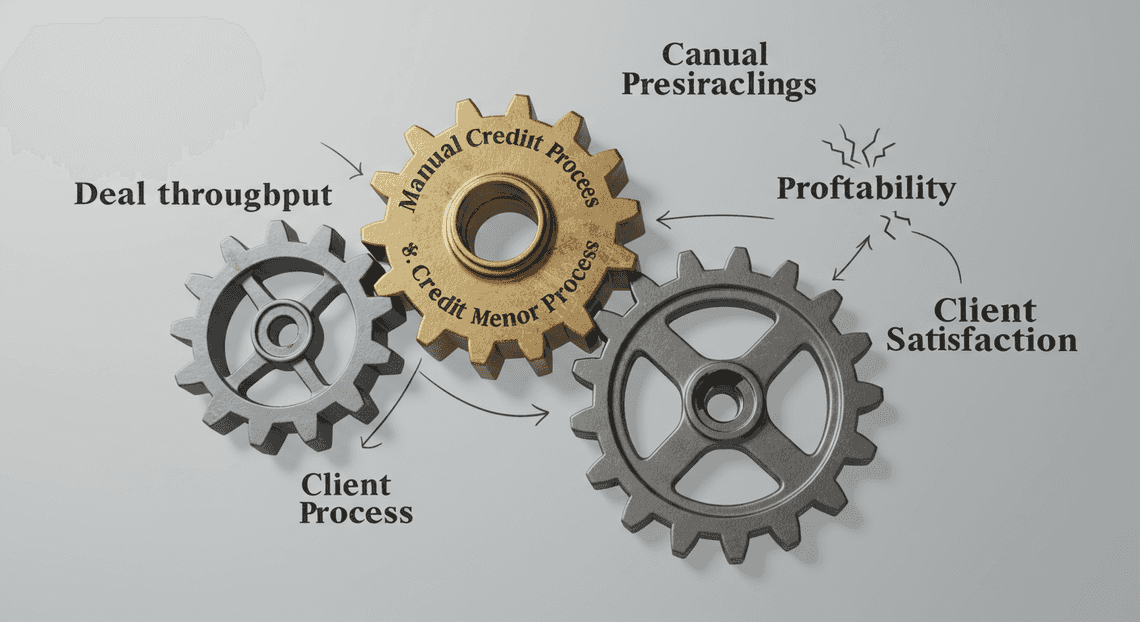
On the Profitability Front:
-
High Operational Overhead: The “time cost” of an analyst manually compiling a credit memo is a significant operational expense. Every hour spent on data extraction and summarization is an hour that could be dedicated to higher-value activities.
-
Limited Throughput: The speed of your best analyst dictates the speed of your deal flow. This manual constraint puts a hard cap on the number of loans an institution can process, directly limiting revenue growth and scalability.
-
Opportunity Cost: While analysts are buried in documents, they aren’t structuring more complex deals, mentoring junior team members, or identifying new market opportunities. The focus shifts from strategic risk management to administrative data assembly.
On the Client Relations Front:
-
Prolonged “Time to Yes”: In a competitive market, speed is a differentiator. High-value commercial clients expect efficiency. A slow, opaque underwriting process leads to frustration and can drive them into the arms of more agile competitors, including fintech lenders.
-
Inconsistent Outputs: Even with standardized templates, the narrative quality and focus of a manually written credit memo can vary significantly from one analyst to another. This subjectivity can lead to inconsistent risk assessments and a less predictable experience for repeat borrowers.
-
Reactive vs. Proactive Engagement: The sheer time commitment required for underwriting means relationship managers have less bandwidth to proactively engage with clients. The relationship becomes transactional rather than advisory, diminishing long-term value.
Introducing an AI-powered solution on Google Cloud
The fundamental challenge isn’t a lack of data; it’s the manual effort required to synthesize it. This is precisely the type of complex, knowledge-based work that modern Generative AI, specifically a multi-modal model like Google’s Gemini, is designed to accelerate. We can build a solution on Google Cloud that transforms the credit memo process from a manual craft into a streamlined, AI-augmented workflow.
The goal is not to replace the expert analyst but to empower them with a powerful “co-pilot.” Imagine a system where, instead of starting with a blank page, the analyst begins with a comprehensive, 80% complete draft.
Here’s how it works conceptually on the Google Cloud platform:
-
Secure Data Ingestion: All loan application documents—PDFs, XLSX files, DOCX, and market reports—are uploaded to a secure Google Cloud Storage bucket.
-
Multi-modal Processing with Gemini: Using [Building Self Correcting Agentic Workflows with Building Self-Correcting Agentic Workflows with Vertex AI](https://votuduc.com/building-self-correcting-agentic-workflows-with-vertex-ai-p-20260321542526), we orchestrate calls to the Gemini API. The model’s native multi-modality is key; it can read text from a legal document, extract tabular data from a spreadsheet, and even interpret charts within a market analysis report, all within a single, coherent context.
-
Intelligent Synthesis and Generation: We prompt Gemini to act as a senior credit analyst. It is instructed to analyze all the provided documents and generate a structured credit memo based on the institution’s specific template. It performs the heavy lifting of calculating key financial ratios (e.g., Debt Service Coverage Ratio, Leverage Ratio), summarizing management experience, identifying risks from the provided materials, and suggesting potential mitigants.
-
Analyst Review and Refinement: The system outputs a fully-formed draft memo. The human analyst now shifts their role from data synthesizer to strategic editor and validator. They can focus their expertise on the nuances, the exceptions, and the strategic elements of the deal, verifying the AI’s output and adding their final, expert judgment.
By leveraging Gemini on Google Cloud’s secure and scalable infrastructure, we can drastically reduce the time-to-decision, improve the consistency of risk assessments, and free up our most valuable talent to focus on what truly matters: making sound credit decisions and building lasting client relationships.
Architecting an Intelligent [Automated Job Creation in Real Time Jobber and Google Sheets Integration from Gmail](https://votuduc.com/Automated-Job-Creation-in-Jobber-from-Gmail-p115606) Workflow
Moving from theory to practice requires a robust and scalable architecture. A successful Automated Quote Generation and Delivery System for Jobber strategy isn’t about a single, monolithic script; it’s about orchestrating a series of specialized, interconnected services. Our workflow leverages the collaborative power of [Automatically create new folders in Google Drive, generate templates in new folders, fill out text automatically in new files, and save info in [Automated Web Scraping with [Multilingual Text-to-Speech Tool with SocialSheet Streamline Your Social Media Posting 123](https://votuduc.com/Multilingual-Text-to-Speech-Tool-with-Google-Workspace-p809282)](https://votuduc.com/Automated-Web-Scraping-with-Google-Sheets-p292968)](https://workspace.google.com/marketplace/app/auto_create_folder_and_files/430076014869), the analytical depth of Gemini, and the enterprise-grade orchestration of Vertex AI to create a seamless pipeline from raw document to decision-ready analysis.
This architecture is designed for modularity and resilience. Each step is a distinct component, allowing for independent development, testing, and optimization. Let’s break down the end-to-end process.
Step 1: Data Ingestion from Complex Financials using SheetsApp
The first and most significant bottleneck in commercial lending is extracting structured data from unstructured documents. Financial statements, tax returns, and balance sheets arrive in varied formats, most commonly PDFs, which are notoriously difficult to parse programmatically. This is where we lay the foundation for our intelligent workflow.
Our process begins in a familiar environment: Google Sheets.
-
Initiation: An underwriter places the borrower’s financial documents (e.g.,
P&L_2022.pdf,BalanceSheet_2023.pdf) into a designated Google Drive folder. -
Trigger: Within a master Google Sheet template for loan analysis, the underwriter clicks a custom menu item, “Ingest Financials,” powered by [AI Powered Cover Letter Automated Work Order Processing for UPS Engine](https://votuduc.com/AI-Powered-Cover-Letter-Automation-Engine-p111092).
-
Extraction & Structuring: The
SheetsAppscript triggers a backend process. This process can leverage Google’s Document AI or, for more complex layouts, a multimodal call to the Gemini API itself, which can interpret the visual structure of the documents. The model identifies and extracts key line items: Total Revenue, Cost of Goods Sold (COGS), Gross Profit, Operating Expenses, Net Income, Total Assets, Liabilities, Equity, etc. -
Population: The extracted, structured data is then programmatically written into predefined cells within the Google Sheet. What was once a multi-hour manual data entry task, prone to human error, is now completed in seconds.
This initial step transforms messy, real-world documents into a clean, machine-readable dataset—the essential fuel for the analytical engine that follows.
Step 2: Core Risk Analysis and Summary with Gemini Enterprise
With structured financials neatly organized in Google Sheets, we can now engage the core intelligence of our system: Gemini Enterprise. This step moves beyond simple data extraction to sophisticated financial reasoning and analysis.
The Apps Script, having populated the sheet, now gathers the multi-year financial data and packages it into a carefully engineered prompt. This is not a simple question; it’s a structured request for a comprehensive analysis, sent via API call to a Gemini 1.5 Pro model endpoint hosted on Vertex AI.
A sample prompt structure might look like this:
{

"role": "You are an expert senior commercial loan underwriter with 20 years of experience. Your task is to perform a detailed financial analysis based on the provided data for a loan application.",

"instructions": [

"Calculate the following key financial ratios for each year provided: Debt Service Coverage Ratio (DSCR), Debt-to-Equity, and Current Ratio.",

"Analyze year-over-year trends in revenue, gross margin, and net income.",

"Identify the top 3 potential credit risks, providing a brief explanation for each.",

"Identify the top 3 financial strengths of the business.",

"Provide a concise narrative summary (under 150 words) of the borrower's overall financial health and trajectory.",

"Return your entire analysis in a structured JSON format with keys: 'ratios', 'trends', 'risks', 'strengths', and 'summary'."

],

"financial_data": {

"2023": { "revenue": 5200000, "net_income": 450000, "total_debt": 1100000, ... },

"2022": { "revenue": 4800000, "net_income": 410000, "total_debt": 950000, ... },

"2021": { "revenue": 4500000, "net_income": 380000, "total_debt": 800000, ... }

}

}
Gemini processes this request, performing the calculations, identifying nuanced trends (like margin compression despite revenue growth), and synthesizing the information into a structured JSON object. This output is predictable and machine-readable, making it perfect for the final stage of our workflow.
Step 3: Automated Credit Memo Generation in DocsApp
The final output of the underwriting process is the credit memorandum—a formal document that outlines the loan request, the borrower’s financial condition, and the final recommendation. Manually authoring these documents is time-consuming. Our workflow automates the creation of a comprehensive first draft.
-
Receive Analysis: The orchestrating script receives the structured JSON response from the Gemini API.
-
Select Template: The script makes a copy of a standardized credit memo template stored in Google Docs. This template contains placeholders like
{{BORROWER_NAME}},{{RISK_SUMMARY}}, and{{FINANCIAL_TABLE}}. -
Populate Document: Using Apps Script’s
DocsAppservice, the script parses the JSON from Gemini and systematically populates the document.
-
The
summarytext is inserted into the executive summary section. -
The
risksandstrengthsare formatted as bullet points in their respective sections. -
The
ratiosdata is used to dynamically build a table directly within the Google Doc, providing a clear, year-over-year comparison.
- Final Output: A new Google Doc is created in a designated folder, titled something like “Credit Memo - [Borrower Name] - [Date]“.
The underwriter now receives a notification with a link to a 90% complete credit memo. Their role shifts from data entry and document drafting to high-value review, validation, and strategic decision-making. They can now focus their expertise on the qualitative aspects of the deal, confident that the quantitative analysis is accurate and well-documented.
The Role of Vertex AI in Orchestrating the Process
While Genesis Engine AI Powered Content to Video Production Pipeline is the versatile “glue” connecting our Workspace tools, for an enterprise-grade, mission-critical workflow, we need a more robust orchestration layer. This is the role of Vertex AI.
Instead of running the entire logic within a single Apps Script, we elevate the architecture by using Vertex AI as the central nervous system.
-
Scalability & Reliability: The core logic (parsing documents, calling Gemini, generating the doc) is deployed as individual Cloud Functions. A Vertex AI Pipeline is then defined to call these functions in sequence. This provides superior scalability, error handling, and retry logic compared to the execution limits of Apps Script. The Apps Script in the Sheet simply becomes a lightweight trigger that initiates the Vertex AI Pipeline via an HTTP request.
-
Centralized AI Management: All calls to the Gemini API are routed through a Vertex AI endpoint. This gives us a centralized place to manage, version, and monitor our models. We can A/B test different prompts or models, track token usage, and ensure consistent performance.
-
Security & Governance: Vertex AI integrates seamlessly with Google Cloud’s Identity and Access Management (IAM), ensuring that API calls are secure and auditable. All data processing happens within your secure cloud environment, adhering to strict data governance and compliance standards.
-
Extensibility with Grounding: A key advantage of using Vertex AI is the ability to use features like Grounding. We can ground the Gemini model’s analysis against our institution’s internal credit policy documents. This ensures that the identified “risks” and “strengths” are not just generic financial observations but are specifically aligned with our organization’s unique risk appetite and lending criteria.
By leveraging Vertex AI, we transform a clever automation script into a resilient, secure, and intelligent enterprise platform capable of handling the rigors of commercial loan processing at scale.
A Practical Use Case From Balance Sheet to Draft Memo
Theory is valuable, but seeing a model in action provides clarity. Let’s walk through a tangible, end-to-end workflow, taking a financial report for a fictional company, “Innovate Corp,” and transforming it into a structured, pre-populated credit memo ready for an analyst’s review. This example demonstrates how Gemini can bridge the gap between unstructured data and actionable insight, automating the most tedious aspects of credit analysis.
Processing a sample corporate financial report
Our process begins with a standard corporate financial statement, which could be a PDF, a scanned image, or a text file. Using Optical Character Recognition (OCR) or a document parsing library, we extract the raw text. For this demonstration, we’ll use a simplified, extracted version of Innovate Corp’s key financial data.
The next step is to craft a precise prompt for Gemini. A well-structured prompt is the key to getting reliable, structured data in return. We’ll instruct the model to act as a senior credit analyst, perform specific calculations, and format the output as a JSON object. This last part is critical for seamless integration into downstream applications.
Here is the prompt we would send to the Gemini API, bundling our instructions with the extracted financial data:
You are a senior commercial credit analyst. Your task is to analyze the provided financial statements for "Innovate Corp" and generate a structured JSON object.

**Financial Data:**

[Assume the text content extracted from the Innovate Corp PDF has been inserted here.]

Balance Sheet (in USD thousands):

- Cash: 500

- Accounts Receivable: 800

- Inventory: 700

- Total Current Assets: 2000

- Property, Plant, & Equipment: 3000

- Total Assets: 5000

- Accounts Payable: 600

- Short-term Debt: 400

- Total Current Liabilities: 1000

- Long-term Debt: 1500

- Total Liabilities: 2500

- Total Equity: 2500

Income Statement (in USD thousands):

- Revenue: 10000

- Cost of Goods Sold: 6000

- Gross Profit: 4000

- Operating Expenses: 2500

- Operating Income: 1500

- Interest Expense: 150

- Net Income: 1000

**Instructions:**

1.  **Extract Key Figures:** Identify and list the values for Total Assets, Total Liabilities, Total Equity, Revenue, and Net Income. Ensure the values are full numbers, not in thousands.

2.  **Calculate Financial Ratios:** Calculate the following key financial ratios. Show your formula and provide a one-sentence interpretation for each.

- Current Ratio (Current Assets / Current Liabilities)

- Debt-to-Equity Ratio (Total Liabilities / Total Equity)

- Debt-to-Asset Ratio (Total Liabilities / Total Assets)

- Net Profit Margin (Net Income / Revenue)

3.  **Identify Key Risk Factors:** Based on the provided data, identify 3-5 potential risk factors a lender should consider. These should be concise, bullet-point observations.

4.  **Generate a Summary:** Write a brief, 2-3 sentence narrative summary of the company's financial health.

**Output Format:**

Return your entire response as a single, valid JSON object with the following keys: "key_figures", "financial_ratios", "risk_factors", "summary".
Gemini’s output Key risk factors and financial ratios
After processing the prompt, Gemini returns a clean, structured JSON object. This output is not just a block of text; it’s machine-readable data that can be directly consumed by other software. It contains the extracted figures, the calculated ratios with interpretations, and the qualitative risk assessment we requested.
This structured data is the linchpin of the automation process. It eliminates the need for manual data entry, copy-pasting, and pocket calculations, all of which are prone to human error.
{

"key_figures": {

"total_assets": 5000000,

"total_liabilities": 2500000,

"total_equity": 2500000,

"revenue": 10000000,

"net_income": 1000000

},

"financial_ratios": [

{

"ratio_name": "Current Ratio",

"formula": "Total Current Assets / Total Current Liabilities",

"value": 2.0,

"interpretation": "Indicates strong short-term liquidity, with $2.00 of current assets for every $1.00 of current liabilities."

},

{

"ratio_name": "Debt-to-Equity Ratio",

"formula": "Total Liabilities / Total Equity",

"value": 1.0,

"interpretation": "A moderate level of leverage where the company is financed equally by debt and equity."

},

{

"ratio_name": "Debt-to-Asset Ratio",

"formula": "Total Liabilities / Total Assets",

"value": 0.5,

"interpretation": "50% of the company's assets are financed through debt, indicating a balanced capital structure."

},

{

"ratio_name": "Net Profit Margin",

"formula": "Net Income / Revenue",

"value": 0.10,

"interpretation": "The company earns 10 cents in profit for every dollar of revenue, representing a solid margin."

}

],

"risk_factors": [

"Leverage Position: While the Debt-to-Equity ratio of 1.0 is moderate, any significant increase in debt could strain cash flow, especially in a rising interest rate environment.",

"Inventory Concentration: Inventory constitutes a significant portion (35%) of current assets. A risk of obsolescence or slow turnover could negatively impact liquidity.",

"Operational Efficiency: Operating expenses consume 62.5% of gross profit, suggesting there may be opportunities for improved cost control to further boost profitability."

],

"summary": "Innovate Corp demonstrates a solid financial position with strong liquidity and moderate leverage. Profitability is healthy, though close attention should be paid to operational cost management and inventory turnover. Overall, the company presents a reasonable credit risk profile based on these statements."

}
Reviewing the auto-populated credit memo document
The final step is to use this structured JSON to populate a standardized credit memo template. A simple script can parse the JSON and map its values to the corresponding fields in the document. This transforms a blank template into a comprehensive draft in seconds.
Below is a comparison of a template with placeholders versus the final, auto-populated document.
Credit Memo Template (Before Population):
| Section | Content |
| :--- | :--- |
| Borrower | Innovate Corp |
| Financial Summary | The company reports Total Assets of {key_figures.total_assets} and Total Liabilities of {key_figures.total_liabilities}. |
| Liquidity Analysis | The Current Ratio stands at {financial_ratios[0].value}, which {financial_ratios[0].interpretation}. |
| Leverage Analysis | The Debt-to-Equity ratio is {financial_ratios[1].value}. This represents {financial_ratios[1].interpretation}. |
| Key Risk Factors | 1. {risk_factors[0]}
2. {risk_factors[1]}
3. {risk_factors[2]} |
| Analyst’s Conclusion| {summary} The analyst should further investigate… [Manual input required here] |
Populated Credit Memo (Ready for Review):
| Section | Content |
| :--- | :--- |
| Borrower | Innovate Corp |
| Financial Summary | The company reports Total Assets of 5,000,000 and Total Liabilities of 2,500,000. |
| Liquidity Analysis | The Current Ratio stands at 2.0, which indicates strong short-term liquidity, with $2.00 of current assets for every $1.00 of current liabilities. |
| Leverage Analysis | The Debt-to-Equity ratio is 1.0. This represents a moderate level of leverage where the company is financed equally by debt and equity. |
| Key Risk Factors | 1. Leverage Position: While the Debt-to-Equity ratio of 1.0 is moderate, any significant increase in debt could strain cash flow, especially in a rising interest rate environment.
2. Inventory Concentration: Inventory constitutes a significant portion (35%) of current assets. A risk of obsolescence or slow turnover could negatively impact liquidity.
3. Operational Efficiency: Operating expenses consume 62.5% of gross profit, suggesting there may be opportunities for improved cost control to further boost profitability. |
| Analyst’s Conclusion| Innovate Corp demonstrates a solid financial position with strong liquidity and moderate leverage. Profitability is healthy, though close attention should be paid to operational cost management and inventory turnover. Overall, the company presents a reasonable credit risk profile based on these statements. The analyst should further investigate… [Manual input required here] |
The result is a first-draft credit memo completed in moments. The human analyst is now free to bypass the mechanical steps of data extraction and calculation. Their expertise can be applied immediately to higher-value tasks: validating the AI’s findings, investigating the identified risks, incorporating non-financial data, and making the final, nuanced credit decision.
Transformative Business Outcomes for Underwriting Teams
Integrating a frontier model like Gemini into the commercial underwriting workflow is not an incremental upgrade—it’s a fundamental re-architecture of how credit risk is assessed and managed. The efficiency gains are immediate and substantial, but the true transformation lies in how it elevates the role of the entire underwriting team. By automating the mundane, we unlock the capacity for strategic, high-value work, leading to better, faster, and more consistent credit decisions.
Drastically reducing memo turnaround from days to hours
The traditional credit memo process is a well-known bottleneck in the commercial lending lifecycle. An underwriter must manually sift through hundreds of pages of disparate documents—financial statements, tax returns, appraisals, market analyses, and legal agreements—to extract critical data points. This information is then painstakingly synthesized into a comprehensive narrative and financial analysis. This meticulous, manual effort often takes several days, delaying term sheet issuance and impacting client relationships.
Gemini acts as a powerful analytical engine that collapses this timeline. It can ingest an entire deal file’s worth of structured and unstructured documents in seconds. By leveraging advanced prompting techniques, it can:
-
Extract and Structure Data: Pull key figures from financial statements, rent rolls, and appraisals, populating financial spreading models automatically.
-
Calculate Key Ratios: Instantly compute debt service coverage ratios (DSCR), loan-to-value (LTV), and other critical covenants and metrics.
-
Draft Narrative Sections: Generate a coherent first draft of the credit memo, including the business summary, management overview, market conditions, and collateral analysis, complete with citations pointing back to the source documents.
The underwriter transitions from an author to an editor. Instead of starting with a blank page, they receive a data-rich, well-structured draft memo within minutes of submitting the documents. Their focus shifts to validating the AI’s output, refining the narrative, and adding their expert qualitative insights. This compression of the timeline from multiple days to a few hours directly accelerates deal velocity, improves the bank’s competitiveness, and enhances the borrower experience.
Enhancing consistency and accuracy in risk evaluation
Human expertise is invaluable, but it is also inherently variable. Two different underwriters, even when working from the same credit policy, may interpret data differently, weigh risk factors with varying emphasis, or structure their analysis in unique ways. This can lead to inconsistencies in risk ratings and credit decisions across the institution’s portfolio. Furthermore, manual data entry and calculation are always susceptible to human error.
Gemini introduces a powerful layer of standardization and quality control. When configured to operate within the bank’s specific risk framework and credit policies, it acts as a tireless, objective analyst, applying the same rigorous logic to every single deal.
-
Policy Adherence: The model can be prompted to explicitly check the deal against specific policy requirements (e.g., minimum DSCR, maximum LTV for a given asset class) and flag any exceptions or violations.
-
Data Cross-Validation: It can systematically cross-validate figures across dozens of documents, identifying discrepancies that a human might easily miss—for instance, a revenue figure in a profit and loss statement that doesn’t align with narrative descriptions in the business plan.
-
Reduced Bias: By focusing purely on the data and the established policy framework, the model helps mitigate the risk of unconscious human biases influencing the initial risk assessment.
This creates a standardized, auditable, and highly defensible risk assessment process. The resulting credit memos are more uniform in quality and structure, which simplifies portfolio reviews, internal audits, and regulatory examinations. The accuracy of the underlying data is significantly improved, leading to more reliable financial models and, ultimately, a healthier loan portfolio.
Freeing underwriters for strategic decision-making
Perhaps the most profound impact of this automation is the liberation of an underwriter’s most valuable asset: their expert judgment. Today, underwriters often spend 80% of their time on the low-judgment, high-effort tasks of data aggregation and report writing, leaving only 20% for deep analysis and strategic thought.
By automating the administrative burden, Gemini completely flips this ratio. This newly created cognitive surplus can be reinvested into activities that directly drive value and mitigate risk more effectively:
-
Deep Qualitative Analysis: Focusing on the nuances that numbers alone cannot convey, such as assessing the strength and succession plan of the management team, evaluating the company’s competitive moat, or stress-testing assumptions against potential industry headwinds.
-
Complex Deal Structuring: Spending more time designing creative loan structures, negotiating protective covenants, and identifying innovative risk mitigants for non-standard transactions.
-
Proactive Collaboration: Engaging more deeply with relationship managers and clients to understand the story behind the numbers and act as a true strategic financial partner.
-
Mentorship and Training: Dedicating time to mentor junior analysts on the art and science of credit risk, cultivating the next generation of talent within the institution.
This shift elevates the underwriter from a process-driven analyst to a strategic risk manager. They are empowered to focus on the complex, judgmental aspects of lending where human experience and intuition are irreplaceable, securing the bank’s assets and fostering stronger client relationships.
Security and Compliance in an AI-Powered Environment
Integrating powerful AI like Gemini into a high-stakes domain like commercial lending isn’t just a matter of connecting APIs. It demands a security-first architecture that addresses regulatory scrutiny, data confidentiality, and operational integrity from day one. When dealing with sensitive financial statements, business plans, and personal guarantees, “secure by design” is the only acceptable approach. This isn’t about adding a layer of security on top; it’s about building the entire workflow on a foundation of trust, control, and auditability.
Leveraging Google Cloud’s secure infrastructure
Building on Google Cloud provides a significant head start. Instead of constructing a secure environment from scratch, we inherit a multi-layered defense-in-depth security posture that protects some of the world’s largest enterprises.
-
Network Isolation: The entire workflow, from data ingestion in Cloud Storage to processing with Cloud Functions and inference with Vertex AI, can be isolated from the public internet. By using a Virtual Private Cloud (VPC) and VPC Service Controls, we create a secure service perimeter. This ensures that sensitive financial data never traverses public networks, dramatically reducing the attack surface. API calls to Gemini models are made through private endpoints, keeping all traffic within Google’s network.
-
Granular Access Control: Google’s Identity and Access Management (IAM) is central to enforcing the principle of least privilege. We can define precise roles for each actor in the system. For example, a data ingestion service account might only have permission to write to a specific Cloud Storage bucket, while an underwriter’s role has read-access to the final analysis in Firestore but no access to the underlying AI models or infrastructure. This prevents unauthorized access and lateral movement.
-
Encryption by Default and by Design: All data within Google Cloud is encrypted at rest by default. For enhanced control, we can leverage Customer-Managed Encryption Keys (CMEK) through Cloud Key Management Service (KMS). This allows your organization to control the keys used to encrypt your data, providing a verifiable layer of separation. All data in transit between Google Cloud services is automatically encrypted, securing the communication channels throughout our loan assessment pipeline.
Maintaining data privacy and integrity throughout the workflow
A secure infrastructure is the foundation, but data-centric controls are what ensure privacy and integrity as information moves through the system. Gemini on Vertex AI is an enterprise-grade service, meaning your prompts, your data, and the model’s outputs are not used to train Google’s foundational models. This contractual guarantee is critical for financial institutions.
-
Secure Ingestion and Pre-processing: Loan application documents are uploaded to a Cloud Storage bucket with strict IAM policies and retention rules. Before any data is sent to Gemini, a Cloud Function can be triggered to pre-process the documents. This step can leverage the Cloud Data Loss Prevention (DLP) API to automatically detect, redact, or mask sensitive Personally Identifiable Information (PII) like social security numbers or bank account details that are not relevant to the risk assessment model.
-
Controlled AI Interaction: The orchestrated workflow sends only the necessary, pseudonymized data to the Gemini API via a secure, private endpoint. The prompts themselves are carefully engineered to instruct the model on its task without exposing unnecessary context.
-
Immutable Audit Trails: Every action within the workflow is logged using Cloud Audit Logs. This creates an immutable record of who accessed what data, which service processed it, and when the AI model was invoked. If a regulator asks to see the history of a specific loan application, you can provide a detailed, chronological log of every event, from document upload to the final decision, demonstrating a transparent and compliant process. Data integrity is further maintained by using versioning on Cloud Storage buckets, ensuring that original documents can never be overwritten accidentally.
The underwriter’s role as the final human-in-the-loop
Automating risk assessment with AI is not about replacing the expert underwriter; it’s about augmenting their capabilities. The underwriter’s judgment, experience, and intuition are irreplaceable. The AI serves as a powerful co-pilot, handling the laborious task of data extraction and initial synthesis, but the final decision remains a human one.
This “human-in-the-loop” (HITL) design is not just a best practice; it’s a critical compliance and risk management control.
-
AI as an Analyst, Not a Decider: The system’s output is presented to the underwriter as a structured, evidence-based summary. Through careful [Prompt Engineering for Reliable Autonomous Workspace Agents for Reliable Autonomous Workspace Agents](https://votuduc.com/prompt-engineering-for-reliable-autonomous-workspace-agents-p-20260319404106), Gemini is instructed to cite its sources directly from the provided documents. For example, a finding about declining revenue will be accompanied by a reference to the specific page and line item in the P&L statement.
-
Verifiability and Explainability: The underwriter can instantly cross-reference the AI’s summary with the source documents, which are presented alongside the analysis in the user interface. This allows them to validate the AI’s findings, investigate anomalies, and apply their own contextual understanding that the model may lack—such as knowledge of local market conditions or the applicant’s industry sector.
-
The Definitive Audit Log: The underwriter’s final action—be it approval, denial, or a request for more information—is the definitive event in the loan’s lifecycle. This decision, along with any commentary they add, is logged, creating a clear and defensible audit trail. This proves to regulators that every decision was ultimately made and validated by a qualified human expert, fulfilling key principles of responsible AI.
Conclusion The Future of AI-Augmented Underwriting
We’ve journeyed from raw data streams to a sophisticated, AI-driven risk assessment framework powered by Gemini. This isn’t just an incremental improvement over existing models; it represents a fundamental paradigm shift in how commercial lending decisions are made. The era of manual, time-intensive underwriting is giving way to a more dynamic, intelligent, and data-rich future.
Recap of the AI-driven advantage
The integration of a multimodal Large Language Model like Gemini into the commercial loan underwriting process unlocks a multi-faceted competitive edge. Let’s distill the core advantages we’ve demonstrated:
-
Accelerated Decision Velocity: We’ve collapsed the underwriting timeline from weeks or days to mere hours, or even minutes. By automating the ingestion, synthesis, and initial analysis of complex document sets—from financial statements and cash flow projections to legal contracts and market analysis—we empower underwriters to focus on final judgment rather than preliminary data wrangling.
-
Comprehensive Risk Synthesis: Gemini moves beyond structured data points. Its ability to comprehend unstructured text, interpret tables within PDFs, and synthesize information from disparate sources provides a holistic risk narrative that is simply unattainable through traditional methods. It can identify subtle risks buried in news sentiment, flag covenant inconsistencies across multiple legal documents, and contextualize financial performance against macroeconomic trends in real-time.
-
Enhanced Consistency and Auditability: By codifying the risk assessment logic into prompts and automated workflows, we introduce a level of consistency that mitigates individual analyst bias. Every assessment follows a standardized, repeatable process. This not only improves the quality of the loan book but also creates a transparent, auditable trail for every decision, simplifying regulatory compliance and internal governance.
-
Proactive Portfolio Management: The framework isn’t limited to loan origination. The same pipelines can be repurposed for continuous, automated monitoring of existing loans. The system can perpetually scan for credit events, market shifts, or negative sentiment related to borrowers, enabling proactive risk management long before a loan’s health deteriorates.
Ready to scale your architecture for next-generation lending?
The proof-of-concept we’ve built is a powerful blueprint, but the true transformation lies in scaling this capability into a robust, production-grade system. Moving from a successful experiment to an enterprise-wide platform requires deliberate architectural planning. As you consider this journey, focus on these critical pillars:
-
Intelligent Data Orchestration: Your system’s effectiveness is contingent on the data it consumes. Architect resilient, event-driven data pipelines that can ingest information in real-time from a multitude of sources—your core banking system, CRM, third-party data providers like Dun & Bradstreet, and public data feeds. The goal is to create a unified, analysis-ready data fabric for the AI to operate on.
-
Sophisticated AI Workflow Management: A production system requires more than single API calls. You’ll need an orchestration layer to manage complex chains of prompts, handle conditional logic (e.g., if initial screening flags a risk, trigger a deeper forensic analysis), and integrate results from multiple AI-powered tools. This ensures the process is not just automated but intelligent and adaptive.
-
Human-in-the-Loop (HITL) by Design: The objective is AI-augmentation, not blind automation. The ultimate architecture must include a sophisticated user interface for your underwriters. This “underwriting workbench” should present the AI’s findings, evidence, and confidence scores in an intuitive way. It must empower your human experts to quickly validate, challenge, and override AI recommendations, ensuring that their invaluable experience remains central to the final decision.
-
Enterprise-Grade Security and Governance: Operating in a highly regulated industry demands a security-first mindset. Your architecture must incorporate robust access controls, data encryption at rest and in transit, and comprehensive logging. Ensure every AI-generated insight and every human interaction is logged to create an immutable audit trail, satisfying both internal governance and external regulatory requirements.
The transition to AI-augmented underwriting is an architectural challenge as much as it is a data science one. The institutions that succeed will be those that not only master the models but also build the scalable, secure, and human-centric platforms required to deploy them effectively. The blueprint is here; the future of lending is waiting to be built.


Stop Doing Manual Work. Scale with AI.
Want to turn these blog concepts into production-ready reality for your team?
Table Of Contents
Portfolios
Related Posts
Quick Links
Legal Stuff