

Automating Post Op Care Summaries with Gemini AI and Apps Script


A successful surgery is only the beginning, but confusing, jargon-filled discharge instructions often leave patients struggling to navigate their recovery. Discover how solving this critical communication bottleneck can transform complex care plans into actionable steps for better patient outcomes.

The Challenge of Communicating Complex Care Plans
The success of a surgical procedure does not end when the patient leaves the operating room; it relies heavily on the critical days and weeks of recovery that follow. However, translating a complex surgical outcome and its subsequent care protocol into actionable, digestible steps is a massive communication challenge. Healthcare providers are chronically pressed for time, often relying on boilerplate discharge summaries generated by Electronic Health Record (EHR) systems. From a systems engineering perspective, this is a classic data pipeline bottleneck: highly accurate, dense data is being transmitted to an end-user who lacks the specific “decoder ring” needed to process it.
Why Medical Jargon Confuses Patients
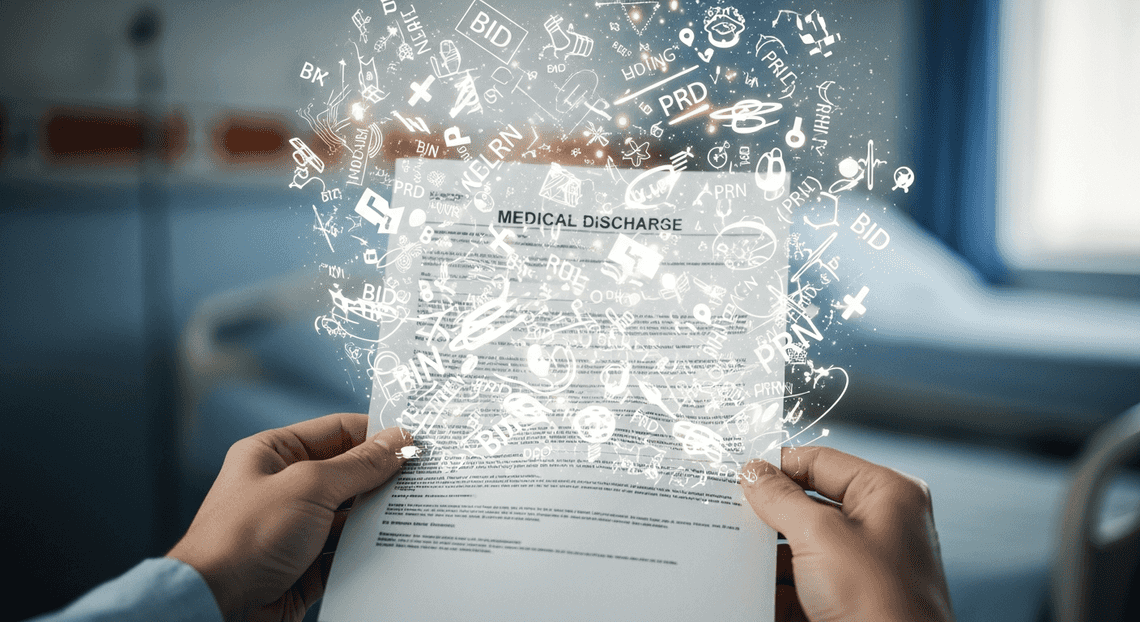
Medical professionals spend years mastering clinical terminology. To a surgeon or a post-op nurse, terms like “edema,” “erythema,” “ambulate,” or pharmacological shorthand like “BID” and “PRN” are second nature. To the average patient, however, this is an entirely foreign language.
This linguistic disconnect is severely compounded by the patient’s physical and mental state at the time of discharge. Patients are frequently groggy from anesthesia, managing acute pain, or overwhelmed by the anxiety of their diagnosis. Their cognitive bandwidth is operating at a fraction of its normal capacity. When they are handed a dense wall of text filled with ICD-10 codes, clinical observations, and technical wound-care instructions, the result is rarely comprehension.
The Hidden Costs of Poor Post Op Instructions
When discharge communications fail, the consequences ripple outward, creating cascading failures across the entire healthcare ecosystem. The costs of these poorly translated care plans are both clinical and operational:
-
Clinical Complications: Misunderstanding wound care instructions or medication schedules directly leads to preventable complications, such as surgical site infections or accidental overdoses.
-
Operational Strain: When patients are confused, they call their doctors. Clinics and hospital switchboards are routinely flooded with triage calls from anxious patients asking for clarification on their discharge papers. This forces nurses and administrative staff to spend valuable hours acting as manual translators for information that should have been clear from the start.
-
Financial Penalties: The ultimate cost of poor post-op communication is preventable hospital readmissions. Under modern value-based care models, readmissions directly impact a hospital’s bottom line, resulting in steep financial penalties and lowered quality-of-care ratings.
Fundamentally, this communication gap is an unstructured data translation problem. Taking dense, highly technical clinical notes and transforming them into personalized, accessible, and empathetic language at scale is a monumental task for human staff—but it is the exact type of workload where modern, cloud-native generative AI thrives.
How Gemini AI Transforms Healthcare Content Operations
Healthcare organizations generate massive amounts of unstructured data daily, from intricate surgical notes to dense discharge summaries. Historically, converting this clinical data into digestible, patient-facing content has been a manual, time-consuming bottleneck that drains administrative resources. Enter Google’s Gemini AI. By integrating Gemini’s advanced multimodal and natural language processing capabilities directly into Automatically create new folders in Google Drive, generate templates in new folders, fill out text automatically in new files, and save info in Google Sheets via Apps Script, healthcare providers can completely overhaul their content operations.
Instead of relying on stretched clinical staff to manually draft post-operative instructions, clinics can leverage the Gemini API to instantly process complex medical records, extract critical care steps, and generate tailored content. This transformation isn’t just about operational speed; it’s about bridging the communication gap between the operating room and the patient’s living room, ensuring high-quality, safe care continues seamlessly after discharge.
Translating Clinical Documents into Patient Friendly Language
One of the most significant challenges in post-operative care is the “jargon barrier.” Surgical notes and Electronic Health Record (EHR) outputs are written by clinicians, for clinicians. They are packed with Latin-derived terminology, complex anatomical references, and medical abbreviations that can easily overwhelm a patient who is already recovering from the physical stress of surgery.
Gemini AI excels at complex reasoning and translation—not just between traditional languages, but between registers of language. By passing a raw surgical summary to the Gemini model via an Apps Script fetch request, we can use carefully crafted system instructions to distill the information into plain, accessible language. For instance, instead of handing a patient a document that mentions “erythema,” “edema,” and strict “analgesic protocols,” Gemini translates these into actionable, patient-friendly instructions like “watch for redness,” “expect some swelling,” and “how to take your pain medication.”
By leveraging Gemini’s massive context window, we can ensure that critical nuances—such as specific wound care instructions, dietary restrictions, and warning signs that require immediate medical attention—are accurately preserved. The model can be prompted to output this data at an optimal reading level (typically around a 6th-to-8th-grade level), maximizing patient comprehension, reducing readmission risks, and improving overall compliance.
Maintaining an Empathetic and Helpful Tone at Scale
While clinical accuracy and simplicity are paramount, the delivery of medical information is equally critical. Post-operative patients are often anxious, in pain, and vulnerable. A sterile, robotic list of instructions can feel alienating and cold. The true transformative power of Gemini AI in healthcare content operations lies in its ability to adopt and maintain a specific persona and tone.
Through precise Prompt Engineering for Reliable Autonomous Workspace Agents within our Apps Script integration, we can instruct Gemini to act as a compassionate, reassuring care coordinator. We can program the model to wrap its clinical translations in warm greetings, validating language (e.g., “It is completely normal to feel a bit tired after this procedure”), and encouraging closing statements.
Achieving this level of personalized empathy manually for hundreds of patients a week is nearly impossible for busy healthcare staff. However, with Gemini, this empathetic touch is programmatically scaled. Every single patient receives a post-op care summary that feels highly personalized, supportive, and human. This fosters a better patient experience and builds trust in the healthcare provider, all while operating at the speed, security, and scale of Google Cloud.
Building Your Automated Patient Education Portal
Transitioning from raw, jargon-heavy clinical notes to a fully automated patient education portal requires a robust orchestration layer. By leveraging the native, serverless capabilities of AC2F Streamline Your Google Drive Workflow, binding them together with AI Powered Cover Letter Automation Engine, and injecting the cognitive power of Gemini 3.0 Pro, we can build a highly scalable pipeline. This system will automatically ingest operative reports, translate them into empathetic, easy-to-understand instructions, and output ready-to-print PDFs for patients.
Setting Up Automated Client Onboarding with Google Forms and Google Drive. and Apps Script
The foundation of our automated portal relies on a structured Google Drive environment and a standardized Google Doc template. Because we are operating entirely within the Google Cloud ecosystem, we don’t need to provision external servers or worry about complex authentication flows between our document storage and our code.
To set up your environment:
-
Create the Directory Structure: In Google Drive, create a master folder named
Post-Op Automation. Inside, create two subfolders:Raw Clinical Notes(where doctors will drop their dictated or typed notes) andGenerated Patient Guides(where the final PDFs will live). -
Design the Template: Create a Google Doc to serve as your patient guide template. Use standard mustache-style tags for dynamic data injection. For example, include placeholders like
\{\{Patient_Name\}\},\{\{Procedure_Name\}\},\{\{Medication_Schedule\}\}, and\{\{Wound_Care_Instructions\}\}. -
Initialize Apps Script: From your Google Drive, click New > More > Genesis Engine AI Powered Content to Video Production Pipeline. This opens the cloud-based IDE. Apps Script will act as the event-driven glue for our architecture, monitoring the input folder, calling the AI, and handling file conversions.
Integrating Gemini 3.0 Pro for Smart Data Extraction
Raw surgical notes are dense, filled with medical acronyms, and entirely unsuitable for a patient recovering from anesthesia. This is where Gemini 3.0 Pro shines. With its massive context window, advanced reasoning capabilities, and native JSON-output structuring, it can accurately parse complex operative reports and extract actionable, patient-friendly instructions.
To integrate Gemini into Apps Script, you will need an API key from Google AI Studio (or Google Cloud Building Self Correcting Agentic Workflows with Vertex AI if you require enterprise-grade HIPAA compliance and strict data residency controls). We utilize Apps Script’s UrlFetchApp class to securely pass the raw clinical text to the Gemini API.
Here is an example of how you can structure the API call to enforce a JSON response tailored to your template:
function extractPostOpData(rawClinicalNote) {

const apiKey = 'YOUR_GEMINI_API_KEY';

const endpoint = `https://generativelanguage.googleapis.com/v1beta/models/gemini-3.0-pro:generateContent?key=${apiKey}`;

const systemInstruction = `You are an expert, empathetic medical communicator.

Read the following surgical note and extract the data into a strict JSON format with these keys:

"Patient_Name", "Procedure_Name", "Medication_Schedule", "Wound_Care_Instructions".

Translate all medical jargon into simple, 8th-grade reading level instructions suitable for a patient.`;

const payload = {

"contents": [{

"parts": [{"text": systemInstruction + "\n\nClinical Note:\n" + rawClinicalNote}]

}],

"generationConfig": {

"responseMimeType": "application/json"

}

};

const options = {

'method': 'post',

'contentType': 'application/json',

'payload': JSON.stringify(payload)

};

const response = UrlFetchApp.fetch(endpoint, options);

return JSON.parse(response.getContentText()).candidates[0].content.parts[0].text;

}
Auto Generating PDF Guides with DocsApp
Once Gemini returns the structured JSON data, the final step is to merge this information into our template and generate a secure, portable PDF. We achieve this using a combination of the DriveApp and DocumentApp services in Apps Script.
The workflow is highly efficient: we duplicate the master template to avoid overwriting it, open the temporary copy, swap the placeholders with the AI-generated instructions, and finally export the document as a PDF.
Here is how you execute the document generation:
function generatePatientPDF(extractedDataJSON, templateId, outputFolderId) {

const data = JSON.parse(extractedDataJSON);

const template = DriveApp.getFileById(templateId);

const outputFolder = DriveApp.getFolderById(outputFolderId);

// 1. Create a temporary copy of the template

const tempDocFile = template.makeCopy(`Temp_${data.Patient_Name}_Guide`, outputFolder);

const tempDocId = tempDocFile.getId();

// 2. Open the document using DocumentApp to manipulate the text

const doc = DocumentApp.openById(tempDocId);

const body = doc.getBody();

// 3. Replace placeholders with Gemini's extracted data

for (const key in data) {

body.replaceText(`\{\{${key\}\\}\}`, data[key]);

}

// Save and close to ensure changes are flushed before PDF conversion

doc.saveAndClose();

// 4. Convert the populated Google Doc into a PDF

const pdfBlob = tempDocFile.getAs('application/pdf');

pdfBlob.setName(`Post-Op_Guide_${data.Patient_Name}.pdf`);

// 5. Save the PDF to the output folder and clean up the temporary Doc

outputFolder.createFile(pdfBlob);

tempDocFile.setTrashed(true);

}
By chaining these services together, you create a seamless pipeline. The moment a physician uploads a raw text file or dictates a note into the system, Apps Script triggers Gemini 3.0 Pro to process the data, and DocumentApp instantly formats and compiles a beautiful, personalized post-op PDF ready for the patient’s discharge.
The Impact on Patient Recovery and Content Workflows
When we architect solutions using Google Cloud and the Automated Discount Code Management System ecosystem, the goal is rarely just to write clever code; it is to solve real-world problems. In the healthcare sector, the stakes are uniquely high. By integrating Gemini AI with Architecting Multi Tenant AI Workflows in Google Apps Script, we are not merely automating a document generation process—we are fundamentally transforming how medical information is processed, distributed, and consumed. This serverless, AI-driven architecture creates a powerful ripple effect that touches both the operational efficiency of healthcare providers and the physical well-being of their patients.
Saving Time for Healthcare Content Teams
Traditionally, drafting post-operative care summaries is a heavily manual, bottleneck-prone process. Healthcare content teams, nurses, and administrative staff often find themselves trapped in a cycle of copy-pasting boilerplate templates, manually parsing dense surgical notes, and painstakingly formatting documents to ensure they are patient-ready. This administrative burden is a prime candidate for automation.
By leveraging Google Apps Script as the orchestration layer and Gemini AI as the cognitive engine, we completely rewire this workflow. Here is how the automated pipeline directly benefits healthcare content teams:
-
Elimination of Manual Data Entry: Apps Script can automatically trigger the workflow the moment a surgeon’s notes are uploaded to Google Drive or logged in a Google Sheet. The script securely passes this data to the Gemini API, eliminating the need for human transcription.
-
Intelligent Content Generation: Instead of relying on static templates, Gemini dynamically generates customized summaries. It can instantly extract the relevant procedural details, medication schedules, and specific wound-care instructions from raw, unstructured medical text.
-
Seamless Workspace Integration: Because the solution lives natively within Automated Email Journey with Google Sheets and Google Analytics, the generated summaries can be automatically formatted into a Google Doc, saved to a specific patient folder in Drive, or drafted as an email in Gmail.
-
Scalability and Focus: A process that once took twenty minutes per patient is reduced to mere seconds. This massive reduction in administrative overhead allows content teams and medical staff to redirect their focus toward high-value tasks, such as patient follow-ups and complex care coordination, effectively reducing burnout.
Improving Patient Compliance and Health Outcomes
The ultimate measure of any healthcare technology is its impact on the patient. The immediate post-operative period is a vulnerable time. Patients are often overwhelmed, fatigued, and heavily medicated, making it the worst possible moment to hand them a stack of generic, jargon-heavy discharge papers. Poorly understood instructions are a leading cause of patient non-compliance, which directly correlates to surgical complications and hospital readmissions.
Integrating Gemini AI into the discharge workflow bridges the communication gap between the operating room and the living room:
-
Translating Medical Jargon: Gemini excels at natural language processing. It can be prompted to translate complex clinical terminology into clear, accessible language tailored to an 8th-grade reading level, ensuring the patient actually understands what they need to do.
-
**Personalized, Actionable Care Plans: Because the AI generates the summary based on the specific surgical notes of that individual, the resulting document is highly personalized. Patients receive a clear, step-by-step breakdown of their specific recovery timeline, their specific physical therapy exercises, and the exact warning signs they need to watch out for.
-
Timely and Accessible Delivery: Using Apps Script, these summaries can be automatically emailed to the patient and their designated caregivers before they even leave the recovery room. Having immediate, digital access to their care plan on their mobile devices ensures the information is always at their fingertips.
-
Empowering the Patient: When patients clearly understand their medication schedules, dietary restrictions, and wound care protocols, compliance skyrockets. This AI-driven clarity empowers patients to take an active, confident role in their own recovery, directly leading to fewer complications, reduced readmission rates, and significantly improved long-term health outcomes.
Scale Your Healthcare Architecture Today
The integration of Gemini AI and Google Apps Script for post-operative care summaries is just the tip of the iceberg. True digital transformation in healthcare requires a robust, scalable architecture that can handle increasing patient loads, stringent compliance requirements, and the seamless flow of sensitive health information. By leveraging the broader Google Cloud ecosystem, healthcare organizations can move beyond isolated automations and build enterprise-grade, AI-driven pipelines. Whether you are looking to integrate Vertex AI with your existing Electronic Health Records (EHR) systems, secure your data lakes with the Cloud Healthcare API, or automate complex administrative tasks, scaling your architecture ensures that your technological capabilities grow seamlessly alongside your practice.
Evaluating Your Current Content Workflows
Before you can effectively scale your cloud infrastructure, you need to take a critical look at your existing processes. How much time are your clinicians spending on administrative documentation instead of direct patient care? Are your post-op instructions, discharge summaries, and patient follow-up communications still being generated and routed manually?
Evaluating your current content workflows involves identifying bottlenecks where manual intervention slows down care delivery or introduces the risk of human error. You should audit your systems for repetitive tasks—such as parsing unstructured clinical notes, translating complex medical jargon into patient-friendly language, or manually copying data between Automated Google Slides Generation with Text Replacement apps and your core medical databases. These friction points are prime candidates for AI-driven automation. By mapping out the entire lifecycle of your clinical content, you can pinpoint exactly where Google Cloud’s generative AI models and Apps Script automations will deliver the highest return on investment. The ultimate goal isn’t just to process documents faster, but to engineer a resilient, compliant workflow that enhances patient outcomes and significantly reduces provider burnout.
Book a GDE Discovery Call with Vo Tu Duc
Navigating the intersection of healthcare compliance, advanced cloud engineering, and generative AI is a complex undertaking. If you are ready to modernize your clinical workflows but need help architecting a secure and scalable solution, expert guidance is your most valuable asset.
Take the guesswork out of your cloud strategy by booking a discovery call with Vo Tu Duc, a recognized Google Developer Expert (GDE) in Google Cloud and Automated Order Processing Wordpress to Gmail to Google Sheets to Jobber. During this personalized consultation, you will have the opportunity to discuss your organization’s specific architectural challenges, explore advanced Gemini AI use cases beyond post-op summaries, and map out a secure deployment strategy tailored to your compliance needs. Don’t let legacy systems and technical debt hold back your patient care initiatives—connect with a GDE today to start architecting the future of your healthcare operations.


Stop Doing Manual Work. Scale with AI.
Want to turn these blog concepts into production-ready reality for your team?
Table Of Contents
Portfolios
Related Posts
Quick Links
Legal Stuff