

Scaling Personalized Academic Advising with Gemini


The traditional model of academic advising is buckling under a crisis of scale, turning the promise of personal guidance into a logistical impossibility for most universities.

The Unscalable Challenge of Personalized Student Advising
The promise of higher education has always been deeply personal. It’s the vision of a mentor guiding a student, unlocking their potential, and helping them navigate the complex path to a degree and a meaningful career. Academic advising is the institutional embodiment of this promise. Yet, for most institutions today, the operational reality of advising is a world away from this ideal. The traditional, human-centric model, while noble in its intent, is buckling under the immense pressure of modern university ecosystems. It’s a system facing a fundamental crisis of scale, where the promise of personalization is colliding with the hard math of logistics.
Why traditional advising models are reaching their limits
At its core, the traditional advising model is built on one-to-one human interaction. It relies on scheduled appointments where an advisor and student review progress, plan for the next semester, and discuss long-term goals. This approach is invaluable, but it was designed for a different era. Today, it’s being stretched to its breaking point by several compounding factors.
The most glaring issue is the advisor-to-student ratio. It’s not uncommon for a single advisor to be responsible for 300, 500, or even more students. This isn’t a failure of the advisors; it’s a systemic bottleneck. With such a heavy caseload, the time allotted for each student shrinks dramatically. Meetings that should be transformational—exploring career paths, identifying research opportunities, or addressing personal challenges—become purely transactional. The focus narrows to checking boxes: “Are you registered for the right classes to graduate on time?”
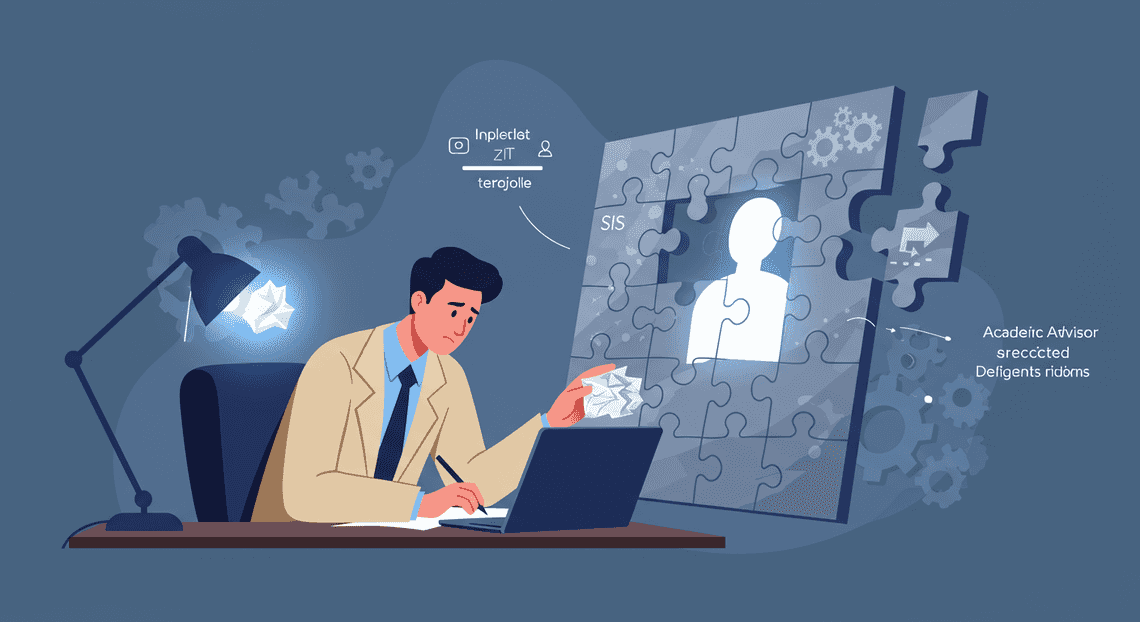
Furthermore, advisors are often forced to become data detectives, piecing together a student’s profile from a patchwork of disconnected systems: the Student Information System (SIS), the Learning Management System (LMS), degree audit tools, and separate platforms for financial aid or student life. This technological fragmentation consumes precious time and often results in an incomplete picture, forcing advisors to make recommendations based on partial data.
The administrative burden of tracking thousands of unique student journeys
A university with 20,000 undergraduates isn’t managing 20,000 static paths; it’s attempting to guide 20,000 dynamic, evolving, and utterly unique journeys. The complexity is staggering. Each journey is a composite of countless data points: major, minor, concentration, GPA, transfer credits, prerequisite chains, internship experiences, study abroad plans, financial aid status, and personal goals.
The administrative overhead required to manually track this “combinatorial explosion” of possibilities is immense. Advisors rely on a combination of CRM notes, spreadsheets, and institutional memory to keep everything straight. This heroic effort is both unsustainable and prone to error. A single missed detail—a failed prerequisite for a critical upper-level course, a forgotten application deadline for a competitive program—can have a cascading effect, potentially delaying a student’s graduation by a semester or more.
This burden is most acute when dealing with “what-if” scenarios, which are the lifeblood of academic exploration. When a student asks, “What would it take to add a data science minor to my biology major, and can I still graduate on time?” the advisor must embark on a time-consuming manual audit. They have to cross-reference multiple course catalogs, check prerequisite dependencies, and map out several potential semester plans. Multiplying this effort across hundreds of students reveals a system that is fundamentally reactive, spending most of its energy on logistical problem-solving rather than proactive, strategic guidance.
Connecting advisor overload to student attrition rates
The consequences of this unscalable model extend far beyond administrative inefficiency. There is a direct and painful line connecting advisor overload to student attrition. When students feel like just another number in a queue, their sense of belonging and connection to the institution erodes—a key predictor of whether they will persist to graduation.
An overloaded advisor, no matter how dedicated, simply cannot engage in the proactive outreach necessary to catch students who are beginning to struggle. The system waits for a student to fail a class or miss a deadline before an alert is triggered, by which time the damage may be difficult to reverse. A student who is quietly struggling with a foundational course, feeling overwhelmed, or questioning their choice of major is unlikely to be identified until they’ve already disengaged. They fall through the cracks not because of a lack of caring, but because of a lack of capacity.
This has a profound human and financial cost. For the student, it can mean a derailed education, wasted tuition, and the burden of debt without a degree. For the institution, it translates directly to lower retention rates, diminished graduation statistics, and lost revenue. It creates a vicious cycle: high attrition puts financial pressure on the university, which can lead to budget constraints that prevent the hiring of more advisors, further exacerbating the very ratios that contribute to the problem in the first place. The system is caught in a loop where the inability to scale personalized support actively undermines the institution’s core mission and financial stability.
A New Paradigm: An AI-Powered Architecture for Student Success
To truly scale personalized advising, we must move beyond incremental improvements to existing systems. The challenge isn’t just about managing data more efficiently; it’s about transforming that data into timely, actionable intelligence. This requires a new architectural paradigm—one that places a powerful AI model at the core of the student support ecosystem, creating a system of intelligence that augments, rather than simply records, the advising process.
Introducing the Gemini-driven advising co-pilot
At the heart of this new paradigm is the concept of an advising “co-pilot,” powered by Google’s Gemini models. This is not a replacement for human advisors. Instead, it’s a sophisticated assistant that serves both students and staff, creating a collaborative intelligence network.
For the Student: The co-pilot acts as an always-on, personal academic guide. It provides instant, 24/7 answers to a vast range of questions that would typically require an email or an appointment.
-
Degree Navigation: “What courses do I need to take next semester to stay on track for a psychology major?”
-
Policy Questions: “What is the university’s policy on course withdrawals?”
-
Exploratory Planning: “If I add a minor in data analytics, how many extra credits will I need and what would my graduation timeline look like?”
Leveraging Gemini’s long-context window, the co-pilot can process a student’s entire academic history, preferences, and goals to provide answers that are not just correct, but deeply contextualized.
For the Advisor: The co-pilot is an indispensable productivity and insight engine. It automates tedious, data-gathering tasks and synthesizes complex information, freeing advisors to focus on high-impact, human-centered guidance.
-
Automated Summaries: Before a meeting, the co-pilot can generate a concise summary of a student’s academic progress, recent performance trends, and potential risk factors.
-
Communication Drafts: It can draft personalized outreach emails based on specific triggers—for instance, congratulating a student on a strong midterm performance or offering support resources after a dip in grades.
-
Insight Generation: It can analyze data across an advisor’s entire caseload to identify systemic patterns, such as a specific required course that is a common bottleneck for students in a particular major.
Shifting from a reactive to a proactive support model
Historically, academic advising has operated on a reactive model. An advisor’s intervention is typically triggered by a student-initiated request or a lagging indicator of distress, like a failed course or a formal academic probation notice. By the time the problem is visible, it’s often much harder to solve.
An AI-powered architecture fundamentally flips this script, enabling a proactive and preventative support model. By continuously analyzing real-time data streams from various university systems, the Gemini-driven co-pilot can identify leading indicators of potential challenges long before they escalate into crises.
Consider these proactive interventions:
-
Engagement Flagging: A student’s login frequency to the Learning Management System (LMS) drops by 50% over a two-week period. The system automatically flags this subtle shift in behavior and prompts the advisor to send a supportive check-in message, which the co-pilot can help draft.
-
Risk-Aware Registration: A student attempts to register for a combination of courses with a historically high failure rate for students with their academic profile. The co-pilot can immediately surface a warning to both the student and the advisor, suggesting a more balanced schedule or prerequisite review.
-
Opportunity Identification: The system notes a student is consistently achieving high marks in quantitative reasoning courses within their humanities major. It can proactively suggest exploring a relevant minor, certificate, or internship opportunity, providing links to resources and a potential course plan.
This shift transforms advising from a series of transactional “firefighting” events into a continuous, strategic partnership focused on student development and success.
The core components of an automated advising workflow
Building this proactive system requires a thoughtfully designed architecture with several key components working in concert. This isn’t a single piece of software, but an integrated workflow.
-
Data Ingestion & Integration Layer: This is the foundation. Secure, real-time data pipelines connect to core university systems via APIs. Key sources include the Student Information System (SIS) for academic records, the Learning Management System (LMS) for engagement data, degree audit software for progress tracking, and CRM platforms for interaction history. The goal is to create a single, unified view of each student.
-
Unified Student Profile & Institutional Knowledge Base: Raw data is processed and structured into a comprehensive, dynamic profile for each student. This is paired with a meticulously curated institutional knowledge base—a vector database containing everything from course catalog descriptions and prerequisites to financial aid policies and campus support service details. This is the “ground truth” that prevents model hallucinations and ensures all AI-generated advice is accurate and policy-compliant through a Building a RAG Context Manager with Apps Script and Gemini Pro (RAG) framework.
-
The Gemini Orchestration Engine: This is the central intelligence hub. When a query is received or a system trigger occurs, this engine coordinates the entire process. It uses specialized agents or “tools” to:
-
Query the Unified Student Profile for relevant academic history.
-
Retrieve accurate information from the Institutional Knowledge Base.
-
Perform complex logic, such as running a degree progress simulation.
-
Finally, it passes this rich, structured context to the Gemini model, which uses its advanced reasoning capabilities to synthesize the information into a coherent, helpful, and personalized response or alert.
- Interaction & Alerting Layer: This is the interface through which users interact with the system’s intelligence.
-
For Students: This is often a conversational AI chatbot embedded within the student portal or mobile app, providing instant access to information and guidance.
-
For Advisors: This manifests as an intelligent dashboard or a plugin within their existing CRM. It surfaces prioritized alerts, provides deep-dive analytics on student progress, and offers tools for AI-assisted communication.
The Four-Step Workflow for Automated Success Plans
Transforming raw student data into personalized, actionable guidance doesn’t require a complete overhaul of your existing systems. By orchestrating the powerful, interconnected tools within [Automatically create new folders in Google Drive, generate templates in new folders, fill out text automatically in new files, and save info in [Automated Web Scraping with [Multilingual Text-to-Speech Tool with SocialSheet Streamline Your Social Media Posting 123](https://votuduc.com/Multilingual-Text-to-Speech-Tool-with-Google-Workspace-p809282)](https://votuduc.com/Automated-Web-Scraping-with-Google-Sheets-p292968)](https://workspace.google.com/marketplace/app/auto_create_folder_and_files/430076014869), supercharged by Gemini’s analytical capabilities, you can build a scalable, semi-automated workflow. This four-step process creates a robust pipeline that moves from data consolidation to personalized distribution, empowering advisors to focus on high-impact interactions rather than administrative overhead.
Step 1: Consolidating student academic history with Google Sheets
The foundation of any data-driven initiative is a clean, structured, and accessible dataset. Google Sheets serves as the perfect centralized hub for this workflow, acting as the single source of truth for the entire process.
First, you must aggregate critical student data into a single Sheet. Each row should represent a unique student, and each column a specific data point. This data is typically exported from your institution’s Student Information System (SIS) and can include:
-
Demographics: Student ID, Name, Declared Major, Cohort Year.
-
Academic Performance: Overall GPA, Major GPA, Credits Earned, Credits in Progress.
-
Course History: A structured list or JSON object of completed courses with corresponding grades.
-
Risk Factors: Pre-calculated flags from the SIS, such as probation status, low attendance in key courses, or being off-track for graduation requirements.
To maintain data currency, this process can be automated. A scheduled [AI Powered Cover Letter [Automated Job Creation in Real Time Jobber and Google Sheets Integration from Gmail](https://votuduc.com/Automated-Job-Creation-in-Jobber-from-Gmail-p115606) Engine](https://votuduc.com/AI-Powered-Cover-Letter-Automated Quote Generation and Delivery System for Jobber-Engine-p111092) can pull data directly from SIS APIs or connected databases. Alternatively, services like Zapier or native BigQuery connectors can pipe the information into your Sheet on a recurring basis. The end goal is a machine-readable ledger that provides a comprehensive snapshot of each student’s academic journey, ready to be fed into the analytical engine.
Step 2: Leveraging Gemini Enterprise for intelligent analysis and drafting
With a consolidated dataset in place, the next step is to harness the analytical power of Gemini to interpret the data and generate initial drafts of the success plans. This is where raw data is transformed into nuanced, advisor-quality insights.
This is achieved by using Genesis Engine AI Powered Content to Video Production Pipeline to call the Gemini API for each student record (each row) in your Google Sheet. The key to success lies in meticulous [Prompt Engineering for Reliable Autonomous Workspace Agents for Reliable Autonomous Workspace Agents](https://votuduc.com/prompt-engineering-for-reliable-autonomous-workspace-agents-p-20260319404106). Your prompt must provide Gemini with a clear role, context, and a structured task.
Here is an example of a robust system prompt you might use:
You are an expert, empathetic academic advisor for the College of Engineering at Northwood University. Your goal is to help students succeed by providing clear, encouraging, and actionable advice.

You will be provided with a student's academic record in JSON format. Your task is to analyze this record and generate a draft for a personalized academic success plan.

Based on the provided data, perform the following actions:

1.  **Identify Strengths:** Begin with positive reinforcement. Highlight one or two areas where the student is excelling (e.g., high grades in core major courses, consistent performance).

2.  **Pinpoint Challenges:** Identify 1-2 key areas that require attention. This could be a low grade in a critical prerequisite, a GPA trend that needs correction, or being behind on credit requirements for their graduation timeline. Be constructive and avoid alarming language.

3.  **Recommend Actions:** Provide a bulleted list of 3-4 specific, actionable recommendations. These should directly address the challenges identified. Recommendations can include:

- Suggesting specific university resources like the Math Tutoring Center or the Writing Lab.

- Recommending they schedule a meeting with their faculty mentor or a career advisor.

- Proposing specific courses to take in the upcoming semester to get back on track.

- Suggesting study strategies relevant to their field.

Structure your output as a concise, well-formatted text block ready to be inserted into a document. Do not include any introductory or concluding pleasantries outside of the plan itself.
The Apps Script iterates through each student row, packages their data into the specified format (e.g., JSON), sends it to the Gemini API along with the system prompt, and writes the generated text response into a new column in the Sheet, such as Gemini_Draft_Plan.
Step 3: Generating polished academic plans with Google Docs
While the AI-generated text provides the core substance, the final plan needs to be presented in a professional, branded, and easily readable format. Google Docs is the ideal tool for this, allowing for the automated creation of polished documents from a template.
The process works as follows:
-
Create a Template: Design a Google Doc that serves as your master template. This document should include your university’s letterhead, standard formatting, and placeholders for dynamic content. Placeholders are typically denoted with double curly braces, for example:
{{StudentName}},{{StudentID}},{{Date}}, and a main placeholder for the AI-generated content,{{PlanContent}}. -
Automate Document Creation: A [Architecting Multi Tenant AI Workflows in Building Modular Agentic Apps Script with Gemini Function Calling](https://votuduc.com/architecting-multi-tenant-ai-workflows-in-google-apps-script-p-20260321290501) function is triggered to handle the merge. For each student row in your Sheet, the script:
-
Makes a copy of the master Google Docs template.
-
Renames the new document with a unique identifier, like
"Success Plan - [Student Name] - [Date]". -
Performs a “find and replace” action, substituting the placeholders (
{{StudentName}}, etc.) with the corresponding data from the student’s row in the Google Sheet. -
Saves the finalized document to a specific Google Drive folder.
-
Writes the shareable link for the newly created Doc back into a column in the Sheet for easy access and tracking.
This step also provides a critical human-in-the-loop checkpoint. Before distribution, an academic advisor can quickly open the generated Doc, review the AI’s analysis, make any necessary tweaks or personal additions, and then mark the plan as “Approved for Sending” in the Google Sheet. This ensures quality control and preserves the essential human touch.
Step 4: Distributing personalized communications at scale via Gmail
The final step is to deliver these personalized plans to students efficiently. Using Automating Technical Debt Audits in Apps Script with AI Agents’s GmailApp service, you can automate the entire distribution process, creating a powerful mail merge system that leverages all the previously generated assets.
The distribution script can be configured to run on a schedule or be triggered manually (e.g., by clicking a custom menu item in Sheets). When executed, it scans the Google Sheet for students whose plans are marked “Approved for Sending.” For each of these students, the script:
-
Crafts a Personalized Email: It pulls data from the student’s row—such as their name and the link to their unique Google Doc—to populate an email template. The email can be personalized further by including a snippet from the Gemini analysis, like a line of positive reinforcement.
-
Sends the Email: It uses
GmailApp.sendEmail()to send the message directly from a designated advisor or departmental email address. This maintains a professional and familiar point of contact for the student. -
Updates the Status: After successfully sending the email, the script updates the student’s status in the Google Sheet to “Sent” and timestamps the action. This creates a clear and auditable record of communication, closing the loop on the entire workflow.
By the end of this four-step process, you have successfully moved from a raw data export to the mass distribution of highly personalized, high-quality academic success plans, freeing up countless hours for advisors to engage in the meaningful conversations that truly drive student success.
The Transformative Impact on Students and Operations
Integrating a large language model like Gemini into the academic advising ecosystem isn’t merely an incremental upgrade; it’s a fundamental shift that redefines the student support paradigm. The benefits ripple outward, touching everything from individual student journeys to the institution’s core operational metrics. By automating routine tasks and providing instantaneous, data-driven insights, this technology creates a more efficient, equitable, and ultimately more human-centric advising model.
Boosting student retention and on-time graduation rates
Student attrition is often a story of a thousand small cuts. A missed prerequisite, a misunderstood degree requirement, or a feeling of being lost in the institutional maze can collectively derail an academic career. A Gemini-powered advising system acts as a proactive, ever-present guide, directly addressing these common failure points.
The system can continuously monitor a student’s progress against their declared degree plan, flagging potential issues long before they become critical. Imagine automated, personalized nudges sent directly to a student’s phone: “Heads up, the section of BIOL 201 you need for your major is filling up fast,” or “Planning to study abroad next year? Let’s map out how it fits with your senior capstone requirements.” This isn’t generic spam; it’s tailored, timely intervention.
Furthermore, by providing 24/7 access to accurate answers, the system removes friction and anxiety. A student wrestling with a registration question at 10 PM on a Sunday can get an immediate, correct answer instead of waiting two days for an advisor’s office hours, by which time frustration may have set in. This constant, reliable support network fosters a sense of empowerment and clarity, keeping students on a clear and efficient path to completion. The cumulative effect is a powerful defense against attrition, leading to measurable improvements in the two most critical metrics for student success: retention and on-time graduation.
Freeing up advisors for high-impact human interaction
The paradox of modern academic advising is that advisors are often too buried in administrative work to do the advising that truly matters. Their days are consumed by repetitive, transactional tasks: answering the same questions about deadlines, manually checking degree progress, and navigating complex policy documents.
A Gemini-powered system absorbs the vast majority of this cognitive load. It becomes the “Tier 1” support expert, flawlessly handling the high volume of factual queries that monopolize an advisor’s time. It can instantly perform complex degree audits, synthesize a student’s academic history, and present a clear summary to the human advisor.
This strategic Automated Work Order Processing for UPS is liberating. It frees advisors to focus on the uniquely human elements of their role—the conversations that change lives. Their time is reallocated from information retrieval to genuine mentorship. They can engage in deep discussions about career aspirations, help students navigate personal challenges that impact their studies, and provide coaching on developing skills for the future. The conversation elevates from “What courses do I need to take?” to “What kind of person do I want to become, and how can my education get me there?” By handling the transactional, the AI empowers advisors to be truly transformational.
Ensuring consistency and quality in advising across the institution
In many institutions, the quality of advising a student receives can feel like a lottery, dependent on the caseload, experience, or even the communication style of their assigned advisor. This inconsistency creates inequity and institutional risk, as a single piece of incorrect advice can have significant consequences for a student’s academic and financial future.
Implementing a centralized, AI-driven knowledge base establishes a guaranteed baseline of quality and accuracy for every single student. The system operates from a single source of truth—the official, up-to-the-minute course catalog, academic policies, and degree requirements. It doesn’t have a bad day, it doesn’t forget a recent policy change, and it doesn’t offer conflicting information.
This ensures that every student, regardless of their background or assigned advisor, has access to the same correct, reliable information. A first-generation student who might be hesitant to ask a “silly” question can query the system without fear of judgment. An advisor new to the institution can rely on the system to provide accurate policy guidance while they get up to speed. This consistency doesn’t homogenize advising; it fortifies it. It ensures that the creative, personalized guidance offered by human advisors is always built upon a foundation of unshakeable, universally accessible accuracy.
Is Your Institution Ready to Evolve Its Advising Strategy
The transition from a traditional, high-touch advising model to an AI-augmented framework is not merely a technological upgrade; it’s a strategic evolution. It represents a fundamental shift towards a more proactive, data-informed, and scalable system of student support. The tools are no longer theoretical—they are robust, secure, and ready for implementation. The real question is one of readiness: is your institution prepared to harness this potential to redefine student success for the next decade?
A recap of the AI-powered advising model
Before charting a path forward, let’s briefly revisit the architecture we’ve explored. This isn’t about replacing human advisors but about supercharging them. The model is built on a synergistic core of interconnected components:
-
A Central Intelligence Engine: At its heart, a powerful large language model like Google’s Gemini serves as the reasoning engine. Its long-context window and multimodal capabilities allow it to process and synthesize vast amounts of diverse information, from degree audit reports to transcribed advising sessions.
-
Secure Data Integration: The model securely connects to your institution’s core systems—the Student Information System (SIS), Learning Management System (LMS), and degree planning tools. This provides the real-time, student-specific data necessary for truly personalized guidance.
-
Institutional Knowledge Grounding: Using Retrieval-Augmented Generation (RAG), the system is grounded in your institution’s specific knowledge base. It ingests and indexes course catalogs, academic policies, student handbooks, and transfer equivalency agreements, ensuring its responses are always accurate, relevant, and context-aware.
-
An Advisor Co-pilot & Student-Facing AI: The solution manifests in two primary interfaces. For advisors, it’s a “co-pilot” that automates tedious tasks like generating degree plans, summarizing student progress, and flagging at-risk behaviors. For students, it’s a 24/7 conversational AI that can answer common questions instantly, freeing up advisors to focus on complex, high-impact mentoring.
This model transforms advising from a reactive, appointment-driven process into a continuous, proactive support system that meets students where they are, whenever they need it.
Take the next step towards scalable student success
Moving from concept to reality requires a deliberate, phased approach. The journey towards AI-augmented advising doesn’t happen overnight, but it can begin with a single, impactful step. Here’s how to get started:
-
Identify a High-Value Pilot Program: Don’t try to boil the ocean. Start with a well-defined problem. Is it the flood of registration-related questions that overwhelms your registrar each semester? Is it providing consistent guidance for a complex, high-enrollment major? A successful pilot in one area builds momentum and provides a powerful case study for broader adoption.
-
Assemble a Cross-Functional Team: True transformation requires collaboration. Your initial team should include representatives from academic advising, the registrar’s office, information technology, and institutional research. This ensures that the solution is not only technically sound but also functionally aligned with institutional goals and user needs.
-
Define Success Metrics: How will you measure the impact? Key Performance Indicators (KPIs) could include a reduction in advisor response time, an increase in student self-service interactions, improved course registration accuracy, or a measurable lift in retention rates for the pilot cohort.
The goal is to create a tangible proof-of-concept that demonstrates value quickly. This initial success becomes the foundation for a strategic, campus-wide rollout that can fundamentally enhance your institution’s ability to support every student’s unique academic journey.
How a GDE discovery call can map your custom architecture
Navigating the complexities of integrating a generative AI solution into a legacy university IT environment can be daunting. This is where specialized expertise becomes invaluable. A discovery call with a Google Developer Expert (GDE) specializing in cloud and AI is a critical first step to demystify the process and create a tailored roadmap.
This is not a sales pitch; it’s a strategic architectural session. During this complimentary consultation, a GDE will work with your team to:
-
Audit Your Technical Ecosystem: We’ll discuss your current SIS, LMS, and data warehouse solutions. We’ll identify key integration points, potential data silos, and the most efficient pathways for secure data access.
-
Address Security and Compliance: We’ll tackle the critical questions around FERPA, data privacy, and ethical AI use from the very beginning. We can outline architectures on Google Cloud that prioritize security, using tools like Identity and Access Management (IAM), VPC Service Controls, and data encryption.
-
Scope Your Minimum Viable Product (MVP): We’ll help you refine your pilot idea into a concrete technical scope. This includes defining the data sources, the specific prompts and workflows to be automated, and the user interface for advisors and/or students.
-
Draft a High-Level Blueprint: You will leave the call with a clear, high-level architectural diagram. This blueprint will illustrate how services like [Building Self Correcting Agentic Workflows with Building Self-Correcting Agentic Workflows with Vertex AI](https://votuduc.com/building-self-correcting-agentic-workflows-with-vertex-ai-p-20260321542526) Gemini APIs, Cloud Storage, BigQuery, and secure authentication flows would connect to create your custom advising solution.
This discovery process bridges the gap between your institution’s strategic goals and the technical execution required to achieve them. It provides a clear, actionable plan that minimizes risk and accelerates your path to leveraging AI for unparalleled student success.


Stop Doing Manual Work. Scale with AI.
Want to turn these blog concepts into production-ready reality for your team?
Table Of Contents
Portfolios
Related Posts
Quick Links
Legal Stuff