

Securely Unify Workspace Data with a Gemini RAG Architecture


While each tool in your digital workspace is powerful, their very specialization creates a fragmented experience that quietly hinders your team’s true productivity.
The Challenge of a Fragmented Digital Workspace
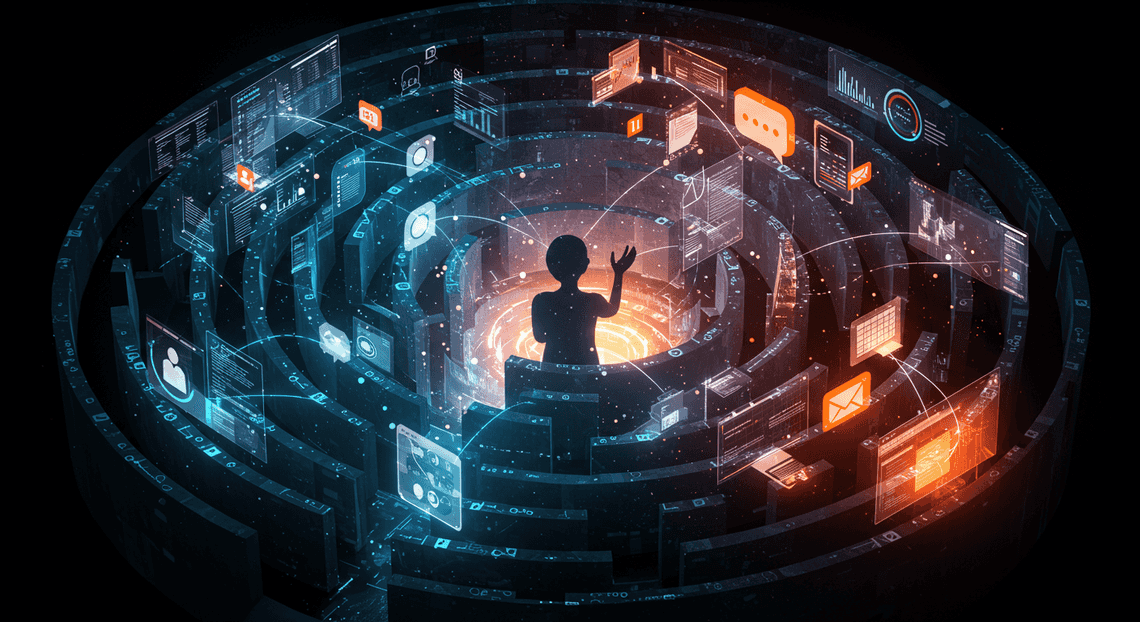
The modern digital workspace, particularly a comprehensive suite like [Automatically create new folders in Google Drive, generate templates in new folders, fill out text automatically in new files, and save info in [Automated Web Scraping with [Multilingual Text-to-Speech Tool with SocialSheet Streamline Your Social Media Posting 123](https://votuduc.com/Multilingual-Text-to-Speech-Tool-with-Google-Workspace-p809282)](https://votuduc.com/Automated-Web-Scraping-with-Google-Sheets-p292968)](https://workspace.google.com/marketplace/app/auto_create_folder_and_files/430076014869), is an engine of productivity. It’s where ideas are born in Google Docs, decisions are debated in Chat, strategies are outlined in Slides, and execution is coordinated through Gmail and Calendar. Each tool is powerful in its own right. Yet, this very specialization creates a fundamental, and costly, challenge: fragmentation. Your organization’s most valuable asset—its collective knowledge—is scattered across a digital landscape of isolated data silos. Finding the right information isn’t just about knowing what to search for, but where. This digital scavenger hunt is a silent tax on productivity, security, and innovation.
Why Information Silos in Mail, Drive, and Chat Cost You More Than Time
The friction caused by information silos goes far beyond the minutes wasted searching for a specific file. The true costs are systemic, impacting everything from operational efficiency to strategic decision-making.
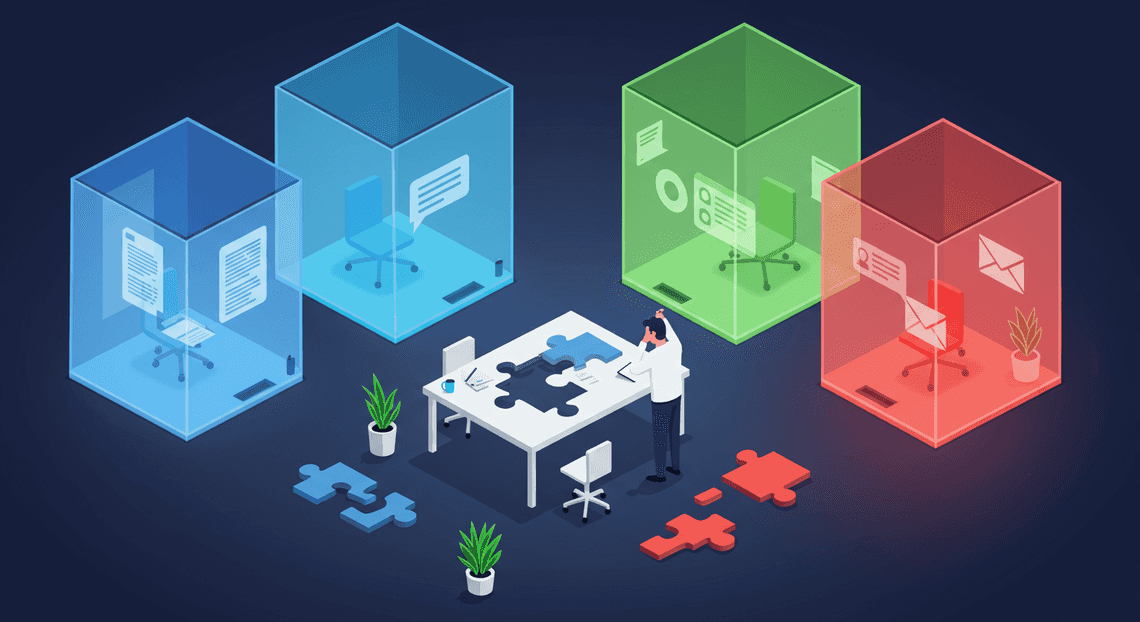
- Degraded Productivity and Cognitive Load: The average knowledge worker switches between apps and windows thousands of times a day. Each switch—from a chat thread to find a link, to an email to verify a decision, to a document to cross-reference a data point—incurs a cognitive cost. This constant context-switching fragments attention, drains mental energy, and leads to errors. It’s the digital equivalent of trying to assemble a puzzle with the pieces scattered across different rooms.
-
Incomplete Context and Flawed Decisions: Critical business decisions are often made with an incomplete picture. A project lead might reference a spec sheet in Drive, completely unaware of a critical blocker discussed by the engineering team in a Chat space an hour prior. A sales executive might craft a proposal based on an old slide deck, missing key pricing updates shared in an internal email thread. When data is siloed, you’re not just missing files; you’re missing the connective tissue of context that leads to sound judgment.
-
Amplified Security and Compliance Risks: A fragmented workspace is a nightmare for governance. How can you consistently enforce data retention policies when critical information exists as email attachments, Drive files, and ephemeral chat logs? How do you manage access controls at a granular level across this entire surface area? This lack of a unified view creates security blind spots, making it difficult to track who has access to sensitive information and nearly impossible to respond effectively to a data spillage incident or a compliance audit.
-
Stifled Innovation and Lost “Corporate Memory”: The most profound cost is the loss of undiscovered insights. True innovation often happens at the intersection of ideas. Silos prevent this serendipity. You can’t easily correlate customer feedback from Gmail with product development discussions in Chat and final design documents in Drive. Your organization’s institutional knowledge—its “corporate memory”—becomes trapped, inaccessible, and unable to inform future work.
The Generative AI Solution: A Unified Intelligence Layer
How do you solve the fragmentation problem without forcing a disruptive change in how people work? You don’t try to move all the data into one massive, monolithic database. Instead, you build an intelligent layer that sits on top of the existing tools. This is where Generative AI, specifically Large Language Models (LLMs) like Google’s Gemini, fundamentally changes the game.
Imagine a unified intelligence layer that has the ability to read, understand, and synthesize information across your entire AC2F Streamline Your Google Drive Workflow. This layer doesn’t just perform keyword searches; it comprehends context and relationships. It allows you to move from simple, targeted queries like “search for ‘Q4 budget’” to complex, conversational questions like:
“Summarize the key concerns raised by the finance team regarding the Q4 budget across all email and chat discussions in the last month, and cross-reference them with the risks outlined in the final project proposal doc.”
This isn’t just a better search bar. It’s a new paradigm for interacting with your organization’s collective knowledge—an expert assistant that has read everything and can provide you with synthesized, contextualized answers instantly.
Introducing a Secure RAG Framework for Automated Client Onboarding with Google Forms and Google Drive.
The architectural pattern that makes this unified intelligence layer possible—and, crucially, secure—is Building a RAG Context Manager with Apps Script and Gemini Pro (RAG). RAG is a framework that grounds the powerful reasoning capabilities of an LLM in your specific, private data without the risks and costs associated with retraining the model itself.
Here’s how a secure RAG framework operates within the context of Automated Discount Code Management System:
-
Retrieval: When a user asks a question, the system first queries a specialized index of your Workspace data. This retrieval step is permission-aware; it only surfaces documents, emails, and chat messages that the user asking the question already has the explicit right to access. It finds the most relevant “snippets” of factual information related to the query.
-
Augmentation: The system then takes these retrieved, factual snippets and dynamically inserts them into the prompt it sends to the Gemini model. The prompt effectively becomes: “Using only the following information {retrieved text from your docs, emails, etc.}, answer this question: {user’s original question}.”
-
**Generation: The LLM generates a response based only on the grounded, real-time context provided. This process mitigates model “hallucinations” and ensures the answer is directly tied to your organization’s actual data.
This RAG approach is inherently secure. Your corporate data is never used for training the base model, it remains within your secure cloud environment, and—most importantly—it rigorously enforces your existing access control lists. The result is a system that can unlock the immense value hidden in your fragmented workspace while upholding the strictest standards of data security and privacy.
Core Concepts: Deconstructing the Cross-Workspace RAG Hub
To build a system that can securely reason across your entire enterprise knowledge base, we need to move beyond simply connecting a large language model (LLM) to a data source. The architecture requires a deliberate, security-first approach that combines cutting-edge AI with robust data governance. Let’s break down the foundational principles and components that make this RAG Hub possible.
What is Retrieval-Augmented Generation (RAG) and Why It Matters for Enterprise
At its core, Retrieval-Augmented Generation (RAG) is a sophisticated technique designed to make LLMs smarter, more accurate, and more useful by grounding them in your specific data. A standard LLM’s knowledge is frozen at the time of its training, making it prone to generating outdated or fabricated information (a phenomenon known as “hallucination”). RAG fundamentally changes this dynamic.
The process works in two main stages:
-
Retrieval: When a user submits a query, the system doesn’t immediately send it to the LLM. Instead, it first uses the query to search a specialized knowledge base—like a vector database containing your company’s documents, wikis, and messages. It retrieves the most relevant snippets of information related to the query.
-
Augmentation & Generation: The system then “augments” the original query by adding the retrieved data as context. This enriched prompt is then sent to the LLM (like Gemini). The model uses this fresh, factual context to generate a response that is not only relevant but also verifiably based on your internal data.
For the enterprise, this isn’t just an enhancement; it’s a necessity.
-
Combats Hallucination: By forcing the LLM to base its answers on retrieved corporate documents, RAG dramatically reduces the risk of inaccurate or invented information, a critical requirement for business-critical applications.
-
Unlocks Proprietary Data: Your company’s most valuable insights are locked in private documents, databases, and communication platforms. RAG provides a secure bridge for an LLM to tap into this knowledge without requiring constant, expensive retraining.
-
Ensures Data Freshness: Business data changes by the minute. RAG allows the AI to access the most current information in your knowledge base, ensuring its responses reflect the present reality, not the state of the world months or years ago when the model was trained.
-
Enables Auditability and Trust: Because the generated response is based on specific retrieved documents, the system can provide citations. This allows users to trace the AI’s reasoning back to the source material, fostering trust and creating an auditable trail.
Key Architectural Components: Gemini Workspace Intelligence API and Firestore
Our Cross-Workspace RAG Hub is built on a synergistic combination of Google Cloud services, each playing a distinct and critical role.
Gemini Workspace Intelligence API (The Orchestrator & Generator)
Think of this as the central nervous system of the architecture. It’s not just a raw LLM endpoint; it’s the intelligent layer that orchestrates the entire secure RAG workflow.
-
Generation Engine: At its heart, it leverages the power of Google’s state-of-the-art Gemini models, particularly models like Gemini 1.5 Pro with its massive context window. This allows it to synthesize information from numerous retrieved documents into a single, coherent answer.
-
Integration Hub: It acts as the glue connecting user authentication, the data retrieval layer, and the generation model. It manages the flow of information, ensuring each step is executed securely and in the correct order.
-
Secure Prompting: It is responsible for constructing the final, augmented prompt that includes the user’s query and the securely retrieved context before passing it to the core model for generation.
Firestore (The Metadata & Permissions Gatekeeper)
While a dedicated vector database handles the lightning-fast semantic search, Firestore plays the arguably more critical role of the security gatekeeper. In our architecture, it’s the source of truth for metadata and, most importantly, access control.
-
Metadata Store: For every piece of data indexed from your workspaces (e.g., a paragraph from a Google Doc, a message from a Slack channel), a corresponding document is created in Firestore. This document stores vital metadata: the source file ID, creation date, owner, and the original vector embedding.
-
Permissions Engine: Crucially, this Firestore document also stores a precise copy of the source material’s Access Control List (ACL). If a Google Doc is only shared with
user:[email protected]andgroup:[email protected], that exact permission set is stored alongside the document’s content chunks in Firestore. -
Pre-filtering Power: Before any vector search occurs, our system queries Firestore first. Using Firestore’s powerful and scalable querying capabilities, it can instantly determine the exact set of documents a given user is allowed to see. This pre-filtering step is the cornerstone of our security model.
The Security-First Approach to Centralized Data Access
The single greatest challenge in creating a unified enterprise search and intelligence tool is permissions. How do you pool knowledge from HR, Finance, and Engineering without creating a catastrophic data leak? The answer is to build a system where security is not an afterthought but the foundational principle.
Our architecture achieves this through a permissions-aware retrieval process. It never grants the LLM, or even the retrieval system itself, broad access to the entire knowledge base. Access is determined dynamically, on a per-user, per-query basis.
Here’s the step-by-step flow that ensures zero data leakage:
-
User Authentication: A user submits a query through a secure endpoint. The system authenticates the user and retrieves their identity and all associated group memberships (e.g.,
jane.doe,engineering,project-pegasus-leads). -
Pre-Retrieval Filtering (The Firestore Check): The system does not immediately perform a semantic search. Instead, it first queries Firestore with the user’s credentials. The query effectively asks: “Return the unique IDs of all indexed document chunks where the ACL contains
jane.doeORengineeringORproject-pegasus-leads.” This returns a list of document IDs the user is explicitly authorized to access. -
**Scoped Semantic Search: Now, and only now, does the retrieval step begin. The vector search is performed, but with a critical constraint: it is filtered to search only within the subset of vectors corresponding to the allowed document IDs returned from Firestore in the previous step. Any document the user doesn’t have permission to view is completely invisible to the search algorithm.
-
Secure Augmentation and Generation: The relevant text snippets from the securely retrieved documents are collected. This authorized-only context is combined with the user’s original query and passed to the Gemini API.
This model ensures that the LLM never sees, processes, or learns from data that the requesting user wasn’t already permitted to access in the source system. It perfectly inherits and enforces the existing data governance policies of your workspaces, making it a trustworthy and secure foundation for enterprise intelligence.
A Blueprint for Building Your Secure RAG Hub
With the conceptual framework established, let’s transition from theory to practice. Building a secure, enterprise-grade RAG hub isn’t about loosely connecting services; it’s about architecting a cohesive system where security and data governance are integral at every stage. This four-step blueprint outlines a robust and scalable approach using Google Cloud and Workspace services.
Step 1: Establishing a Secure Foundation with Firestore for State Management
Before any data is retrieved or generated, we need a reliable and secure way to manage the state of each user interaction. This is where Firestore, in its native mode, excels. It’s more than just a NoSQL database; it’s the central nervous system for our RAG application, managing session context, conversation history, and metadata about retrieved documents.
Why Firestore?
-
Granular, User-Aware Security: Firestore’s power lies in its Security Rules. We can define intricate rules that tie data directly to a user’s identity. For example, a rule can explicitly state that
a user can only read or write their own conversation history. This server-side enforcement is non-negotiable and prevents any possibility of one user’s session data leaking into another’s. -
Serverless Scalability: As a fully managed, serverless database, Firestore scales automatically with your usage. Whether you have ten users or ten thousand, you don’t need to provision or manage infrastructure. This ensures high availability and low operational overhead.
-
Real-time Capabilities: While not always a primary requirement for RAG, Firestore’s real-time features can be used to build more dynamic user interfaces, showing the status of long-running data retrieval or processing tasks.
In our architecture, Firestore will store documents mapping user IDs to their session data, including previous queries, conversation IDs, and references to the documents accessed, ensuring a stateful and personalized experience within a secure-by-default environment.
Step 2: Leveraging the Workspace Intelligence API for Secure Data Retrieval
This is the heart of the “Retrieval” stage. The challenge with corporate data is not just finding it, but finding it securely. The Automated Email Journey with Google Sheets and Google Analytics Intelligence API is the key that unlocks this capability by acting as a smart, permission-aware search layer across the user’s entire Workspace corpus—Gmail, Drive, Calendar, and more.
The critical design principle here is that the API operates within the user’s existing access control list (ACL) context. When your application makes a call to the API on behalf of a user (via a proper OAuth 2.0 flow), the API only returns results that the user already has explicit permission to view.
How it Works:
-
A user submits a query, like “Find the presentation on the Q4 marketing budget.”
-
Your RAG service, authenticated as that user, calls the Workspace Intelligence API with the query.
-
The API securely searches across the user’s Drive, respecting all file ownership, “shared with me,” and folder-level permissions.
-
It returns a list of relevant documents (e.g., Google Slides, Sheets) along with metadata. It will not return a document the user cannot access, even if it perfectly matches the search query.
This completely obviates the need to build and maintain a separate, complex permissions engine. You inherit the robust, battle-tested security model of Automated Google Slides Generation with Text Replacement directly, ensuring data is never over-shared.
Step 3: Implementing Gemini in Drive for Dynamic Context Generation
Simply retrieving a list of documents is not enough. Passing entire multi-page documents into a Large Language Model (LLM) is inefficient, expensive, and often counterproductive due to context window limitations and “lost in the middle” problems. This is where we move from simple retrieval to intelligent context generation.
With Gemini models now integrated directly into services like Google Drive, we can perform sophisticated pre-processing on our retrieved documents before they ever reach the final prompt.
The Workflow:
-
Retrieval: The Workspace Intelligence API identifies a highly relevant but lengthy 20-page Google Doc.
-
**In-Situ Summarization: Instead of downloading and parsing the raw text, your service makes an API call to a Gemini-powered function within Drive (such as through an App Script or a dedicated API endpoint). You can ask it to “summarize the key findings and action items from this document.”
-
Context Refinement: The model generates a concise, dense summary. This summary—not the full 20-page document—becomes the context that is injected into the final prompt for the generative LLM.
This “on-the-fly” summarization and context extraction step is transformative. It dramatically reduces token count, lowers latency, and provides the LLM with a much cleaner, more relevant signal, leading to significantly higher-quality and more accurate generated responses.
Step 4: Enforcing Granular Access Controls and Data Governance
The final step is to wrap our entire RAG hub in a comprehensive governance and access control framework using Google Cloud’s IAM (Identity and Access Management) and audit logging capabilities.
Layered Access Control:
-
User-Level (Workspace): As established, the Workspace Intelligence API handles data access based on the end-user’s permissions.
-
Service-Level (Google Cloud IAM): The Cloud Function or Cloud Run service that orchestrates the RAG workflow must be secured. Using IAM, you define precisely which users, groups, or service accounts are allowed to invoke this service. This prevents unauthorized access to the RAG application itself. For example, you can restrict its usage to members of the
{company-employees}group.
Comprehensive Auditing for Governance:
Data governance requires visibility. By leveraging Cloud Audit Logs, you gain a complete, immutable record of every action taken by the system:
-
Data Access Auditing: Every call to the Workspace Intelligence API is logged, showing who requested what data and when.
-
Model Interaction Auditing: All interactions with the Gemini models can be logged, providing transparency into how the models are being used and what information is being processed.
This creates a powerful audit trail essential for compliance, security investigations, and understanding data lineage. You can answer critical questions like “Which documents were used to generate the answer for user X’s query about Project Falcon?” This level of oversight is non-negotiable for any enterprise-grade AI system.
Real-World Impact and Strategic Advantages
Moving beyond the architectural diagrams and technical specifications, the true value of a Gemini-powered RAG system is measured by its impact on business operations and strategic outcomes. This isn’t merely an upgrade to an enterprise search bar; it’s a fundamental shift in how an organization accesses, synthesizes, and acts upon its collective intelligence. By securely unifying disparate data sources—from code repositories and wikis to chat logs and project management boards—this architecture unlocks tangible efficiencies and creates a significant competitive edge.
Use Case: Accelerating Project Onboarding and Knowledge Transfer
The “tribal knowledge” problem is a silent productivity killer in many organizations. Critical information lives in the minds of senior engineers, in ephemeral chat conversations, or buried in outdated documentation. For a new hire or an engineer rotating onto a new project, the initial weeks are often a frustrating scavenger hunt for context.
A Gemini RAG system transforms this experience into a guided exploration. Instead of asking a senior team member and interrupting their workflow, a new developer can pose complex, natural-language questions directly to the unified knowledge base:
-
“What is the standard CI/CD pipeline for a new JSON-to-Video Automated Rendering Engine microservice? Provide a summary of the deployment steps, link to the relevant Terraform module in GitHub, and show me the last major discussion about it in the
#devopsSlack channel.” -
“Summarize the original project brief and the key technical decisions made for ‘Project Apollo’ from the documents in Confluence and Google Drive.”
-
“Who are the primary contacts for the payments API, and what are the most common support issues filed in Jira for it in the last quarter?”
The system doesn’t just return a list of links. It synthesizes information from these multiple sources, providing a coherent, actionable answer complete with citations. This dramatically reduces the time-to-productivity from weeks to days, preserves institutional knowledge when employees depart, and fosters a culture of self-service, freeing up senior talent to focus on more complex challenges.
Use Case: Streamlining Compliance and Internal Audits
Internal audits and compliance checks are notoriously resource-intensive processes. Teams spend hundreds of hours manually collating evidence from dozens of systems to satisfy requests from auditors. This process is slow, prone to human error, and highly disruptive to normal business operations.
The RAG architecture, built with security and access controls at its core, serves as a powerful force multiplier for governance, risk, and compliance (GRC) teams. Because the system honors the native Access Control Lists (ACLs) of the source data, auditors can be granted secure, read-only access to a centralized query interface.
They can now execute complex, cross-system queries that were previously impossible or would have taken weeks to fulfill:
-
“Generate a report of all users who had production database access in Q4, and cross-reference it with the completion records from the mandatory annual security training in our LMS.”
-
“List all projects in Jira tagged with ‘PII-Data’ and provide links to their corresponding Data Protection Impact Assessment (DPIA) documents in SharePoint.”
-
“Show me all change requests related to the authentication service that were deployed in the last 6 months, along with their approval records and links to the associated regression test results in our test management tool.”
This capability transforms auditing from a reactive, manual slog into a proactive, data-driven exercise. It reduces audit preparation time exponentially, increases the accuracy of responses, and provides a clear, demonstrable record of compliance and control.
Measuring the ROI: Reduced Search Time and Enhanced Decision Quality
Quantifying the return on investment for a knowledge management platform requires looking at both direct efficiency gains and less tangible, but equally important, strategic benefits.
Tangible Metrics:
-
Productivity Recapture: The most direct metric is time saved. Consider a conservative estimate: if a knowledge worker saves just 30 minutes per day previously spent searching for information, the cumulative impact across an organization is massive. For a company with 1,000 knowledge workers, this translates to over 120,000 hours of recaptured productivity per year.
-
Reduced Rework & Error Rates: By providing access to the most current and accurate information—from design specs to coding standards—the system helps reduce errors and rework. This can be measured by tracking a decrease in bug reports related to misinterpretation of requirements or the use of deprecated libraries.
-
Decreased Mean Time to Resolution (MTTR): For IT and DevOps teams, the RAG system acts as an expert assistant during an incident. It can instantly surface relevant runbooks, past incident reports with similar symptoms, and recent changes to the affected system, significantly accelerating diagnosis and resolution.
Strategic Benefits:
-
Enhanced Decision Quality: This is arguably the most significant, albeit less quantifiable, advantage. When leadership can ask strategic questions and receive synthesized answers based on real-time data from across the entire business—from sales reports in Salesforce, to engineering velocity in Jira, to customer feedback in Zendesk—they can make faster, more confident, and better-informed decisions.
-
Increased Innovation Velocity: By removing the friction of information discovery, you empower your most creative employees. They spend less time hunting and more time innovating, experimenting, and building value. The system can even proactively surface connections and insights between disparate projects that might otherwise have gone unnoticed.
-
Improved Employee Experience: Frustration with poor information access is a leading cause of employee dissatisfaction and burnout. Providing a powerful, intuitive tool that respects their time and empowers them to find what they need is a direct investment in employee retention and morale.
Conclusion: From Information Chaos to Intelligent Architecture
The journey from fragmented data silos to a unified, intelligent workspace is no longer a distant vision; it’s an architectural reality. By harnessing the power of a Retrieval-Augmented Generation (RAG) framework built on Google Cloud and supercharged by Gemini, organizations can transform their scattered information into a cohesive, secure, and profoundly valuable asset. We’ve moved beyond simple data aggregation. This is about creating an intelligent fabric that understands context, respects security boundaries, and empowers every user with the collective knowledge of the entire organization. This architecture doesn’t just answer questions—it anticipates needs, synthesizes insights, and accelerates innovation at a scale previously unimaginable.
Key Takeaways for IT Directors and Security Leadership
For those responsible for steering the technological and security posture of the organization, the Gemini RAG architecture presents a paradigm shift. Moving past the technical diagrams, the strategic implications are what truly matter. Here are the critical takeaways:
-
Security is the Foundation, Not a Feature: The architecture we’ve outlined places security at its core. Through VPC Service Controls, granular IAM policies, and robust data governance within [Building Self Correcting Agentic Workflows with Building Self-Correcting Agentic Workflows with Vertex AI](https://votuduc.com/building-self-correcting-agentic-workflows-with-vertex-ai-p-20260321542526), you maintain sovereign control over your data. This isn’t about bolting on security after the fact; it’s about building your AI capabilities within a fortified, compliant, and auditable environment from day one.
-
Unlock the Latent Value of Your Data Estate: Your organization’s true value lies in the terabytes of data spread across [Automated Order Processing Wordpress to Gmail to Google Sheets to Real Time Jobber and Google Sheets Integration](https://votuduc.com/Automated-Order-Processing-Wordpress-to-Gmail-to-Google-Sheets-to-Jobber-p649487), Confluence, Slack, and countless other platforms. This architecture provides the key to unlock it. By indexing and making this data securely accessible to Gemini, you directly attack productivity drains, reduce time-to-information, and enable data-driven decisions at every level. The ROI is measured in reclaimed hours and superior business outcomes.
-
A Scalable Platform for Future Innovation: This is not a single-purpose solution. It is a foundational platform built on the hyperscale, managed infrastructure of Google Cloud. As your data grows and your use cases evolve, the architecture scales effortlessly. Whether you’re starting with Gemini 1.0 Pro for broad applications or leveraging Gemini 1.5 Pro’s massive context window for complex document analysis, the framework is designed to adapt, ensuring your investment today pays dividends for years to come.
-
From Tool Provider to Business Enabler: Implementing this solution elevates the role of IT and security from gatekeepers of tools to strategic enablers of business velocity. You are providing the workforce with a secure “superpower”—the ability to instantly access and synthesize the entirety of the company’s knowledge, fostering a culture of innovation and operational excellence.
The Future of Work is Connected and Context-Aware
Imagine a future where the distinction between applications blurs. A project manager doesn’t need to hunt through emails for a specific spec, cross-reference a Slack channel for a decision, and then find the relevant document in Drive. Instead, they ask a natural language question, and the system provides a synthesized, accurate answer, complete with citations from all three sources.
This is the promise of a context-aware workspace. The Gemini RAG architecture acts as the organization’s central nervous system, connecting disparate limbs of information into a single, intelligent entity. It transforms the employee experience from one of frustrating, manual “search and discovery” to one of seamless, “ask and understand.” Companies that build this intelligent layer will not just be more efficient; they will be smarter, faster, and more adaptive. They will retain corporate memory, onboard new team members in record time, and uncover hidden connections that drive competitive advantage.
Scale Your Architecture with an Expert GDE Discovery Call
Translating this powerful architectural blueprint into a production-ready solution for your unique enterprise environment requires expertise. The theoretical model is clear, but successful implementation hinges on navigating your specific data landscape, security requirements, and business objectives.
This is where we can help.
Take the definitive next step by scheduling a complimentary discovery call with a Google Developer Expert (GDE) in Cloud and AI. In this no-obligation session, we will help you:
-
Map Your Data Ecosystem: Identify your key information silos and assess the opportunities for unification.
-
Define a High-Impact Use Case: Pinpoint the ideal starting point for a proof-of-concept that will deliver measurable value quickly.
-
Chart a Path Forward: Outline a high-level implementation roadmap tailored to your security posture and strategic goals.
Don’t let your organization’s most valuable asset remain locked away in digital chaos. Let’s build your intelligent architecture together.
[Book Your Complimentary GDE Discovery Call Today]
About the Author
The author is a Google Developer Expert (GDE) for Google Cloud, specializing in enterprise AI and data architecture. With over 15 years of experience, they focus on helping organizations design and implement secure, scalable solutions using Retrieval-Augmented Generation, large language models, and cloud-native security principles. They are passionate about translating complex technology into tangible business value, enabling companies to transform their information ecosystems into strategic, high-performance assets and innovate responsibly on their AI journey.


Stop Doing Manual Work. Scale with AI.
Want to turn these blog concepts into production-ready reality for your team?
Table Of Contents
Portfolios
Related Posts
Quick Links
Legal Stuff