

The Agentic Data Cloud Driving Real Time Action with BigQuery and Gemini


By the time traditional analytics deliver an insight, the critical window for action has often slammed shut. This is the problem of latency—a chasm between data and decision where opportunities are lost.

The Problem with Latency From Delayed Insights to Missed Opportunities
In the digital economy, the speed of decision-making is a primary competitive advantage. Yet, for many organizations, a fundamental chasm exists between the moment an event occurs and the moment they can act on the insight derived from it. This chasm is latency, and it’s more than just a technical delay; it’s a breeding ground for missed opportunities, escalating risks, and operational inefficiencies. The data is there, but by the time it’s processed, contextualized, and presented, the critical window for action has often slammed shut. We’re left analyzing the past while the future unfolds without our input.
Why Traditional Batch BI Fails in a Real-Time World
For decades, the standard for data analytics has been batch processing. The rhythm is familiar to any data professional: nightly ETL (Extract, Transform, Load) jobs pull data from operational systems, process it in bulk, and load it into a data warehouse. Business Intelligence (BI) tools then query this warehouse to populate dashboards and generate reports, which are refreshed every 24 hours.
This model was sufficient when the pace of business was measured in days or weeks. Today, it’s an anachronism. It’s like trying to navigate a Formula 1 race car by looking exclusively in the rearview mirror. You get a perfectly clear picture of where you’ve been, but you have zero visibility into the hairpin turn directly ahead.
Traditional batch BI fails because it is fundamentally reactive. It is architected for historical reporting, not for in-the-moment intervention. Key limitations include:
-
**High Data Latency: The insights are, by design, hours or even a full day old. A dashboard showing “yesterday’s sales” is useless for influencing a customer who is on your website right now.
-
Periodic Snapshots: Batch processing provides discrete snapshots of the business, not a continuous, flowing stream. This can mask crucial intra-day trends and volatile fluctuations that demand immediate attention.
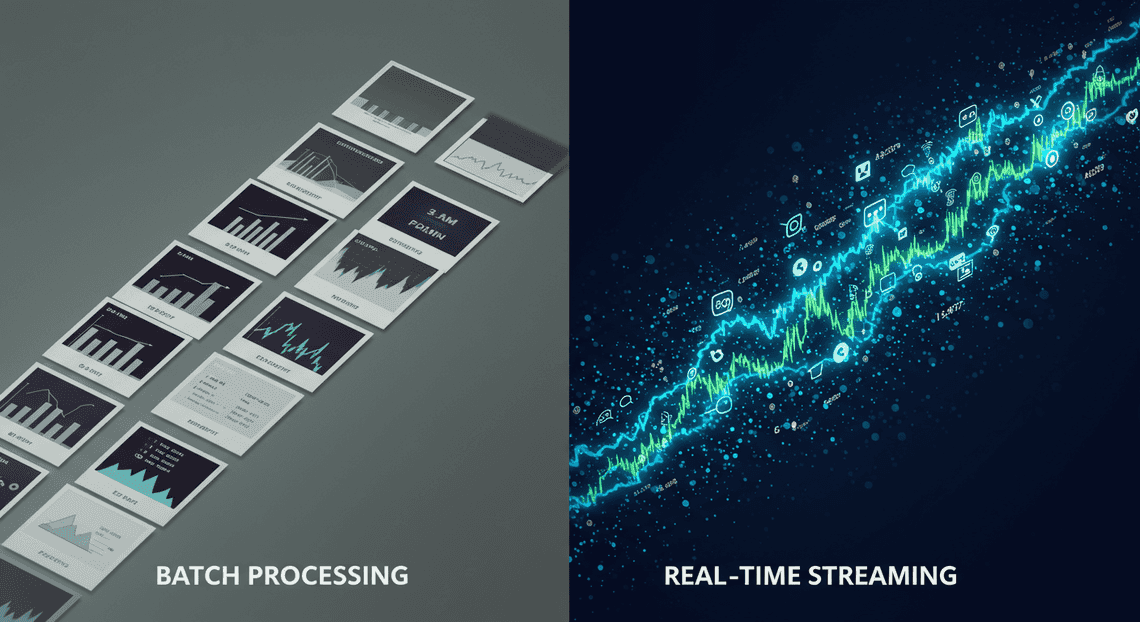
- Resource-Intensive Processing: Large, monolithic batch jobs are often resource-intensive, requiring significant compute power during off-peak hours. Scaling them to run more frequently is often cost-prohibitive and operationally complex.
In a world of instant transactions, real-time customer interactions, and dynamic supply chains, this rearview-mirror approach doesn’t just fall short—it actively creates a competitive disadvantage.
The High Cost of Stale Data in Critical Operations
The cost of data latency isn’t an abstract concept; it manifests as tangible losses across every business unit. Stale data isn’t just less valuable; it’s a liability. Consider the direct impact in a few critical domains:
-
E-commerce & Marketing: A potential customer adds a high-value item to their cart but hesitates. A real-time system can detect this “cart abandonment” signal within seconds and trigger a personalized incentive, like a free shipping offer, before the user navigates away. A batch system might send a follow-up email the next day, long after the customer has completed their purchase on a competitor’s site. The cost is lost revenue.
-
**Financial Services & Fraud Detection: A criminal uses stolen credentials to initiate a fraudulent transaction. An analytics system powered by real-time data can analyze the transaction’s attributes against historical patterns and block it before it’s processed. A batch-based system would only flag the anomaly in its nightly run, hours after the funds are irretrievably gone. The cost is direct financial loss and eroded customer trust.
-
Supply Chain & Logistics: A critical shipment is unexpectedly delayed at a port. A real-time monitoring system can instantly alert logistics managers, who can proactively re-route other dependent shipments and manage customer expectations. A system relying on stale data would report the delay the following morning, triggering a cascade of downstream failures, missed delivery windows, and frustrated customers. The cost is operational chaos and reputational damage.
-
IoT & Predictive Maintenance: A sensor on a manufacturing assembly line begins to show subtle deviations in its readings, a precursor to mechanical failure. A real-time streaming analytics platform can identify this pattern and trigger an immediate maintenance alert, allowing for a scheduled repair during a planned shutdown. A batch system would only process this data overnight, potentially after the machine has already suffered a catastrophic and costly breakdown. The cost is unplanned downtime and expensive repairs.
In each scenario, the value of the data decays exponentially with time. The insight is perishable, and the ability to act on it is the only thing that matters.
Shifting from Passive Reporting to Proactive Action
The fundamental flaw of latency-ridden data architectures is that they relegate data to a passive, historical role. They empower us to be excellent historians of our business, creating detailed reports on what has already transpired. We look at dashboards that tell us we lost a customer, missed a sales target, or suffered a system failure. This is passive reporting: analyzing the past to manually inform future strategy.
The modern imperative is to shift from this passive stance to one of proactive, intelligent action. The goal is no longer just to understand what happened but to influence what happens next. This requires a paradigm shift in both technology and mindset:
-
From Batch to Streaming: Data must be treated as a continuous stream of events to be processed and analyzed as they occur, not as static tables to be copied overnight.
-
From Dashboards to Triggers: While dashboards remain useful for high-level overviews, the primary output of a real-time system should be automated alerts, API calls, and programmatic triggers that initiate a business process.
-
From Human-in-the-Loop to Human-on-the-Loop: Instead of requiring a person to interpret a report and decide on an action, the system should be empowered to take the initial action automatically, with humans overseeing, refining, and managing the process at a strategic level.
This evolution moves us beyond Business Intelligence and into the realm of what we might call “Operational Intelligence.” The data platform ceases to be a mere system of record and becomes an active, participating agent in the business’s daily operations. The critical question is no longer, “What does the data from yesterday tell us?” but rather, “What is the data telling us to do, right now?”
Introducing the Agentic Data Cloud: A New Paradigm for Business Operations
For decades, the primary function of a data warehouse was to serve as a passive repository—a system of record for retrospective analysis. We moved from reporting to business intelligence, and then to predictive analytics. The data cloud, with platforms like Google BigQuery, unified storage and compute, making data more accessible and scalable than ever before. Yet, in most architectures, the data still waits for a human to ask the right question.
The next evolutionary leap is to invert this relationship. Instead of humans pulling insights from data, the data cloud will proactively push action into the business. This is the dawn of the Agentic Data Cloud, an architecture where the data platform itself becomes an active, intelligent participant in day-to-day operations. It’s a system designed not just for insight, but for autonomous, goal-driven action, powered by a new intelligence layer built directly into the data stack.
Defining the ‘Agentic’ Layer in Your Data Stack
At its core, an “agent” is an entity that can perceive its environment, reason about its observations, create a plan, and act to achieve specific goals. In the context of a data cloud, the agentic layer is an intelligent fabric, powered by foundation models like Gemini, that sits atop your data foundation in BigQuery.
This layer transforms your data platform from a passive database into a dynamic system with four key capabilities:
-
Sensing: The agent continuously monitors the state of the business as represented by the data flowing into BigQuery. This includes structured data (e.g., sales transactions, inventory levels), semi-structured data (e.g., application logs), and even unstructured data (e.g., customer support tickets, product reviews) that can be processed and understood by multimodal models.
-
**Reasoning: This is where Large Language Models (LLMs) are a game-changer. The agent doesn’t just see that a metric has changed; it uses its reasoning engine to understand the implications. It can correlate disparate datasets to hypothesize a root cause, predict second-order effects, and understand the context behind an anomaly. For example, it can connect a spike in web server latency (from logs) to a drop in conversion rates (from transaction data) and negative sentiment in social media feeds (from unstructured text).
-
Planning: Based on its reasoning, the agent formulates a multi-step plan to achieve a predefined business goal. This isn’t a simple, hardcoded workflow. It’s a dynamic strategy. Given an objective like “mitigate supply chain disruption,” the agent might devise a plan to: 1) Query logistics data to identify the affected SKUs, 2) Analyze sales data to predict the revenue impact, 3) Draft a notification for stakeholders, and 4) Suggest alternative suppliers by querying a vendor database.
-
Acting: The agent executes its plan by interacting with other systems via tools, which are typically APIs. It can execute a BigQuery SQL job for deeper analysis, call a Salesforce API to update a customer record, trigger a workflow in Google Cloud Workflows, or use a communications API to send a detailed alert to a Slack channel.
Think of your traditional data stack as a car’s dashboard—it provides critical information. The agentic layer is the advanced driver-assistance system that uses that information to proactively brake, adjust steering, and navigate toward a destination.
Core Principles: Proactive, Autonomous, and Goal-Driven
The agentic paradigm is defined by three core principles that distinguish it from previous data architectures.
-
**Proactive: The system doesn’t wait for a query. It actively monitors for opportunities and threats within the data streams. Instead of a daily report showing yesterday’s inventory levels, the agentic cloud predicts a potential stock-out for a high-demand product within the next 72 hours and initiates a re-supply workflow before a human even knows there’s a problem. It shifts the posture from reactive analysis to proactive operational intervention.
-
Autonomous: The agent can operate independently within carefully defined guardrails. It has the Supermarket Chain’s Site Redesign Boosts Online Sales And Market Share to select and use the right tools for the job. Faced with a sudden dip in user engagement, it might decide to first query performance logs, then analyze user behavior data, and finally run a diagnostic on a new feature release—all without direct human intervention for each step. This autonomy drastically reduces the latency between insight and action, allowing the business to operate at machine speed.
-
Goal-Driven: This is the most profound shift. You don’t give the agent a rigid script; you give it a high-level objective. For instance, instead of programming a rule like
IF churn_risk_score > 0.8, THEN send_email(), you assign the agent the goal of “Reduce customer churn.” The agent then uses its reasoning and planning capabilities to determine the best course of action based on the real-time context of a specific customer. It might decide an email is best for one customer, an in-app notification with a special offer for another, and a task for a human account manager for a third, constantly adapting its strategy to maximize the outcome.
How This Architecture Moves Beyond Simple [Automated Job Creation in Real Time Jobber and Google Sheets Integration from Gmail](https://votuduc.com/Automated-Job-Creation-in-Jobber-from-Gmail-p115606)
It’s crucial to distinguish the agentic approach from traditional Automated Quote Generation and Delivery System for Jobber. While both execute tasks, their underlying mechanics and capabilities are fundamentally different.
| Characteristic | Simple Automated Work Order Processing for UPS (e.g., ETL scripts, IFTTT) | Agentic System (e.g., Gemini on BigQuery) |
| :--- | :--- | :--- |
| Logic | Rigid, predefined IF-THEN-ELSE rules. | Flexible, context-aware reasoning and planning. |
| Triggers | Static and pre-programmed. | Dynamic, based on complex pattern recognition and prediction. |
| Adaptability | Brittle. Fails or produces incorrect results when conditions deviate from the script. | Resilient. Can adapt its plan in response to errors or changing environmental data. |
| Context | Lacks situational awareness. Executes a task without understanding the “why”. | Deeply contextual. Understands unstructured text, infers intent, and synthesizes data from multiple sources. |
| Orientation | Task-Oriented: “When this event occurs, run this specific script.” | Goal-Oriented: “Achieve this business outcome, and figure out the best steps to get there.” |
Consider a practical example: handling a payment failure.
-
Simple Automation:
IF payment_fails, THEN send email_template_#3.This system is brittle. It treats all failures the same and cannot adapt if the template becomes outdated or ineffective. -
Agentic System: The goal is “Maximize successful payment recoveries.” When a payment fails, the agent acts:
-
Senses & Reasons: It calls the payment gateway API to get the specific decline code. Is it a hard decline (
Invalid Card) or a soft decline (Insufficient Funds)? -
Plans: If it’s a soft decline, it queries the customer’s account history in BigQuery. Is this a high-value customer? The plan becomes: “Wait 24 hours and trigger a smart retry. If that fails, send a personalized SMS.”
-
Acts: If it’s a hard decline, the plan is different: “Immediately lock the account from further charges, draft a contextual email referencing the customer’s most-used premium feature, and create a task in the CRM for follow-up.”
This architecture moves beyond simply executing pre-written code. It creates a system that can reason, strategize, and act, turning your data cloud from a cost center for storage and analysis into a revenue-driving engine for real-time, intelligent operations.
Architectural Blueprint: Triggering Actions from BigQuery Data Streams
To transform the Agentic Data Cloud from a concept into a working reality, we need a robust, scalable, and Architecting an Event-Driven Workspace with PubSub Firebase and Gemini. This blueprint outlines a serverless, real-time pipeline on Google Cloud that connects data streams in BigQuery directly to intelligent, automated business actions powered by Gemini. This isn’t just about analytics; it’s about creating a closed-loop system where data reflexively triggers operational responses.
The architecture is composed of four distinct but interconnected layers: a real-time data foundation, a reactive nerve center, an intelligent decision-making core, and a pragmatic action layer. Let’s dissect each component.
Foundation: Capturing Real-Time Events in BigQuery
The entire process begins with data in motion. The foundation of our agentic system is BigQuery’s ability to act not just as a historical data warehouse, but as a real-time sink for streaming events. The key technology here is the BigQuery Storage Write API.
Unlike traditional batch loading, the Storage Write API provides a high-throughput, low-latency gRPC interface designed for capturing massive volumes of data as it’s generated. It offers several critical advantages for our real-time architecture:
-
Exactly-once semantics: Guarantees that each event is written precisely one time, preventing data duplication and ensuring the integrity of our triggers.
-
Stream-level transactions: Allows for atomic commits of batches of records, maintaining consistency even in high-volume scenarios.
-
Schema evolution: Supports non-breaking schema updates on the fly, allowing your data structures to evolve without pipeline downtime.
In this model, events—whether they are IoT sensor readings, user clickstream data from a web app, or financial transaction logs—are streamed directly into a dedicated BigQuery table. This table becomes the canonical, real-time log of business activity, serving as the single source of truth for all subsequent actions.
-- Example: A simple table for capturing real-time transactions

CREATE TABLE my_dataset.transactions (

transaction_id STRING NOT NULL,

customer_id STRING,

amount NUMERIC,

timestamp TIMESTAMP NOT NULL,

status STRING,

ingestion_time TIMESTAMP DEFAULT CURRENT_TIMESTAMP()

);
The Nerve Center: Using GCP Pub/Sub to Detect Changes
With data flowing into BigQuery, the next challenge is to detect meaningful changes instantly. Polling the table with queries is inefficient, costly, and introduces latency. The solution is to make the data warehouse itself proactive.
This is achieved by leveraging BigQuery’s native Change Data Capture (CDC) functionality, which integrates directly with Google Cloud Pub/Sub. When you enable CDC on a BigQuery table, any row-level mutation (INSERT, UPDATE, DELETE) is automatically and immediately published as a message to a specified Pub/Sub topic.
This transforms BigQuery from a passive repository into an active event source. Pub/Sub acts as the central nervous system of our architecture: a highly scalable, durable, and fully managed messaging service that decouples the data source from the downstream processors.
Configuring this is straightforward. You alter your BigQuery table to enable CDC and point it to a Pub/Sub topic.
-- Enable CDC on the transactions table

ALTER TABLE my_dataset.transactions

SET OPTIONS (

change_data_capture = (

pubsub_topic = 'projects/your-gcp-project/topics/bq-transaction-changes'

)

);
Each message published to the topic contains a rich JSON payload with metadata about the change (e.g., change_type, table_id) and the full row data before and after the modification. This provides all the necessary context for our intelligence layer to make an informed decision.
The Intelligence Core: Applying Gemini Enterprise for Decision Logic
Once a change event is captured in Pub/Sub, it needs to be processed. A serverless component, such as a Cloud Function or Cloud Run service, subscribes to the Pub/Sub topic. This service acts as the host for our “agent”—the logic that decides what to do next. This is where Gemini Enterprise comes into play.
Upon receiving a Pub/Sub message, the function executes the following steps:
-
Parse the Event: It deserializes the JSON payload from the message to understand what changed. For an
INSERTinto ourtransactionstable, it extracts thetransaction_id,customer_id,amount, etc. -
Enrich the Context (Optional): For more sophisticated decisions, the function can perform a quick lookup in BigQuery to gather historical context. For example, it might query for the customer’s average transaction value or recent activity patterns.
-
Formulate a Prompt for Gemini: This is the critical step. The function constructs a detailed prompt for a Gemini model (e.g., Gemini 1.5 Pro) via the [Building Self Correcting Agentic Workflows with Building Self-Correcting Agentic Workflows with Vertex AI](https://votuduc.com/building-self-correcting-agentic-workflows-with-vertex-ai-p-20260321542526) API. This prompt combines the real-time event data, any enriched historical context, and a clear instruction set defining the desired decision and output format.
-
Invoke Gemini and Get a Decision: The function sends the prompt to the Gemini API and awaits a structured response. By instructing Gemini to respond in JSON, we create a predictable, machine-readable contract for the next layer.
Here is a conceptual example of a prompt and the expected Gemini response:
// --- Example Prompt Sent to Gemini ---

{

"contents": [

{

"role": "user",

"parts": [

{

"text": "You are a fraud detection agent for an e-commerce platform. A new transaction has occurred. Based on the transaction data and customer history, determine the risk level and recommend a next action. Provide your response ONLY in JSON format with the keys 'risk_level' (Low, Medium, High), 'reasoning' (a brief explanation), and 'recommended_action' (APPROVE, REVIEW, BLOCK). \n\n**Transaction Data:**\n- transaction_id: 'txn_12345'\n- customer_id: 'cust_abcde'\n- amount: 950.75\n- currency: 'USD'\n\n**Customer History:**\n- average_transaction_value: 75.50\n- transactions_last_24h: 12\n- country: 'USA'\n- last_login_country: 'Romania'"

}

]

}

],

"generation_config": {

"response_mime_type": "application/json"

}

}

// --- Example JSON Response from Gemini ---

{

"risk_level": "High",

"reasoning": "Transaction amount is over 10x the customer's average. The high number of recent transactions combined with a geographic mismatch between customer country and login country is highly indicative of account takeover.",

"recommended_action": "BLOCK"

}
The Action Layer: Executing Business Processes via APIs
The final step is to translate Gemini’s intelligent decision into a tangible business outcome. The same Cloud Function that invoked Gemini now parses its structured JSON response and executes the recommended_action.
This layer is all about integration. The function acts as an orchestration hub, making API calls to the appropriate downstream systems based on the decision:
-
"recommended_action": "BLOCK": The function calls an internal microservice API endpoint, likePOST /api/v1/payments/block-card, passing thecustomer_id. -
"recommended_action": "REVIEW": It could call the Zendesk or Jira API to create a new support ticket for manual review by a human agent, populating the ticket with the transaction details and Gemini’s reasoning. -
"recommended_action": "APPROVE": It might do nothing, or it could call an internal logging service to record the successful, automated approval. It could even trigger a subsequent API call to a shipping or fulfillment system.
This API-driven approach ensures that the action layer is decoupled, flexible, and extensible. You can easily add new actions by simply updating the logic in the Cloud Function to call different APIs, without having to re-architect the entire flow from the data source. This completes the loop, creating a fully automated, agentic system that senses changes in its data environment and acts upon them in near real-time.
Use Case in Action: Real-Time Supply Chain Optimization
Theoretical discussions of agentic systems are useful, but their true value is realized in practical, high-impact scenarios. Let’s walk through a tangible example of how an agentic data cloud, powered by BigQuery’s real-time capabilities and Gemini’s reasoning engine, can prevent a costly stock-out scenario for a large electronics retailer, moving from reactive problem-solving to proactive, automated optimization.
Scenario: Detecting a Critical Drop in Inventory Levels
The process begins with data in motion. Our retailer continuously streams operational data into BigQuery from multiple sources:
-
Point-of-Sale (POS) Systems: Every transaction from every physical store.
-
E-commerce Platform: Real-time web and app sales data.
-
Warehouse Management System (WMS): Inventory movements, receipts, and cycle counts from distribution centers.
Within BigQuery, a materialized view constantly calculates the current inventory-on-hand for high-velocity products against their defined safety stock levels. A scheduled query, running every five minutes, monitors this view for any product that breaches its threshold.
At 2:15 PM, the system flags an event:
-
Product:
SKU-9A4B8C(a newly released, popular gaming console) -
Location:
DC-US-WEST -
Status: Inventory has dropped to 110 units, below the safety threshold of 150 units.
This event isn’t just a row in a table; it’s a trigger. A Cloud Function, subscribed to alerts from this monitoring query, is immediately invoked. This function’s sole purpose is to package this context and activate our supply chain agent.
Agentic Analysis: Gemini Assesses Sales Velocity and Supplier Data
The triggered Cloud Function invokes a Vertex AI agent powered by Gemini. The agent receives the initial context: {"sku": "SKU-9A4B8C", "location": "DC-US-WEST", "event": "INVENTORY_BELOW_THRESHOLD"}.
Instead of following a rigid, pre-programmed workflow, the agent begins a reasoning process, using a suite of tools that allow it to interact with the data cloud.
-
Assess Urgency and Demand: The agent’s first step is to understand the severity of the situation. It uses its
bigquery_toolto formulate and execute a SQL query against the sales data. It’s not just looking at the current level; it’s analyzing the trend. The query calculates the sales velocity over the last 72 hours, comparing it to the 30-day average. The result: sales forSKU-9A4B8Chave spiked by 200% in the last three days, likely due to a new influencer marketing campaign. The current inventory won’t last another 24 hours. -
Evaluate Sourcing Options: The problem is urgent. The agent now queries the
supplier_mastertable in BigQuery to find replenishment options. It retrieves data on two potential suppliers for this SKU:
-
Supplier A (Global Components): Standard lead time of 7 days, cost of $450/unit, historically 98% on-time delivery.
-
Supplier B (Express Electronics): Expedited lead time of 2 days, cost of $485/unit, historically 95% on-time delivery.
- Check Inbound Logistics: Before acting, the agent performs a final check. It queries the
inbound_shipmentstable to see if a replenishment order is already in transit toDC-US-WEST. The query returns an empty result set. No help is on the way.
Gemini synthesizes these disparate data points into a coherent conclusion: A severe stock-out is imminent due to an unforeseen demand spike. The standard supplier cannot meet the immediate need. The premium for the expedited supplier is justified to prevent significant lost revenue and customer dissatisfaction.
Automated Outcome: Triggering a Purchase Order and Alerting Logistics
With a clear strategy formulated, the agent moves from analysis to action.
- Trigger Purchase Order: The agent uses its
erp_api_tool. It calculates the required order quantity based on the new sales velocity, desired safety stock, and the 2-day lead time. It then constructs a JSON payload and makes a secure API call to the company’s ERP system to create a new purchase order.
{

"supplierId": "EE-459",

"sku": "SKU-9A4B8C",

"quantity": 500,

"destination": "DC-US-WEST",

"shippingMethod": "EXPEDITED_AIR",

"chargeCode": "MK-784-URGENT"

}
- Alert Human Stakeholders: The agent understands that automation requires communication. It doesn’t just execute the order silently. It uses a
notifications_toolto perform two simultaneous actions:
-
It sends a message to the
#logistics-west-alertsSlack channel: “ACTION: Critical low inventory forSKU-9A4B8CatDC-US-WESTdue to 200% sales spike. Auto-generated expedited PO #E-10872 from Express Electronics for 500 units. ETA: 48 hours. Please confirm receiving dock availability.” -
It updates a central BigQuery monitoring table with a log of its actions, analysis, and the resulting PO number, creating a fully auditable trail of the automated decision.
In under a minute, the system has moved from detecting a subtle data pattern to executing a complex business decision, involving multi-faceted data analysis and integration with external systems. This is the power of an agentic data cloud: transforming a potential crisis into a seamless, optimized, and fully autonomous operational response.
Strategic Advantages for Data Architects and BI Leaders
For those of us architecting the data-driven enterprise, the fusion of a real-time analytical engine like BigQuery with a powerful reasoning engine like Gemini isn’t just an incremental upgrade; it represents a fundamental paradigm shift. It’s the transition from a passive, historical reporting system to an active, operational nervous system for the business. This move unlocks strategic capabilities that directly address the most persistent challenges in our field: closing the gap between insight and action, justifying data platform ROI, and building resilient, future-proof systems.
Drastically Reducing Time-to-Action from Hours to Seconds
The traditional analytics workflow is a study in latency. Data lands, batch ETL jobs run, dashboards refresh, an analyst notices a trend, investigates, builds a report, and finally, a business stakeholder makes a decision. This human-in-the-loop process, even when highly optimized, measures its “time-to-action” in hours or days. The opportunity cost of this delay is immense, especially in fast-moving domains like fraud detection, supply chain logistics, or programmatic marketing.
The agentic data cloud architecture collapses this timeline. Consider the new flow:
-
Event Ingestion (Milliseconds): Streaming data from application logs, IoT sensors, or clickstreams lands directly in BigQuery via services like Pub/Sub. The data is available for query instantly.
-
In-Situ Analysis & Reasoning (Seconds): A scheduled query or event-triggered function invokes a Gemini model directly within BigQuery using
ML.GENERATE_TEXT. The model doesn’t just identify an anomaly; it interprets its business context, assesses its urgency, and determines the optimal next step based on its training and the real-time data. -
Automated Action (Seconds): Based on the model’s output, a Cloud Function is triggered. This function executes a precise, pre-defined action: updating a CRM record, placing an inventory hold, adjusting a digital ad bid, or alerting a specific on-call engineer via a rich, context-aware notification.
This entire event-to-action loop is completed in seconds, without direct human intervention. The role of the data team shifts from being reactive report builders to proactive architects of autonomous processes. We move from answering “What happened?” to building systems that answer “What should we do now?” and then actually do it.
Maximizing Data ROI by Connecting Analytics Directly to Operations
For years, BI and data leaders have struggled with the “last mile” problem. We build powerful, expensive data platforms, yet the value is often trapped in dashboards. The return on investment is indirect, hinging on whether a human interprets the data correctly and acts on it in a timely manner. This makes proving the direct business impact of our data initiatives a perpetual challenge.
An agentic architecture solves the ROI equation by making the data platform an active participant in operational workflows. The insights generated within BigQuery are no longer just informational assets; they become direct triggers for business value.
-
From Passive Insight to Active Intervention: Instead of a dashboard showing a potential customer churn risk, the system automatically triggers a personalized retention offer through the marketing automation platform. The value is no longer the insight itself, but the prevented churn.
-
From Manual Process to Intelligent Automation: Instead of an analyst manually reviewing a list of potentially fraudulent transactions, a Gemini agent performs the initial investigation, enriches the data with customer history and transaction patterns, and either automatically clears low-risk events or escalates high-risk ones with a complete, machine-generated summary. The value is measured in reduced fraud losses and radically improved operational efficiency.
-
From Reactive Reporting to Proactive Optimization: Instead of a logistics manager seeing a report on a potential supply chain disruption, the system proactively re-routes shipments, adjusts inventory levels in downstream warehouses, and notifies affected customers—all before the disruption becomes a critical failure.
By closing the loop between analytics and operations, every query and every model has the potential to generate direct, measurable business outcomes. The data warehouse ceases to be a cost center for reporting and becomes a profit center for intelligent automation.
Building a Scalable Future-Proof Architecture for Autonomous Business
Designing an architecture that meets today’s needs without becoming tomorrow’s technical debt is the core challenge for any data architect. The agentic model built on Google Cloud provides a blueprint for a resilient, scalable, and adaptable future.
The architectural elegance lies in its composition of serverless, managed components:
-
Scalability by Default: BigQuery, Cloud Functions, and Vertex AI are serverless. They scale transparently from zero to millions of events per second without any infrastructure provisioning or management. This elastic scalability is essential for building systems that can handle the unpredictable, spiky nature of real-time business events.
-
Decoupled and Extensible: The core components—data storage (BigQuery), intelligence (Gemini), and action (Cloud Functions)—are loosely coupled. This allows you to evolve each part independently. You can add new data sources, upgrade to more powerful models, or integrate with new operational systems via their APIs without re-architecting the entire stack. An agent that sends an email today can be enhanced to manage a complex workflow across Salesforce and SAP tomorrow.
-
AI at the Core, Not the Edge: This architecture places reasoning and intelligence at the heart of the data platform, not as an afterthought or a separate application. By integrating Gemini directly with the data, you create a foundation that is inherently cognitive. As foundation models become more capable, the intelligence of your entire business system can be upgraded centrally. You are not just building a data pipeline; you are building a cognitive engine that learns and grows with the business.
This approach allows you to move beyond building systems of record to building systems of intelligence. It’s an architecture designed for an autonomous future, where business processes can increasingly sense, reason, and act on their own, freeing up human capital to focus on strategy, creativity, and exception handling—the things humans do best.
Activate Your Data Architecture
The preceding sections have laid the groundwork, moving from theoretical concepts to tangible architectural patterns. We’ve explored how to ingest streaming data into BigQuery and how to configure Gemini to reason over that data. Now, we arrive at the most critical phase: activation. This is where your data platform transcends its role as a passive repository of historical facts and evolves into an active, intelligent engine that drives real-time business outcomes. It’s time to connect the components and ignite the agentic workflow.
Recap: The Power of an Agentic Real-Time Framework
Let’s distill the architecture we’ve built into its core principles. At its heart, this framework is a powerful symbiosis between three key pillars:
-
The Unified Data Brain (BigQuery): Your foundation is a serverless, highly scalable data cloud that unifies streaming and batch data. BigQuery isn’t just a warehouse; it’s the source of truth and the long-term memory for your agentic system. Its ability to perform low-latency analytics on petabytes of fresh data is the fuel that powers intelligent decision-making.
-
The Reasoning Engine (Gemini): Layered on top of this data foundation is Gemini, acting as the central nervous system. Through sophisticated function calling and its advanced reasoning capabilities, Gemini interprets complex situations presented by the data. It’s not merely executing pre-programmed
IF-THEN-ELSElogic; it’s understanding context, evaluating options, and formulating a plan of action based on the goals you define. -
The Action Framework (Cloud Functions & APIs): This is the agent’s connection to the real world—its hands and feet. By granting Gemini access to a curated set of tools (APIs exposed via secure endpoints like Cloud Functions), you empower it to do more than just provide an answer. It can update a CRM, adjust a bid in an ad platform, dispatch a technician, or send a personalized notification.
When combined, these pillars transform the traditional data flow of Data In -> Analysis Out into a dynamic, closed-loop system: Real-Time Signal -> Agentic Reasoning -> Automated Action -> Feedback to System. You’ve effectively built a cognitive loop that allows your business to sense, understand, and act at machine speed.
Your Next Step Towards Intelligent Automation
Moving from this blueprint to a production-ready agent requires a strategic approach. The goal is not to automate everything at once, but to build momentum by delivering value on a well-defined, high-impact use case. Here’s how to begin your journey.
1. Identify Your “Moment of Action”:
Start by pinpointing a critical business process where speed and data-driven context are paramount. Don’t begin with the most complex problem. Look for a “moment of action” with clear triggers and desired outcomes. Good candidates include:
-
Logistics: A shipment is delayed beyond a certain threshold (
trigger), so the agent proactively notifies the customer and re-calculates the ETA (action). -
E-commerce: A product’s inventory level drops below a critical point while its view count is trending up (
trigger), so the agent initiates a re-order request and alerts the marketing team (action). -
Security: A pattern of anomalous API calls is detected from a specific IP range (
trigger), so the agent temporarily throttles access from that range and creates a high-priority security ticket with all relevant data (action).
2. Define the Agent’s Toolkit and Boundaries:
Once you have a use case, define the specific tools (APIs) the agent is allowed to use. This is the most critical step for control and security. For each tool, you must clearly define its purpose, its parameters, and its potential impact. Start with read-only tools to observe the agent’s reasoning before granting it permissions to execute state-changing actions. This “scaffolding” of permissions creates a safe sandbox for the agent to operate within.
3. Craft the Master Prompt (The Agent’s Constitution):
The system prompt is your agent’s constitution. It’s where you define its purpose, its personality, its constraints, and its primary directives. A well-crafted prompt guides the agent’s reasoning process, instructing it on how to handle ambiguity, when to ask for clarification (if applicable), and how to prioritize tasks. This is not a one-time setup; consider your master prompt a living document that you will refine as you observe the agent’s performance.
By starting with a focused use case, carefully curating the agent’s tools, and thoughtfully defining its core directives, you create a clear path to value. You are not just building another data pipeline; you are architecting an autonomous system that learns from and acts upon your most valuable asset—your data. This is the future of the data cloud: active, intelligent, and agentic.


Stop Doing Manual Work. Scale with AI.
Want to turn these blog concepts into production-ready reality for your team?
Table Of Contents
Portfolios
Related Posts
Quick Links
Legal Stuff