

Automate Hospital Meeting Minutes with Gemini AI and Google Sheets


Outdated, manual note-taking in hospital committee meetings isn’t just inefficient—it’s a critical bottleneck that threatens patient care and regulatory compliance. Discover why modernizing this siloed workflow is essential for safeguarding your healthcare organization’s operational agility.

The Challenge of Managing Hospital Committee Meetings
Healthcare organizations operate through a complex web of mission-critical committees—from Infection Control and Quality Assurance to Pharmacy and Therapeutics. These meetings serve as the nerve centers of hospital governance, where high-stakes decisions impacting patient care, regulatory compliance, and operational efficiency are made. However, capturing the essence of these discussions and translating them into actionable data is notoriously difficult.
The traditional approach to managing hospital meeting minutes usually relies on a designated note-taker frantically typing out summaries, which are later polished and circulated via email. In a fast-paced clinical environment, this outdated, siloed workflow is not just inefficient; it is a critical bottleneck that stifles operational agility and creates systemic vulnerabilities. When you are dealing with life-saving protocols and strict healthcare regulations, treating meeting minutes as static text documents is a recipe for operational failure.
Why Accountability Slips Through the Cracks
In any given hospital committee meeting, dozens of action items are generated at a rapid pace. The Chief Medical Officer might need to review a new triage protocol, while the IT Director is tasked with auditing Electronic Medical Record (EMR) access logs by Friday. When these critical tasks are buried deep within a multi-page text document or a lengthy email thread, accountability inevitably suffers.
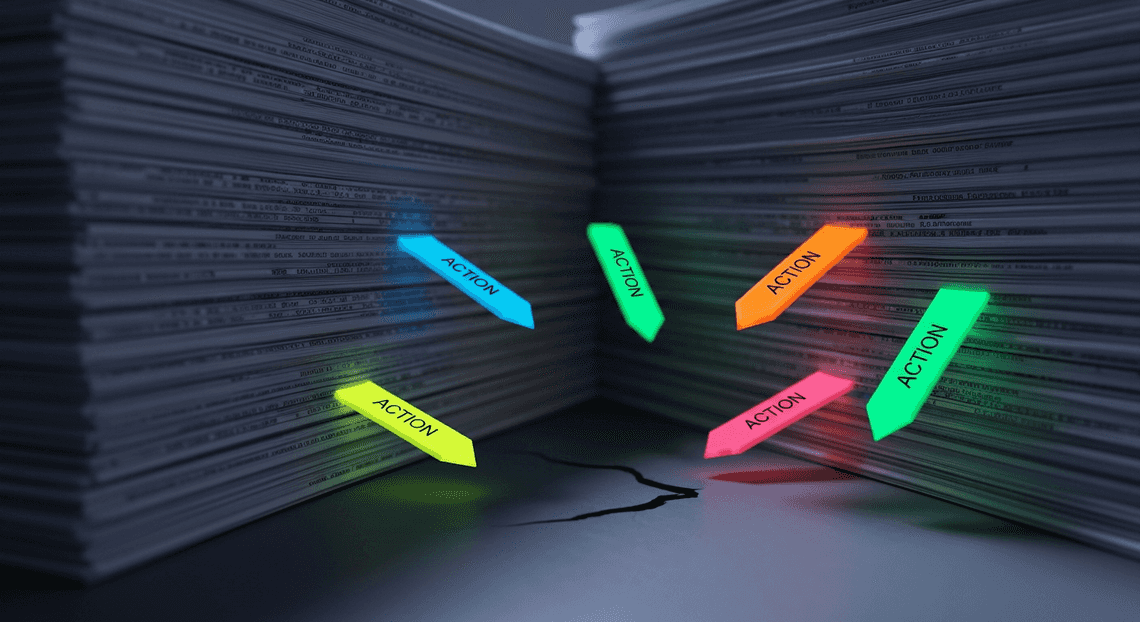
Without a structured system to extract, assign, and track these action items, follow-ups rely entirely on human memory and manual check-ins. Tasks slip past deadlines, ownership becomes ambiguous, and the momentum generated during the meeting quickly dissipates. The disconnect between discussing an initiative in the boardroom and actually executing it on the hospital floor can almost always be traced back to this lack of actionable, trackable documentation. When action items are not immediately isolated and assigned, “Who is doing what by when?” becomes a guessing game rather than a guarantee.
The Hidden Costs of Manual Minute Tracking
The financial and operational toll of manual minute-taking extends far beyond the scheduled hour of the meeting. The most immediate hidden cost is the drain on human capital. Highly skilled professionals—often clinical leads, department heads, or specialized administrators—spend hours transcribing, formatting, and distributing notes. This is valuable time that should be spent on patient care, staff development, or strategic planning.
Furthermore, there is a significant compliance risk. Hospitals are heavily regulated environments, and accrediting bodies (like the Joint Commission) frequently request historical meeting minutes to verify that safety protocols and governance standards are actively upheld. Inaccurate, delayed, or poorly archived minutes can lead to severe compliance violations and failed audits.
Finally, there is the cost of delayed decision-making. If it takes three days for an administrator to finalize and share the meeting notes, that is three days lost in implementing critical hospital policies. This administrative lag is a silent drain on hospital resources, highlighting the urgent need for a modern, automated intervention that can transform unstructured conversations into structured, actionable data instantly.
A Proactive Solution for Hospital Administrators
Hospital administrators are the operational backbone of healthcare facilities, often caught in a relentless cycle of committee meetings, departmental syncs, and board reviews. Traditionally, documenting these critical discussions requires hours of manual transcription and synthesis, creating an administrative bottleneck that delays decision-making. By leveraging the power of Google Cloud and Automatically create new folders in Google Drive, generate templates in new folders, fill out text automatically in new files, and save info in Google Sheets, we can architect a fundamentally proactive solution. Integrating Gemini AI with Google Sheets transforms static audio or raw transcripts into dynamic, structured datasets. This isn’t just about saving administrative time; it’s about shifting from reactive documentation to proactive operational intelligence, ensuring that critical healthcare decisions are captured, tracked, and executed with precision.
Introducing Automated Categorization
In a typical hospital management meeting, the conversation shifts rapidly—from clinical compliance and staffing shortages to equipment procurement and patient safety protocols. Manually sorting these topics is tedious and highly susceptible to human error. Enter Gemini AI. By utilizing Gemini’s advanced natural language understanding capabilities via the Building Self Correcting Agentic Workflows with Vertex AI API, we can programmatically ingest meeting transcripts and apply zero-shot or few-shot prompting to classify the text into predefined healthcare domains.
Through a seamless AI Powered Cover Letter Automation Engine integration, the AI processes the raw text and automatically populates specific columns in a Google Sheet based on these categories. For instance, discussions around “ICU ventilator maintenance” are instantly tagged under Equipment & Facilities, while “nurse shift rotations” automatically fall under Human Resources. This automated categorization allows hospital leadership to filter, query, and visualize departmental focus areas in real-time, turning a monolithic text document into a highly organized, searchable database.
Extracting Action Items Instantly with AI
Categorizing the discussion is only half the battle; the true operational value lies in execution. In a healthcare environment, missed follow-ups can lead to compliance violations or, worse, compromised patient care. Gemini AI excels at contextual extraction, allowing us to parse complex, multi-speaker meeting narratives and isolate specific commitments.
Using targeted Prompt Engineering for Reliable Autonomous Workspace Agents, the AI is instructed to identify the “Who, What, and When” buried within the transcript. It instantly extracts action items, infers task owners based on the conversational context, and determines deadlines. This structured data is then routed directly into our Google Sheets tracker. Because this architecture operates natively within the AC2F Streamline Your Google Drive Workflow ecosystem, it can be extended effortlessly. A simple Apps Script trigger can detect a newly extracted action item in the Sheet and automatically generate a Google Task for the assigned physician, or send a targeted Gmail notification to a department head. This ensures that critical tasks—like updating a triage protocol or auditing pharmacy inventory—are immediately actionable, fostering a culture of strict accountability and rapid response.
The Technology Stack Powering the Automation
Building a resilient and compliant automation pipeline for healthcare administration requires a robust set of tools. By leveraging the native interoperability of the Google Cloud and Automated Client Onboarding with Google Forms and Google Drive. ecosystems, we can create a seamless workflow that transforms unstructured meeting audio or transcripts into actionable, structured data. Let’s break down the core components of this architecture.
Google Drive for Secure Document Storage
In a hospital environment, data security and compliance—such as adhering to HIPAA regulations—are non-negotiable. Google Drive serves as the secure ingestion point and repository for our meeting assets. When a raw audio recording or a raw transcript from a department sync, board meeting, or patient care committee is dropped into a designated Drive folder, it acts as the catalyst for the entire automation workflow.
Using Automated Discount Code Management System’s robust access control lists (ACLs) and enterprise-grade encryption (both at rest and in transit), hospital administrators can ensure that sensitive discussions remain strictly confidential. Furthermore, Drive’s seamless API integration allows our cloud-based backend services or Genesis Engine AI Powered Content to Video Production Pipeline triggers to automatically detect new files, securely fetch them, and initiate the AI processing pipeline without any manual intervention.
Gemini AI for Intelligent Processing
The brain of this automation pipeline is Google’s Gemini AI. Traditional transcription tools simply convert speech to text, but hospital meeting minutes require deep contextual understanding to identify complex medical terminology, critical patient care decisions, and specific staff assignments. Gemini excels in this arena due to its advanced reasoning capabilities and massive context window.
By passing the meeting transcript—or directly processing the audio using Gemini’s multimodal capabilities—through a carefully engineered prompt, the Large Language Model (LLM) acts as an expert medical scribe. It parses the unstructured dialogue, filters out the conversational noise, and intelligently extracts key deliverables. It identifies exactly who needs to do what, by when, and captures the clinical or administrative context behind the decision. This allows the system to transform a dense, hour-long cardiology department meeting into a concise, highly structured JSON payload ready for downstream routing.
Google Sheets for Centralized Task Management
Once Gemini AI has distilled the meeting into structured data, that information needs a highly accessible, collaborative home. Google Sheets acts as our centralized task management dashboard, bridging the gap between complex cloud automation and everyday hospital operations.
Using Architecting Multi Tenant AI Workflows in Google Apps Script or the Google Sheets API, the extracted action items, task owners, deadlines, and summary notes are automatically appended to a designated tracking spreadsheet. This provides medical staff, department heads, and hospital administrators with a real-time, collaborative view of pending tasks. We can further enhance this dashboard by utilizing Sheets’ native features: conditional formatting to highlight overdue compliance tasks, data validation for status updates, and Apps Script triggers to send automated Gmail reminders to doctors and nurses. By utilizing Google Sheets as the frontend interface, we keep the learning curve practically nonexistent for healthcare professionals while maintaining a powerful, automated backend.
Step by Step Workflow to Automate Meeting Minutes
To turn static hospital meeting minutes into actionable, trackable data, we need a robust, event-driven architecture. By combining Automated Email Journey with Google Sheets and Google Analytics APIs with the analytical power of Google’s Gemini models, we can build a seamless pipeline that requires zero manual intervention. Here is the step-by-step breakdown of how this automation engine operates under the hood.
Scanning the Minutes Folder Automatically
The first link in our automation chain is detecting when new meeting minutes are available. Hospital staff shouldn’t have to manually click a button to trigger a script; the system should work invisibly in the background.
Using Google Apps Script (or a Google Cloud Function paired with Eventarc and Pub/Sub for larger, enterprise-scale deployments), we can set up a time-driven trigger that routinely scans a designated “Meeting Minutes” Google Drive folder.
When a new Google Doc, text file, or PDF is dropped into this folder—whether it’s from the oncology tumor board, the ER shift handover, or a hospital administration meeting—the script identifies it. To ensure idempotency and prevent duplicate processing, the workflow utilizes Google Drive file metadata. Once a file is successfully read, the script either tags it with a custom Drive property (e.g., processed: true) or automatically moves it to an “Archived” subfolder, ensuring only fresh documents are picked up in the next execution cycle.
Processing Decisions and Tasks with Gemini
Once a new document is detected, the script extracts its raw text and hands it over to the brain of our operation: the Gemini API. This is where traditional regex parsing falls short, and advanced generative AI shines.
We send the meeting transcript to Gemini (leveraging a model like Gemini 1.5 Flash for speed, or Gemini 1.5 Pro if the minutes are exceptionally long and require a massive context window) along with a highly engineered system prompt. Because we are operating in a healthcare administration context, accuracy and role-definition are paramount. The prompt instructs Gemini to act as a meticulous clinical administrative assistant, parsing the unstructured text to identify key entities:
-
Key Decisions: What clinical or administrative policies were agreed upon?
-
Action Items: What specific tasks need to be executed?
-
Assignees: Who is responsible (e.g., “Dr. Smith”, “Pharmacy Dept”, “Head Nurse Davis”)?
-
Deadlines: When is the task due?
Crucially, we enforce JSON structured output in our API request payload. By configuring the responseMimeType to application/json and providing a strict schema, we force Gemini to return the extracted data as a clean, predictable JSON array. This eliminates the unpredictability of conversational AI responses and ensures the data is perfectly formatted for programmatic handling.
Syncing Data to Your Task Manager Sheet
The final step bridges the gap between AI analysis and human execution. With our cleanly parsed JSON data in hand, the script utilizes the Google Sheets API (or the native SpreadsheetApp service if you are building entirely within Apps Script) to route the information into a centralized Task Manager Sheet.
The script iterates through the JSON array and appends a new row for every individual action item or decision extracted by Gemini. Columns are automatically populated with the meeting date, department, specific task description, assigned personnel, and deadline.
Because we are engineering a complete solution, the script doesn’t just dump raw text. It maps the data to specific columns and can even apply data validation rules upon insertion—such as setting a default “Not Started” status dropdown for new rows. You can pair this with native Google Sheets conditional formatting to automatically highlight urgent tasks or overdue deadlines in red. The result is a dynamic, real-time database where hospital administrators can track compliance, follow-ups, and operational bottlenecks without ever having to read through pages of dense meeting transcripts.
Scale Your Hospital Architecture Today
Automating meeting minutes with Gemini AI and Google Sheets is just the tip of the iceberg. True digital transformation in healthcare requires a robust, scalable, and secure infrastructure. By leveraging the full power of Google Cloud Platform (GCP) and Automated Google Slides Generation with Text Replacement, hospitals can move beyond isolated automation scripts to enterprise-grade, event-driven architectures.
Whether it is deploying serverless Cloud Functions to process real-time HL7 data streams, utilizing Vertex AI for predictive patient analytics, or securing document pipelines with Cloud IAM, the ultimate goal is to create a cohesive, intelligent ecosystem. Google’s secure-by-design infrastructure ensures that as your administrative and clinical workloads scale, your compliance with stringent healthcare data regulations—such as HIPAA—remains completely uncompromised. Scaling your architecture means building a foundation where AI-driven automation operates seamlessly in the background, allowing medical professionals to focus entirely on patient care.
Audit Your Current Administrative Workflows
Before deploying advanced machine learning models or overhauling your cloud architecture, you must understand your operational baseline. Start by conducting a comprehensive audit of your current administrative workflows. Where are your medical staff and hospital administrators spending the most time on non-clinical, repetitive tasks?
To effectively audit your systems, focus on the following key areas:
-
Identify Data Bottlenecks: Are nursing shift handovers delayed by manual transcription? Are critical hospital board meeting decisions getting lost in siloed email threads instead of being automatically tracked in Automated Order Processing Wordpress to Gmail to Google Sheets to Jobber?
-
Evaluate Integration Gaps: Assess how well your current Electronic Health Record (EHR) systems communicate with your daily productivity tools. Look for manual data entry points that could be eliminated using Automated Payment Transaction Ledger with Google Sheets and PayPal APIs and Apps Script.
-
Map the Cloud Potential: Pinpoint specific workflows where GCP serverless solutions—like Cloud Run, Pub/Sub, and Eventarc—can replace fragile, manual data pipelines with resilient, automated microservices.
By meticulously mapping these workflows, you create a strategic blueprint. This ensures that when you do implement generative AI and cloud engineering solutions, they are targeted exactly where they will deliver the highest Return on Investment (ROI) and operational relief for your facility.
Book Your Discovery Call with Vo Tu Duc
Ready to transform your hospital’s operational efficiency? Transitioning from legacy on-premise systems to a modernized, AI-driven Google Cloud architecture requires strategic planning, rigorous security protocols, and deep technical expertise. That is where specialized cloud engineering guidance becomes invaluable.
Book a discovery call with Vo Tu Duc to explore how custom cloud architectures can solve your institution’s specific challenges. During this one-on-one consultation, we will:
-
Dive deep into the results of your workflow audit and analyze your current IT infrastructure.
-
Discuss tailored Google Docs to Web and GCP integrations designed specifically for healthcare environments.
-
Outline a secure, compliant roadmap for deploying enterprise AI solutions—like Gemini and Vertex AI—within your hospital’s daily operations.
Do not let administrative overhead dictate your hospital’s quality of care or slow down your medical teams. Schedule your discovery call with Vo Tu Duc today to start architecting a smarter, more scalable, and highly automated future for your healthcare organization.


Stop Doing Manual Work. Scale with AI.
Want to turn these blog concepts into production-ready reality for your team?
Table Of Contents
Portfolios
Related Posts
Quick Links
Legal Stuff