

Automating Medical Legal Review in Google Chat with Gemini Enterprise


In the race to bring life-changing therapies to market, the critical process meant to ensure safety has become the biggest bottleneck slowing the entire industry down.

The Compliance Bottleneck Slowing Down Life Sciences
In the life sciences sector, speed is a dual-edged sword. The race to bring life-changing therapies and medical devices to market is relentless, driven by patient needs and competitive pressures. Yet, this velocity is perpetually checked by an unyielding force: regulatory compliance. Every piece of public-facing content, from a simple social media post to a detailed clinical brochure, must navigate a gauntlet of approvals to ensure it is accurate, balanced, and non-promotional in a way that violates strict government regulations. This critical function, known as Medical Legal Review (MLR), has become a significant bottleneck, creating a fundamental tension between innovation and regulation that slows the entire industry down.
Why traditional Medical Legal Review (MLR) is a critical but broken process
The Medical Legal Review process is the bedrock of ethical and legal communication in pharmaceuticals, biotech, and medical device companies. Its purpose is non-negotiable: to protect patients and the public by ensuring all materials are scientifically sound (Medical review), legally defensible (Legal review), and compliant with complex regulations from bodies like the FDA and EMA (Regulatory review). It prevents the dissemination of misleading information, off-label promotion, and unsubstantiated claims that could lead to severe public health consequences and legal penalties.
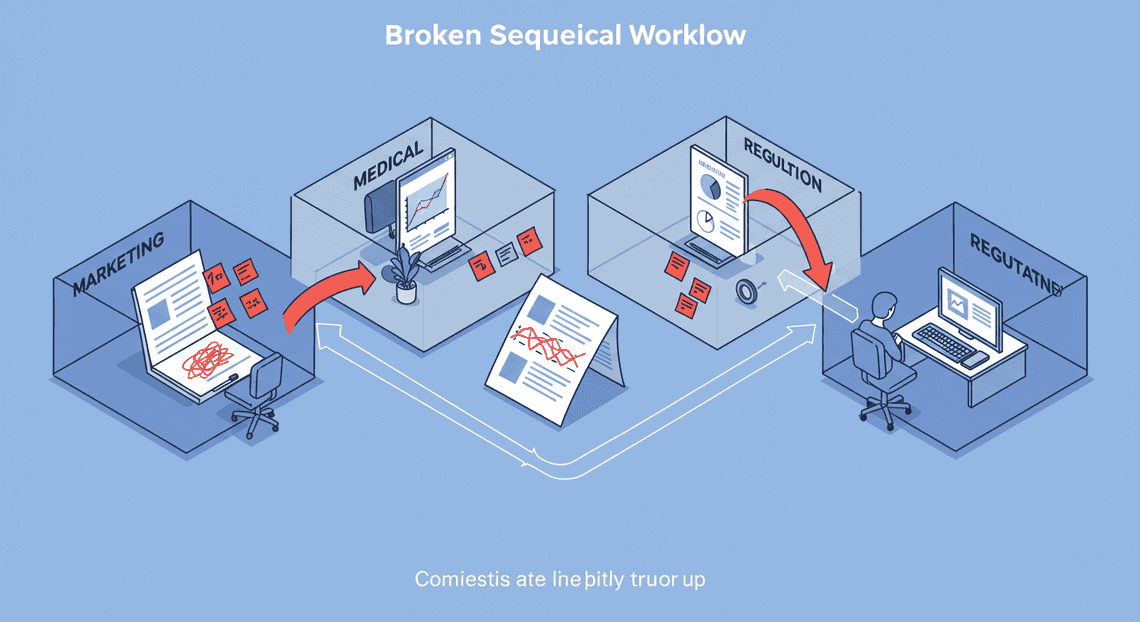
Despite its importance, the traditional MLR workflow is fundamentally broken for the digital age. It’s a relic of a pre-collaborative era, characterized by a series of slow, sequential, and siloed handoffs:
-
Creation: A marketing or communications team creates a new asset.
-
Submission: The asset, often a PDF or Word document, is submitted into a review system or, worse, sent via email.
-
The Queue: The document waits in a queue for the first available reviewer from the medical team.
-
Review & Markup: The medical reviewer scrutinizes the document for clinical accuracy, adding comments and tracked changes.
-
The Next Queue: The marked-up document is sent back or forwarded, where it now waits for the legal team.
-
Repeat: The legal and regulatory teams conduct their own separate reviews, often with conflicting feedback that requires reconciliation meetings.
-
Revision & Resubmission: The original creator attempts to consolidate all feedback, revise the asset, and resubmit it, potentially restarting the entire cycle.
This linear, asynchronous process is inherently inefficient.
The high cost of manual reviews: time, risk, and competitive disadvantage
The inefficiencies of manual MLR are not just frustrating; they impose tangible and significant costs on the organization. These costs manifest in three critical areas.
First, there is the staggering cost of time. An MLR cycle for a single piece of content can stretch from weeks to months. This delay directly impacts go-to-market timelines, delaying product launches, hindering sales enablement, and blunting the impact of marketing campaigns. Every day spent in a review queue is a day of lost opportunity and revenue.
Second, the manual process introduces immense risk. Human reviewers, while essential, are subject to fatigue, inconsistency, and oversight. Different reviewers may interpret guidelines differently, leading to unpredictable outcomes. The sheer volume of content can lead to mistakes, where a non-compliant phrase or an unsubstantiated claim slips through the cracks. The consequences are severe, ranging from FDA warning letters and multi-million dollar fines to lasting reputational damage that erodes trust with both healthcare providers and patients.
Finally, these delays and risks culminate in a significant competitive disadvantage. In a fast-moving market, agility is paramount. A competitor with a more streamlined review process can launch campaigns, respond to new clinical data, and educate the market more quickly and effectively. Being consistently second-to-market because of internal process friction means ceding ground, losing mindshare, and ultimately, sacrificing market share.
Introducing a new paradigm: AI-powered compliance within your existing workspace
To break this cycle, we need more than just a better project management tool. We need a fundamental paradigm shift that transforms compliance from a final, painful gate into an intelligent, integrated part of the creation process itself. This is where AI-powered compliance comes in, delivered not in another new platform, but directly within the collaborative tools your teams already use every day.
Imagine a world where, as a marketer types a message in Google Chat to plan a campaign, an AI assistant is there to provide real-time feedback. This AI, powered by a model like Gemini, has been securely trained on your company’s specific regulatory guidelines, approved claims libraries, and past MLR decisions. It can instantly:
-
Flag potentially problematic language.
-
Suggest pre-approved alternative phrasing.
-
Provide links to the specific internal guidance documents that support its recommendations.
This isn’t about replacing human experts. It’s about augmenting them. It’s about “shifting compliance left,” empowering content creators to be more compliant from the very first draft. By embedding this intelligence directly into the conversational flow of a tool like Google Chat, we eliminate the initial, error-prone steps of the old process. The content that eventually reaches the human MLR team is already 80-90% of the way there, allowing experts to focus their valuable time on high-level strategic review rather than correcting repetitive, low-level mistakes. This is conversational compliance—seamless, immediate, and transformative.
Solution Architecture: The MLR Compliance Bot
The MLR Compliance Bot isn’t a single application but an orchestrated system of powerful, integrated services. It leverages the security and scalability of Google Cloud and the collaborative fabric of [Automatically create new folders in Google Drive, generate templates in new folders, fill out text automatically in new files, and save info in [Automated Web Scraping with [Multilingual Text-to-Speech Tool with SocialSheet Streamline Your Social Media Posting 123](https://votuduc.com/Multilingual-Text-to-Speech-Tool-with-Google-Workspace-p809282)](https://votuduc.com/Automated-Web-Scraping-with-Google-Sheets-p292968)](https://workspace.google.com/marketplace/app/auto_create_folder_and_files/430076014869) to deliver a seamless user experience. At its heart, the architecture is designed for simplicity from the user’s perspective, while handling complex document analysis and AI reasoning on the backend.
Core components: Google Chat, Gemini Enterprise, and AC2F Streamline Your Google Drive Workflow
The solution is built upon three foundational pillars within the Google ecosystem, each playing a distinct and critical role.
-
Google Chat: This is the conversational front-end—the user’s sole interaction point. By building the bot within Chat, we eliminate the need for users to learn a new tool or navigate a separate portal. Marketing and legal teams can collaborate in the same environment where they conduct their daily work. The bot functions as a specialized team member within a Chat space, accessible via direct messages or
@mentions. -
Gemini Enterprise: This is the intelligence engine. Accessed via [Building Self Correcting Agentic Workflows with Building Self-Correcting Agentic Workflows with Vertex AI](https://votuduc.com/building-self-correcting-agentic-workflows-with-vertex-ai-p-20260321542526), Gemini Enterprise provides the advanced reasoning and language understanding capabilities required for nuanced compliance review. Key advantages include:
-
Large Context Window: Models like Gemini 1.5 Pro can process entire documents, style guides, and regulatory handbooks—up to 1 million tokens—in a single prompt, ensuring the analysis is comprehensive and context-aware.
-
Enterprise-Grade Security: Data is never used for training general models. All processing occurs within the customer’s secure Google Cloud project, respecting data residency and providing robust access controls through IAM.
-
Grounding and RAG: The system uses Building a RAG Context Manager with Apps Script and Gemini Pro (RAG) by connecting Gemini to a curated knowledge base of internal compliance documents stored in a vector database. This ensures the bot’s responses are grounded in the company’s specific rules, not generic web knowledge.
-
Automated Client Onboarding with Google Forms and Google Drive. & Google Cloud: This is the operational backbone.
-
Google Drive: Serves as the primary, secure repository for documents. The bot seamlessly integrates with Drive, allowing users to submit files via sharing links, respecting all existing permissions.
-
Google Cloud Functions: Provides the serverless compute layer. These functions act as the “glue,” listening for events from Google Chat, orchestrating API calls to Drive and Gemini, and formatting the responses.
-
Vertex AI Vector Search: Hosts the embeddings of the company’s compliance documents, enabling the fast and efficient retrieval of relevant information for the RAG process.
The user workflow: from document submission to instant analysis
The workflow is designed to be as intuitive as sending a message to a colleague. It transforms a multi-day review cycle into a real-time conversation.
-
Initiate & Submit: A user starts a conversation with the MLR Bot in Google Chat. They upload a document (PDF, Google Doc, etc.) or paste a link from Google Drive and add a simple command like, “@MLR Bot, please review this draft for compliance with our latest promotional guidelines.”
-
Acknowledge & Process: The bot immediately acknowledges the request with a message like, “Got it. Analyzing your document now…” This provides instant feedback that the system is working.
-
Receive Instant Analysis: Within seconds, the bot replies in a threaded conversation. The response is not a simple pass/fail but a structured, actionable report. It might include:
-
A summary of potential issues, categorized by severity (e.g., High-Risk Claim, Phrasing Suggestion).
-
Direct quotes from the document with highlighted text.
-
Specific, compliant alternative phrasing suggestions.
-
Citations and links to the internal compliance documents that justify its findings.
- Iterate and Refine: The user can continue the conversation with follow-up questions. For example: “Can you explain why that claim is high-risk?” or “Suggest three alternative headlines for the first page.” The bot maintains the context of the original document, allowing for a natural, iterative refinement process.
How the system works: a high-level technical overview
Behind the simple chat interface is a sophisticated, Architecting an Event-Driven Workspace with PubSub Firebase and Gemini that connects the components into a cohesive workflow.
-
Event Trigger (Google Chat): When a user sends a message or file to the bot, the Google Chat API fires a webhook event. This event payload contains the message content, user information, and a reference to the uploaded file.
-
Backend Processing (Cloud Function): The webhook triggers a secure Google Cloud Function. This function is the central orchestrator. Its first job is to parse the incoming event.
-
Document Retrieval & Parsing: The Cloud Function uses the Google Drive API to access and read the content of the submitted document. It handles various formats, converting them into clean, analyzable text.
-
Context Retrieval (RAG): The system takes key terms and concepts from the user’s document and query. It converts these into vector embeddings and uses Vertex AI Vector Search to find the most relevant chunks of information from the pre-indexed compliance knowledge base (e.g., specific rules, approved claims, legal precedents).
-
Dynamic [Prompt Engineering for Reliable Autonomous Workspace Agents for Reliable Autonomous Workspace Agents](https://votuduc.com/prompt-engineering-for-reliable-autonomous-workspace-agents-p-20260319404106): The Cloud Function constructs a detailed, multi-part prompt for the Gemini API. This is the “secret sauce” of the system and typically includes:
-
**System Instruction: Defines the bot’s role, personality, and output format (e.g., “You are an expert MLR compliance assistant. Analyze the following text based only on the provided compliance rules…”).
-
Retrieved Context: The relevant compliance information fetched from the vector database.
-
User Document: The full text of the document being reviewed.
-
User Query: The specific question or command from the user.
-
Gemini API Call (Vertex AI): The fully constructed prompt is sent to the Gemini Enterprise model endpoint via the Vertex AI SDK. The model processes the entire context—the rules, the document, and the query—to generate a comprehensive and grounded analysis.
-
Response Formatting & Delivery: The Cloud Function receives the JSON response from Gemini. It parses and formats this data into a human-readable message using Google Chat’s card formatting for clarity (e.g., using headers, dividers, and buttons). Finally, it uses the Google Chat API to post this formatted card back to the user as a reply in the original thread, completing the loop.
Harnessing Gemini Enterprise for Intelligent Risk Detection
This is where the solution transitions from a simple keyword-based bot to a sophisticated, context-aware compliance partner. We leverage the advanced reasoning capabilities of Gemini Enterprise, specifically through Vertex AI, to analyze conversations not just for specific words, but for intent, nuance, and potential regulatory implications. This allows us to catch issues that would fly under the radar of traditional, regex-based systems.
Training the model to flag potential HIPAA and FDA compliance issues
The term “training” here is a bit of a misnomer. We aren’t fine-tuning a foundation model from scratch, which is a resource-intensive process. Instead, we are using a combination of sophisticated prompt engineering and grounding to steer the powerful, pre-trained Gemini model to perform a very specific task. This approach is faster, more cost-effective, and highly adaptable.
The core of this process is the system prompt. This is a detailed set of instructions that tells the model its role, the context of the task, the rules it must follow, and the format for its response.
Here’s a conceptual example of a system prompt designed for our medical-legal review use case:
You are an AI assistant designed for medical and legal compliance review within a pharmaceutical company's internal communications. Your purpose is to analyze employee messages in Google Chat and identify potential violations of two primary regulatory frameworks: HIPAA and FDA guidelines on drug promotion.

**Your Task:**

Analyze the provided message text and determine if it contains any potential compliance risks.

**Risk Categories to Identify:**

1.  **HIPAA Violation:** Flag any text that appears to contain Protected Health Information (PHI), such as patient names, medical record numbers, specific dates related to care, or any other personally identifiable health information.

2.  **FDA Off-Label Promotion:** Flag any claims about our company's products that are not consistent with the FDA-approved labeling. This includes suggesting new uses, implying superior efficacy without substantial evidence cited in the approved label, or making unsubstantiated comparative claims.

**Output Format:**

You MUST respond with a valid JSON object. Do not include any other text or explanations outside of the JSON structure. The JSON object must have the following schema:

{

"risk_detected": boolean,

"risk_score": integer (a score from 0 to 10, where 0 is no risk and 10 is a certain violation),

"risk_type": string ("HIPAA", "FDA Off-Label", or "None"),

"flagged_text": string (the exact substring from the message that constitutes the risk),

"justification": string (a brief, one-sentence explanation of why the text was flagged)

}

If no risk is detected, set "risk_detected" to false, "risk_score" to 0, "risk_type" to "None", and leave the other fields as empty strings.
To make the model’s analysis even more accurate and specific to our organization, we use grounding. With Vertex AI Search, we can connect our Gemini application to our own private data sources, such as:
-
Internal compliance manuals
-
Approved marketing materials and messaging guides
-
The full, official FDA-approved product labels
When Gemini processes a message, it doesn’t just rely on its general knowledge; it performs a real-time search across these private documents. If an employee discusses an “exciting new benefit” of a drug, the model can instantly check the grounded product label data to verify if that benefit is FDA-approved, providing a far more accurate assessment of off-label promotion risk.
Generating an interactive review card directly in Google Chat
A text-based alert is easily lost in a busy chat stream. To make the review process efficient and actionable, we use the structured JSON output from Gemini to construct an interactive Card v2 in Google Chat. This transforms the AI’s analysis into a mini-application right within the conversation.
First, we instruct the model to provide a predictable, machine-readable output. Based on the system prompt above, a message like “Did you see Dr. Smith’s patient, John Doe? His response to DrugX for migraines has been amazing!” would cause Gemini to return the following JSON payload to our Cloud Function:
{

"risk_detected": true,

"risk_score": 9,

"risk_type": "HIPAA",

"flagged_text": "Dr. Smith's patient, John Doe",

"justification": "The message contains a patient's name (John Doe) linked to a specific provider (Dr. Smith), which is considered Protected Health Information (PHI)."

}
Our Cloud Function then parses this JSON and uses it to build and post a dynamic card to a dedicated, private review channel. This card is designed for clarity and quick action:
-
A Clear Header: A title like “⚠️ Compliance Review Required” immediately grabs attention.
-
Contextual Information: The card displays the original message, the author, and the channel it was sent in.
-
AI-Powered Analysis: It clearly presents the
risk_type,risk_score, and thejustificationprovided by Gemini, so the reviewer understands the issue without having to re-read complex regulations. -
Interactive Buttons: This is the most critical part. The card includes buttons like
Approve Message,Reject & Notify User, andEscalate to Legal. Clicking these buttons triggers another event, allowing the Cloud Function to take the appropriate next step, such as deleting the offending message, sending a private coaching message to the user, or notifying a legal team member.
This card-based approach centralizes the entire review workflow directly within the collaboration tool, eliminating the need for reviewers to switch between different applications and manually track issues.
Ensuring security and data privacy within your Google Cloud environment
Handling potentially sensitive medical and proprietary data demands an architecture built on a foundation of security. Using Gemini Enterprise within your own Google Cloud project provides the enterprise-grade controls necessary for this highly regulated space.
Data Governance: A primary concern with any cloud AI service is data privacy. When you use Gemini models through the Vertex AI platform, your data is not used to train Google’s general foundation models. Your prompts, the responses, and any data you use for grounding are contained within your project. The models are called statelessly; they do not retain any memory of your data after the request is processed.
Network Security: To prevent data exfiltration and ensure all communications happen over a private channel, we leverage VPC Service Controls. This allows us to create a security perimeter around our Google Cloud projects (including Cloud Functions and Vertex AI). We can configure this perimeter to block any data from leaving our virtual private cloud, meaning the API calls from our function to the Gemini model never traverse the public internet.
Identity and Access Management (IAM): We adhere to the principle of least privilege. The service account associated with our Cloud Function is granted a very narrow set of permissions. It is only authorized to do three things:
-
Read messages from the Google Chat API.
-
Invoke the prediction endpoint on Vertex AI.
-
Post messages (our interactive cards) back to the Google Chat API.
It has no access to any other cloud resources, databases, or storage buckets, minimizing the potential attack surface.
By using Google Cloud services covered by Google’s HIPAA Business Associate Addendum (BAA) and configuring them with these security controls, we can build a robust, private, and compliant [Automated Job Creation in Real Time Jobber and Google Sheets Integration from Gmail](https://votuduc.com/Automated-Job-Creation-in-Jobber-from-Gmail-p115606) pipeline that meets the stringent data protection requirements of the healthcare and life sciences industry.
Implementation Deep Dive Key Technical Steps
Transitioning from concept to a functional application requires careful orchestration of several Google Cloud services. This section breaks down the core technical pillars of the implementation: setting up the Chat app and APIs, connecting our data sources and sinks, and, most critically, engineering the prompts that drive Gemini’s analytical power.
Setting up the Google Chat App and necessary APIs
The foundation of our solution is a Google Cloud Platform project with the correct APIs enabled and a configured Chat app to serve as the user interface.
-
Google Cloud Project Setup: Begin by creating a new Google Cloud project or selecting an existing one. This project will house all the resources for this application.
-
Enable APIs: Navigate to the “APIs & Services” > “Library” section of the Google Cloud Console. Search for and enable the following APIs. Enabling them links your project to these services and allows you to manage their quotas and billing.
-
Google Chat API: Allows your application to receive and send messages in Google Chat.
-
Vertex AI API: Provides access to Google’s suite of generative AI models, including Gemini.
-
Google Docs API: Needed to read the content from the documents submitted for review.
-
Google Sheets API: Used to write audit trail logs of every review transaction.
-
Google Drive API: Often useful for handling file permissions and metadata, although direct interaction might be minimal if you only pass URLs.
- Configure the Chat App:
-
In the Google Cloud Console, go to the Google Chat API configuration page.
-
Under “Configuration,” define your app’s details:
-
App Name: e.g., “MLR Review Bot”
-
Avatar URL: A publicly accessible URL for your bot’s icon.
-
Description: A brief explanation of what the bot does.
-
Enable “Interactive features” to allow the bot to receive messages and commands.
-
Under “Connection settings,” select “App URL” and provide the endpoint where your backend logic will be hosted (e.g., the trigger URL of a Cloud Function). This is the webhook Google Chat will call every time a user interacts with your bot.
- Authentication with a Service Account: For secure, server-to-server communication, a service account is the best practice.
-
Go to “IAM & Admin” > “Service Accounts” and create a new service account.
-
Grant this service account the necessary IAM roles to interact with the enabled APIs. Essential roles include:
-
Vertex AI User: To invoke Gemini models. -
Google Docs Viewer(or higher): To read documents. -
Google Sheets Editor: To write to the audit log sheet. -
Create a JSON key for this service account and download it securely. Your backend application will use this key to authenticate its API calls to Google Cloud services.
Integrating Google Docs for source content and Google Sheets for audit trails
With the infrastructure in place, the next step is to handle the data I/O—reading from Docs and writing to Sheets.
Reading Source Content from Google Docs:
When a user messages the Chat app with a Google Doc URL, your backend service receives this event. The service must then extract the document’s content.
-
Grant Access: The service account you created must be explicitly shared on the Google Doc(s) being reviewed. Granting it “Viewer” access is sufficient for reading content. This is a critical security and access control step.
-
API Call: Using the Google Docs API client library for your language of choice (e.g., JSON-to-Video Automated Rendering Engine, Node.js), you’ll use the authenticated client to call the
documents.getmethod, passing the document ID extracted from the URL. -
Content Extraction: The API does not return a simple text file. It returns a JSON object representing the document’s structure—paragraphs, tables, lists, etc. Your code will need to traverse this JSON object and concatenate the text content from the relevant structural elements to form a single string of text to be sent to Gemini.
Writing Audit Trails to Google Sheets:
Maintaining a compliant, immutable log of all review activity is non-negotiable in a regulated environment. Google Sheets serves as a simple yet powerful database for this purpose.
-
Create and Share the Sheet: Create a new Google Sheet to act as your audit log. The first row should contain headers like
Timestamp,RequestingUser,DocumentURL,GeminiVerdict,KeyIssues, andRawResponse. Share this sheet with your service account, granting it “Editor” permissions. -
API Call: After receiving the analysis from Gemini, your backend service will format the results into an array that matches the order of your columns.
-
Append Row: Use the Google Sheets API
spreadsheets.values.appendmethod. This is the ideal function as it safely adds a new row to the first empty line after the last entry, preventing race conditions and data overwrites. This ensures each review is logged chronologically and immutably.
Crafting effective prompts for Gemini to ensure meticulous review
The quality of the automated review is directly proportional to the quality of your prompt. A well-structured prompt transforms Gemini from a general-purpose language model into a specialized MLR analysis engine. The goal is to provide a clear persona, comprehensive context, strict rules, and a defined output format.
Here is an example of a robust system prompt structure you can adapt.
You are an expert Medical-Legal-Regulatory (MLR) reviewer with 20 years of experience in the pharmaceutical industry. Your task is to meticulously analyze a provided marketing document for compliance with industry regulations and best practices. You are hyper-vigilant about patient safety and fair balance.

**Analysis Rules:**

1.  **Unsubstantiated Claims:** Flag ANY claim of efficacy or superiority that is not directly supported by data. Identify absolute or superlative language (e.g., "best", "safest", "cures", "eliminates").

2.  **Fair Balance:** Ensure that risk information (side effects, contraindications) is presented with prominence and clarity comparable to the efficacy claims. It should not be minimized or buried.

3.  **Off-Label Promotion:** Identify any language that suggests or implies a use for the product that has not been approved by regulatory bodies.

4.  **Clarity and Audience:** The language must be clear and appropriate for the intended audience (specify if it's for Healthcare Professionals or Patients). Avoid jargon where inappropriate.

5.  **Consistency:** Ensure all information is consistent with a provided reference document or standard prescribing information (if applicable).

**Output Format:**

You MUST provide your response exclusively in a JSON format. Do not include any text before or after the JSON object. The JSON object must conform to the following structure:

{

"overall_assessment": "String (must be one of: 'APPROVED', 'APPROVED_WITH_COMMENTS', 'NEEDS_REVISION')",

"summary": "A one-sentence executive summary of your findings.",

"findings": [

{

"type": "String (e.g., 'Unsubstantiated Claim', 'Fair Balance Violation', 'Off-Label Suggestion')",

"quote": "The exact text from the document that is problematic.",

"line_number_estimate": "An estimated line number where the quote appears.",

"recommendation": "A clear, actionable suggestion for how to remediate the issue."

}

]

}

If there are no issues, return an 'APPROVED' assessment with an empty 'findings' array.

Now, analyze the following document content:

[Your extracted Google Doc text is inserted here]
This prompt engineering approach forces Gemini to operate within a highly structured and predictable framework. By demanding a JSON output, you make the model’s response machine-readable, allowing your backend to easily parse the results and format them into a user-friendly card in Google Chat, while simultaneously logging the structured data to your Google Sheets audit trail.
The Business Impact: Accelerating Go-to-Market Securely
Integrating a Gemini Enterprise-powered agent directly into the collaborative fabric of Google Chat is more than a technical novelty; it’s a strategic accelerator that fundamentally redefines the velocity and safety of your commercial operations. By shifting the Medical, Legal, and Regulatory (MLR) review process from a sequential, human-gated bottleneck to an interactive, real-time consultation, organizations can unlock significant competitive advantages. The impact is felt across three primary vectors: speed, consistency, and empowerment.
Quantifying the reduction in approval cycles
In traditional workflows, the MLR review cycle is a notorious source of delay. A piece of marketing collateral might wait in a queue for days before a human reviewer even begins their assessment. This initial review, followed by subsequent rounds of feedback and revision, can stretch the timeline from content creation to market deployment by weeks.
Automating the first-pass review with Gemini collapses this timeline dramatically. Consider the typical process:
-
Initial Submission: A marketing manager uploads a draft to a Chat space.
-
Instantaneous Triage: The Gemini agent immediately analyzes the content against its grounded knowledge base of regulatory guidelines, brand standards, and established SOPs.
-
Immediate Feedback: Within seconds, not days, the agent provides line-by-line feedback, flagging non-compliant claims, identifying missing fair balance information, or highlighting unsupported statements.
This initial, automated screening can reduce the “time-to-first-feedback” from an average of 3-5 business days to under 60 seconds. By resolving 80% of common, rules-based issues before a human reviewer is even notified, the overall cycle time for content approval can be cut by 50% or more. This allows human experts to focus their valuable time on the nuanced, strategic aspects of the review, rather than rote checklist enforcement. The result is a direct acceleration of campaign launches and a faster path from product finalization to revenue generation.
Enhancing consistency and mitigating human error in reviews
Human expertise is invaluable, but it is not infallible. Reviewer fatigue, subjective interpretation of dense guidelines, and simple oversight can lead to inconsistent feedback and, in the worst case, non-compliant materials being approved. A claim that is flagged by one reviewer on a Monday might be missed by another on a Friday. This variability introduces significant business risk.
A Gemini-powered agent operates with programmatic precision. It applies the exact same rigorous, pre-defined set of rules to every single piece of content, every single time.
-
Unwavering Objectivity: The model doesn’t have “good days” and “bad days.” It systematically cross-references every claim against the approved source documents and regulatory constraints it has been trained on.
-
Comprehensive Coverage: It can simultaneously check for dozens of discrete compliance points—from the use of specific forbidden words to the correct formatting of safety information—without tiring or losing focus.
-
Centralized Logic: By grounding the agent on a single, curated knowledge base, you ensure that every team and every brand is adhering to the identical standard. This eliminates discrepancies in review outcomes between different departments or therapeutic areas.
This level of automated consistency acts as a powerful backstop, drastically reducing the likelihood of human error and ensuring a uniform standard of compliance across the entire organization. It transforms the review process from a subjective art into a data-driven science.
Empowering teams with real-time compliance guardrails
Perhaps the most transformative impact is the cultural shift from reactive gatekeeping to proactive collaboration. Instead of submitting content into a black box and hoping for the best, creative and marketing teams are equipped with a real-time compliance co-pilot.
This “shift-left” approach embeds regulatory awareness directly into the content creation workflow:
-
**Iterative Development: A copywriter can test a headline or a specific claim with the Chat agent as they write it, receiving instant feedback on its viability. This prevents wasted effort on concepts that would be rejected later.
-
**Frictionless Education: The agent doesn’t just say “no”; it explains why a piece of content is non-compliant, often citing the specific guideline or source document. This serves as a continuous educational tool, helping your teams internalize compliance rules and create better first drafts over time.
-
Reduced Rework: By catching potential issues at the earliest possible stage, the system minimizes the costly and demoralizing cycles of revision and re-review. It fosters a more collaborative relationship between marketing and legal teams, as the agent handles the initial, often contentious, rounds of feedback.
By placing these compliance guardrails directly in the hands of the creators, you empower them to move faster and with greater confidence. The MLR process ceases to be a barrier to innovation and instead becomes an integrated, value-adding component of the go-to-market engine.
Conclusion: Build Your Custom Compliance Engine
We’ve journeyed from a common industry bottleneck—the manual, time-intensive Medical Legal Review process—to a functional, AI-powered solution built directly into the collaborative fabric of Google Chat. By integrating the advanced reasoning capabilities of Gemini Enterprise with the secure, private data handling of Vertex AI, we’ve demonstrated more than just a clever Automated Quote Generation and Delivery System for Jobber. We’ve architected the blueprint for a custom compliance engine.
This approach transforms MLR from a reactive gatekeeper to a proactive, intelligent co-pilot for your marketing and medical affairs teams. It provides instant, context-aware feedback, maintains a verifiable audit trail, and scales effortlessly—all within the familiar interface your teams already use daily. This isn’t about replacing expert human oversight; it’s about augmenting it, allowing your legal and medical experts to focus their invaluable time on the most nuanced and strategic challenges.
The future of automated compliance in regulated industries
The principles we’ve applied to MLR are not confined to a single use case. They represent a fundamental shift in how regulated industries can approach compliance at scale. The fusion of powerful foundation models like Gemini with domain-specific knowledge through Retrieval-Augmented Generation (RAG) is the key to unlocking this future.
Imagine extending this “compliance engine” concept to other critical functions:
-
Pharmacovigilance: Proactively scanning adverse event reports and literature for potential safety signals.
-
Clinical Operations: Automating the review of clinical trial protocols against regulatory guidelines and internal SOPs.
-
Financial Compliance: Pre-screening investor communications and SEC filings for adherence to fair disclosure rules.
The core pattern remains the same: ground a powerful reasoning model in your trusted, proprietary corpus of documents—be it FDA regulations, EMA guidelines, or internal legal precedents. This creates a system that doesn’t just generate text, but reasons based on your specific operational and regulatory context. The human-in-the-loop workflow ensures that the final judgment remains with the experts, but their efficiency is amplified by an order of magnitude. The organizations that master this pattern won’t just be more compliant; they’ll be faster, more consistent, and more innovative.
Ready to scale your architecture? Book a GDE discovery call
Moving this architecture from a proof-of-concept to a production-grade, enterprise-wide service requires careful planning. As you look to scale, you’ll need to address critical components like robust IAM policies, automated data ingestion pipelines for your RAG vector database, scalable serverless infrastructure using Cloud Run or GKE, and comprehensive logging for auditability.
This is where expert guidance becomes invaluable. Building a resilient, secure, and cost-effective AI system on Google Cloud involves navigating a rich ecosystem of services and best practices. How do you ensure your vector database is always in sync with your latest compliance documents? What’s the optimal strategy for fine-tuning a model for your specific therapeutic area? How do you implement enterprise-grade security and data governance?
Don’t navigate these complexities alone. A Google Developer Expert (GDE) in Cloud and AI can help you architect a solution that meets the rigorous demands of your industry. Partner with an expert to accelerate your development, avoid common pitfalls, and build a compliance engine that becomes a true competitive advantage.


Stop Doing Manual Work. Scale with AI.
Want to turn these blog concepts into production-ready reality for your team?
Table Of Contents
Portfolios
Related Posts
Quick Links
Legal Stuff